Following the Bible Timeline: How Chronology Brings Scripture Into Focus
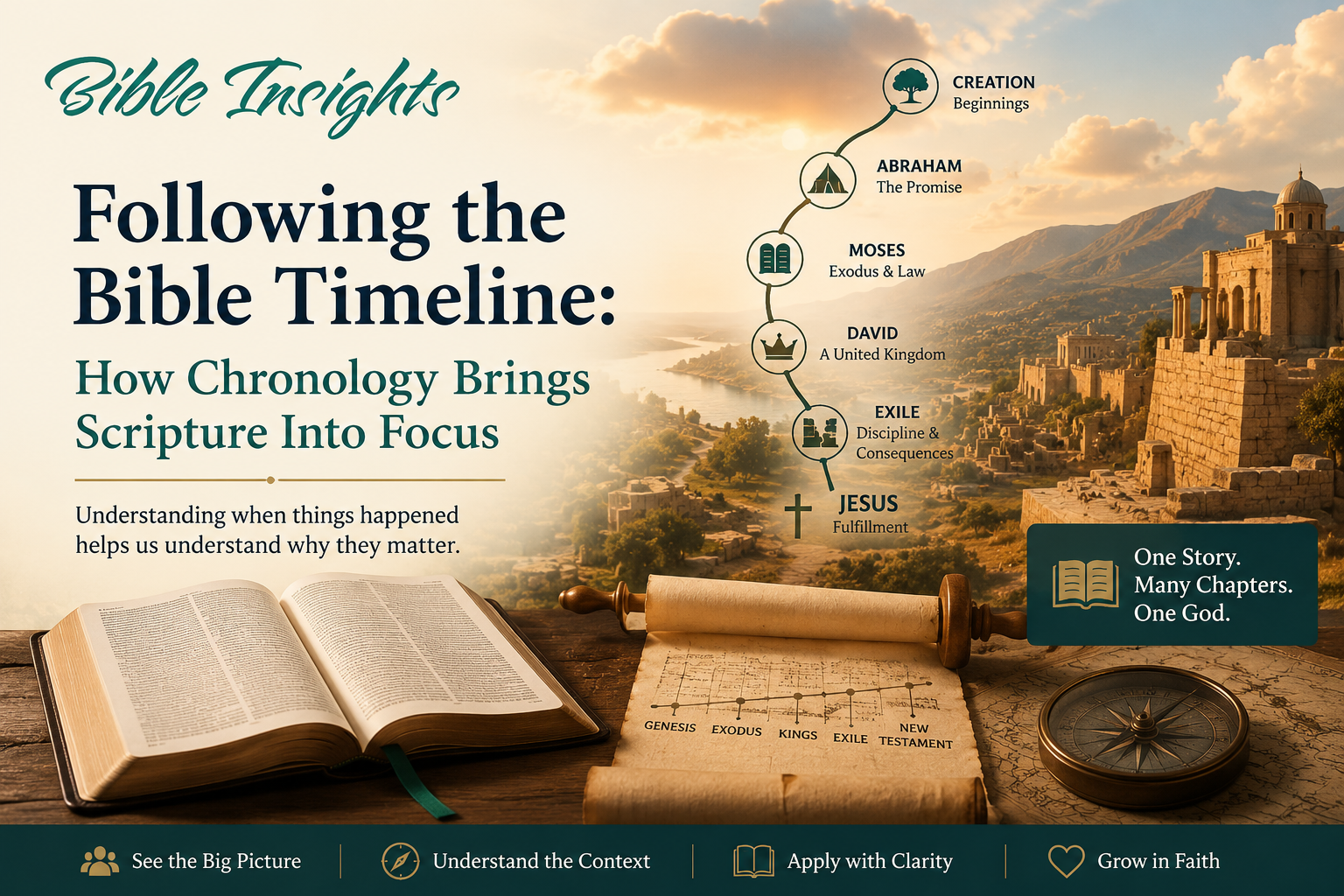
Ask most people to place Abraham, Moses, and David in the correct order, and many will hesitate. It’s not a knowledge gap unique to casual readers either. Even longtime church attendees often carry a blurred sense of when things happened relative to each other. That’s exactly why the Bible Timeline matters so much more than it first appears. Once a reader can see Scripture unfold in order, entire sections of the Bible start making sense in ways they never did before.
At Bible Insight Foundation, this is one of the first tools we point people toward. Not because dates are the point of faith, but because chronology gives readers a frame to hang everything else on.
Why Chronology Changes the Reading Experience
Here’s where things become interesting. The Bible isn’t arranged in strict chronological order. Genesis moves in sequence, but by the time you reach the prophets, historical books, and New Testament letters, events jump around depending on genre and author rather than timeline. A reader moving straight through the table of contents can walk away with events tangled together that actually happened centuries apart.
Isaiah prophesied long before the exile to Babylon, yet his book sits near writings composed after Israel’s return. Without a mental map of the Bible Timeline, that gap is invisible. With it, Isaiah’s warnings suddenly carry weight they didn’t have before. The reader understands what’s coming, what’s being risked, and why the prophet’s urgency makes sense.
That’s the real value of chronology. It’s not about trivia. It’s about proportion and stakes.
Connecting Major Events Across Centuries
One detail that’s easy to overlook is how tightly connected seemingly distant events actually are. The exodus from Egypt, the establishment of the monarchy under Saul and David, the split into northern and southern kingdoms, the exile, and the eventual return: these aren’t isolated stories. They’re chapters in a single, continuous account of a people and their relationship with God.
When a reader tracks a Bible Timeline alongside their study, patterns start to surface. Promises made generations earlier resurface at unexpected moments. Consequences of earlier decisions echo forward in ways that would otherwise seem disconnected. A covenant made with Abraham finds its fulfillment centuries later in ways Abraham himself never witnessed.
This is where Scripture stops feeling like a collection of separate stories and starts feeling like what it actually is: one long, unfolding narrative.
The Role of Biblical Figures in the Bigger Picture
Understanding Biblical Figures in their proper historical setting adds another layer entirely. Moses doesn’t exist in a vacuum. He steps into a specific moment, shaped by four hundred years of Israelite history in Egypt, and his actions ripple forward into everything that follows.
The same is true of David. Reading his psalms without any sense of his life circumstances, his years fleeing Saul, his eventual kingship, his failures and his repentance, strips away much of their emotional weight. Once a reader knows where David stood in the broader story, his words land differently.
Many Biblical Figures appear briefly in Scripture, sometimes for only a chapter or two, yet their placement in the timeline reveals why they mattered. Ruth’s story, for example, sits during the period of the judges, a chaotic era described elsewhere in Scripture with striking honesty. Her quiet faithfulness stands out precisely because of the disorder surrounding her.
Practical Value for Everyday Study
What often surprises readers is how quickly this kind of chronological awareness improves their daily study, even without formal training. A teacher preparing a lesson can explain why a passage matters instead of just what it says. A small group leader can answer the "wait, when did this happen?" question that inevitably comes up. A person reading alone in the morning can sense the weight of a passage because they understand what came before it.
None of this requires memorizing exact dates. Even a rough sense of sequence, early patriarchs, the exodus era, the united and divided kingdoms, exile, return, and the New Testament period, gives enough structure to transform how a person reads.
That said, precision does have its place. Students preparing for deeper study, teachers building curriculum, or anyone writing about Scripture benefits from a more detailed Bible Timeline that maps specific events, reigns, and prophetic ministries against each other.
A Foundation Worth Building
The reality is that Scripture rewards readers who take the time to understand its structure. Chronology isn’t a substitute for faith or spiritual insight, but it does something valuable on its own. It turns disconnected stories into a coherent history, and it turns distant names into people whose lives fit into a larger, purposeful account.
Resources built around Bible Insight Foundation exist precisely to support this kind of study, helping readers place events, movements, and Biblical Figures into a framework that makes the whole of Scripture easier to follow. Once that framework is in place, going back to familiar passages feels less like rereading and more like seeing them clearly for the first time.