MYSTICISM : EAST AND WEST - ALEXIS KARPOUZOS
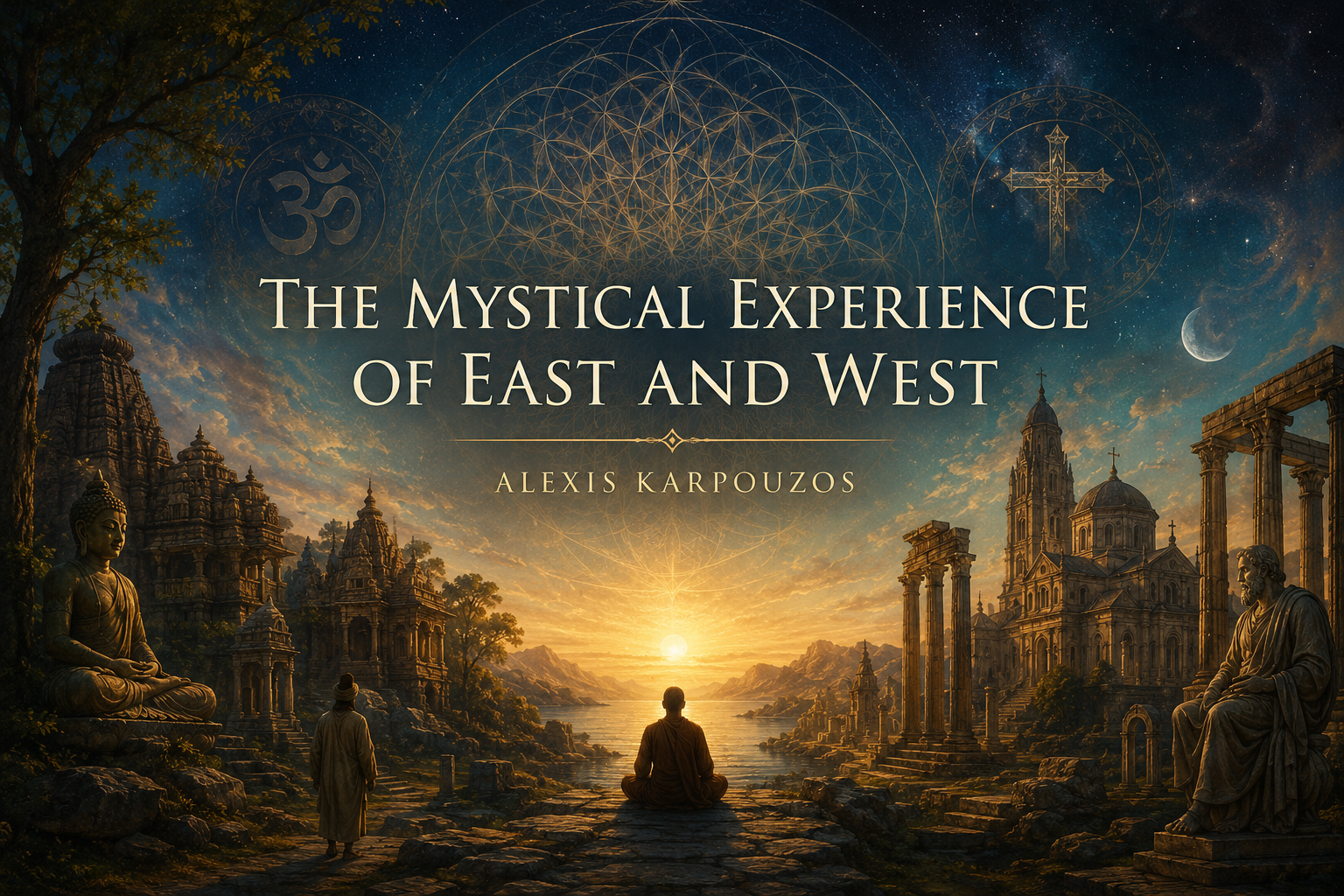
Mystical Experience and the Search for the Absolute: East and West
The history of mysticism can be read as the parallel, subterranean history of human thought. Alongside philosophy, which seeks to know through concepts; theology, which attempts to speak of the divine through doctrine; and science, which seeks to explain phenomena through laws, there exists another, equally ancient movement: the human attempt not simply to know the absolute, but to be transformed in such a way as to be able to experience it. Mysticism, therefore, is not primarily a collection of strange beliefs, visions, or supernatural experiences. It is a radical questioning of the sufficiency of ordinary consciousness. Its point of departure lies in the suspicion that the way we perceive ourselves, the world, and the divine does not constitute the final form of experience. The term “mysticism” of course covers very different practices, institutions, texts, and experiences, and contemporary philosophy of religion rightly warns against the easy assumption that all mystical traditions merely express one and the same experience under different names. Yet from the Upanishads and the Buddha to Lao Tzu, Plotinus, Pseudo-Dionysius, Meister Eckhart, Kabbalah, and Sufism, one question returns with remarkable persistence: perhaps what we ordinarily take to be real is true only on a certain level, and perhaps deeper knowledge requires not more information but a transformation of the knower himself.
In the ancient Indian Upanishads, one of the decisive shifts in the history of religious consciousness takes place. Earlier Vedic religion had centered on sacrifice, ritual action, and the maintenance of cosmic order. In the Upanishads, sacrifice is internalized. The great question is no longer merely which ritual the human being must perform, but who is it that performs the ritual, who sees, who hears, who knows that he knows. The search moves from the external cosmos toward the inner core of consciousness, and there discovers a paradoxical correspondence: what is deepest within the human being is not merely individual. The famous phrase tat tvam asi, “that thou art, ” condenses this reversal. Brahman, the limitless principle that cannot be exhausted by any particular thing, and ātman, the deepest self, are so closely related that later Advaita Vedānta will develop the radical doctrine of their non-duality. Advaita is not simply a vague monism; it is a systematic interpretive tradition grounded in the Upanishads, the Brahma Sūtras, and the Bhagavad Gītā. Its philosophical significance is enormous: the empirical ego, with its desires, memories, social identity, and history, is not the final self. Ignorance consists precisely in identifying with this limited center. Knowledge, jñāna, is therefore not the accumulation of propositions about Brahman, but the dissolution of the illusion that makes the finite ego regard itself as autonomous and absolute. Māyā should not be reduced to the childish idea that “the world does not exist.” The world exists at the level of experience, action, and difference; what is questioned is the ultimate self-sufficiency of those differences. Liberation is therefore knowledge that transforms the very mode of existence: one does not acquire something previously absent; rather, the ignorance that made a limited mode of being appear absolute is removed.
Buddhism begins from a related existential problem, but its answer is so different that any easy identification with Advaita becomes misleading. The Buddha does not seek behind the empirical ego an eternal metaphysical Self. On the contrary, the doctrine of anattā/anātman, non-self, undermines precisely the need to locate a permanent essence behind personality. The human person is constituted by changing bodily and mental processes, the five skandhas—form, feeling, perception, mental formations, and consciousness—and attachment to these as “I” and “mine” is a source of dukkha, suffering and existential dissatisfaction. Here lies one of the boldest ideas in the history of philosophy: perhaps liberation does not require discovering what the true self is, but discovering that the question itself presupposes what must be examined. Nirvāṇa is not simply a paradise to which individuality is transferred after death; it is linked to the cessation of ignorance, attachment, and craving that reproduce suffering. In Mahāyāna, and especially in Nāgārjuna’s Madhyamaka, this deconstruction extends from the ego to all phenomena. Śūnyatā, emptiness, does not mean that nothing exists, but that no phenomenon possesses an independent, self-subsisting, immutable svabhāva, an intrinsic essence. Things are because they are related, conditioned, dependent, and emergent. Dependent origination and emptiness are thus two aspects of the same insight. Buddhism becomes here a profound critique of essentialism: the real is not a collection of self-sufficient things that later enter into relations, but a becoming in which identities are dependently constituted. This is also why we must be cautious when translating Buddhist emptiness into “cosmic consciousness” or some hidden metaphysical substance; such a move may reintroduce precisely the foundation that Madhyamaka seeks to dismantle.
In Zen, this Buddhist critique acquires a particularly existential sharpness. Zen distrusts the idea that ultimate awakening can be produced merely by an increasingly precise conceptual system. The kōan, the paradoxical stories and questions of the tradition, are not irrational riddles concealing a secret answer. They often function as devices that destabilize ordinary categorical thought. The famous question concerning “the sound of one hand” does not ask for an ingenious verbal solution; it turns against the consciousness that assumes every genuine question must be turned into an object and solved in the same manner. Awakening does not mean escape from the everyday world. The great paradox of Zen is precisely that after the transcendence of ordinary distinctions one returns to ordinary things: water, wood, food, breath. Emptiness is not behind forms; forms are empty precisely because they are relational, changing, and non-self-sufficient. Here the everyday may acquire sacred depth without requiring a second, supernatural world.
Chinese Daoism approaches the same boundary through an entirely different language. The Daodejing opens with one of the most famous warnings in world philosophy: “The Dao that can be spoken is not the constant Dao.” The statement does not simply mean that Lao Tzu prefers silence to language. It indicates a fundamental distance between the actual process of the world and its naming. The moment we name, we distinguish; the moment we distinguish, we constitute forms. Language is necessary, but every name risks turning a relation into a thing. The Dao is not a creator-God outside the world, nor an object hidden behind objects. It is the way, the process, the manner in which things arise, transform, and return. Daoism includes, of course, a broad range of philosophical and religious traditions and should not be reduced to a vague doctrine of “unity.” The concept of wu wei, non-coercive action, is decisive. It does not mean passivity. It means action that does not violently impose an abstract subjective will upon the course of things. Water is therefore a privileged Daoist image: it is soft and yet erodes the hard, it insists on no fixed form and precisely for that reason can take on every form. In the Zhuangzi, this logic becomes even more paradoxical. The famous butterfly dream—whether Zhuang Zhou dreamed he was a butterfly or whether the butterfly dreams it is Zhuang Zhou—need not be interpreted merely as skepticism. It questions the absolute privilege of the standpoint from which the ego decides which level of experience is final. The “transformation of things” lies at the center: wisdom is not the possession of an immutable essence but the capacity to inhabit transformation without subordinating it to the demand for fixed identity.
In Greco-Roman antiquity, mystical inquiry follows different paths. Orphic and Pythagorean traditions connect purification of the soul with a cosmic mode of existence, while in Plato philosophy often becomes a spiritual exercise and a turning of the soul. The allegory of the cave does not merely describe an epistemological error; it describes a transformation of the whole human being, a violent turning from shadows toward light. Yet in Plotinus, Greek philosophy reaches one of the clearest forms of philosophical mysticism. The One lies beyond even intellect and ontological multiplicity. It is not “one thing” greater than all others. If it were an entity, it would already possess determination and therefore limitation. From the One proceeds Intellect, from Intellect Soul—not as events that happened at some point in time, but as levels of ontological dependence. The return of the soul is not a spatial journey. It is purification from dispersion in multiplicity and ascent toward its deepest source. Mystical union is not knowledge of an object, because as long as there is a knower standing over against a known, duality remains. The One is not “seen” as an object is seen; ultimate experience requires the transcendence of the very distinction between seer and seen. Here appears a motif that will recur both in Eastern traditions and in Western apophatic theology: the highest knowledge reaches a point at which knowledge, as ordinarily understood, must be relinquished.
Christianity radically alters the framework because its center is not the return of an impersonal soul to an impersonal principle, but relation to a personal God, the Incarnation, love, and the history of salvation. For this reason one must be especially careful when applying non-dual language to Christian mystical experience. In the Johannine tradition, “I and the Father are one” does not simply mean that human individuality discovers itself to be identical with an impersonal cosmic substance. Christian unity is Trinitarian, relational, and loving. Even when Christian mystics speak the language of “union, ” classical theistic tradition usually preserves a distinction between Creator and creature; union is more often communion and deification than simple ontological identity. The “that they all may be one” of the high-priestly prayer expresses precisely the paradox of a unity that does not erase persons. Love is here more than an ethical emotion: it is a different mode of being, in which the person is fulfilled not by closing in upon himself but by going out toward the other. The Gospel paradox that whoever wishes to save his life will lose it, while whoever loses it will find it, expresses a profound reversal of the logic of possession. Life is not fulfilled when it owns itself but when it is given.
From this biblical ground arises the great Christian mystical tradition. Among the Desert Fathers, the desert is not merely a geographical place but a laboratory for the stripping down of consciousness. Silence, fasting, prayer, and detachment from desire do not aim at the destruction of the body but at liberation from the tyranny of distraction. In Gregory of Nyssa appears the remarkable idea of epektasis: movement toward the infinite God never ends, precisely because the Infinite cannot be exhausted. Perfection is therefore not a static endpoint but an unending transcendence of every achieved limit. In Pseudo-Dionysius, apophatic theology reaches extraordinary philosophical precision. God is named good, light, life, wisdom, but no affirmation is adequate. We must negate our affirmations, and ultimately transcend even the negations. The divine is not simply “invisible” rather than “visible, ” nor “non-being” rather than “being”; it lies beyond the opposition of the categories through which finite mind attempts to grasp it. Here ignorance acquires a positive meaning: there is a “super-knowledge” that begins when the mind recognizes that the Infinite cannot become an object without distortion.
The Eastern Christian tradition develops this insight through theosis and hesychasm. Theosis does not mean that the human person ceases to be created and becomes identical with the divine essence. It means participation in divine life. In Gregory Palamas, the distinction between essence and energies attempts precisely to preserve both the absolute transcendence of God and the possibility of genuine participation in Him. The divine essence remains inaccessible, while the human being participates in the uncreated energies. The light of the Transfiguration thus acquires mystical and theological meaning: it is not merely a symbol of a subjective psychological state, but a mode of participation in divine presence. The Jesus Prayer of hesychasm seeks the gathering of a mind ordinarily scattered among objects. The “descent of the mind into the heart” expresses the reintegration of the fragmented human being, not contempt for intellect.
In the Latin and German medieval mystical tradition, the language often becomes even more daring. Meister Eckhart speaks of the “ground” of the soul, a depth that does not coincide with any particular psychological faculty. His Gelassenheit, letting-be or detachment, means that the human being must relinquish even the self-interested desire to “possess” God. Here lies the force of the famous Eckhartian paradox of praying to be freed even from “God”—not from the divine itself, but from God as an object constructed by desire and concept. The mystic no longer seeks to acquire the supreme object. The very structure of possession must collapse. The similarity between Eckhart and Eastern traditions has inspired important comparisons, yet without implying historical or doctrinal identity.
At the same time, Jewish mysticism develops an entirely distinctive symbolic world. Kabbalah is not simply a theory of individual mystical union; it is often a theurgic mystical tradition in which human action, prayer, and observance may acquire cosmic significance. Ein Sof, the “without end, ” signifies the indeterminate depth of the divine beyond determinate manifestations. The sefirot are not ten separate gods but modes, powers, or structures of divine manifestation. In Lurianic Kabbalah, the imagery of tzimtzum, contraction, the shattering of the vessels, and tikkun, restoration, forms a dramatic cosmology: the world bears fracture and exile within itself, and human action participates in its repair. Salvation here is not merely personal. The human being stands within a cosmic drama, and action has ontological weight. Interior life and cosmology interpenetrate.
In the Islamic world, Sufism develops within the absolute centrality of tawḥīd, the unity of God. It is not simply a foreign mysticism added to Islam; mystical thought in Islamic civilization became closely connected with ḥikma, wisdom, philosophy, and spiritual interpretation of revelation. In Rābiʿa al-ʿAdawiyya appears the idea of pure love of God beyond fear of hell and desire for paradise: if I love God for reward, my love remains a transaction. In al-Hallāj, the famous phrase Ana al-Haqq, “I am the Truth, ” becomes one of the most dangerous mystical formulations, precisely because it may sound either like blasphemous self-deification or, mystically, like such radical disappearance of ego that no individual claim to ownership remains. The concept of fanā’, the annihilation of egocentric autonomy, is complemented by baqā’, abiding in God. The final state is not nihilism. The limited ego ceases to regard itself as an independent center so that life may reappear under a different orientation.
In Ibn ʿArabī, Islamic mystical metaphysics reaches extraordinary complexity. God is absolutely incomparable, and yet the divine Names are manifested in the world. Multiplicity is not a second world independent of God, but neither can it simply be dissolved into an easy identity of God and creation. The world becomes a locus of tajallī, divine self-disclosure. The “Perfect Human” functions as a mirror in which the divine Names may be manifested with special fullness. The image of the mirror is fundamental: the mirror does not create what it reflects, but without it the image would not appear in that particular way. The human being becomes a site of manifestation without becoming the source of the divine. Mystical knowledge is therefore transformation of vision: the world remains multiple, but its multiplicity becomes transparent to a deeper unity. And yet the divine Essence remains inexhaustible.
In the esoteric traditions of late antiquity, Hermeticism and Gnostic movements develop a different relation to the world. Gnostic movements were not one unified Church or philosophy, but a loose family of traditions in which gnōsis, saving knowledge, occupied a central place. In many Gnostic cosmologies, the sensible world is not the complete and good creation of the highest God but is associated with lower cosmic powers, while within the human being there is a spark that must awaken and return to its transcendent origin. Here we encounter a much stronger dualism than in Buddhism, Daoism, or even Neoplatonism. Salvation is awakening from cosmic forgetfulness. The image is fascinating but philosophically dangerous: if the sensible world is treated merely as prison, mystical transcendence can become denial of nature, body, and history. This is precisely why there is no single “mysticism.” For some mystics the world is a veil to be pierced, for others divine manifestation, for others empty relationality, for others the spontaneous movement of the Dao.
The Renaissance attempts a grand synthesis of many of these ancient currents. Marsilio Ficino, Pico della Mirandola, and the revival of Hermeticism and Neoplatonism restore the idea of the human being as microcosm, as a being occupying an intermediate place within the cosmic order and capable of turning both toward the material and the spiritual. Renaissance dignitas hominis is not merely early humanistic self-congratulation. Human dignity lies in the fact that the human being does not possess a completely predetermined place: he can transform himself. Alchemy expresses symbolically this double transformation of matter and soul. The alchemist’s opus can be read simultaneously as material work and as an image of inner purification. Lead and gold become symbols of human conditions, dissolution and recomposition of matter symbols of the death and rebirth of the old self. Whatever the scientific validity of alchemical cosmology, its philosophical importance lies in the conviction that the knower does not remain unchanged through the process of knowing.
With modernity, mysticism does not disappear; it transforms. Jakob Böhme creates a striking theosophical cosmology in which divine life is conceived dynamically through opposition, manifestation, and self-revelation. Spinoza, though difficult to classify as a mystic in the strict sense, speaks of the amor Dei intellectualis, the intellectual love of God, within a philosophy in which God and Nature are not two independent realities. Among the Romantics, nature ceases to be merely a mechanical object and becomes a living depth, a symbol of a unity that analytical reason has fragmented. Later Schopenhauer explicitly recognizes affinities between European mysticism, Eckhart, the Upanishads, and Buddhism. In the twentieth century, the meeting of East and West becomes even more intense: Zen, Vedānta, Christian mysticism, and contemporary philosophy begin to enter into dialogue, sometimes creatively and sometimes through dangerous simplifications. The great challenge is precisely to avoid an easy “perennial philosophy” that claims all mystics had exactly the same experience and merely used different words. Concepts, practices, and theological commitments shape what an experience means.
Here perhaps lies the deepest philosophical lesson of comparative study. Mysticism does not provide us with one hidden “theory of everything.” It offers a series of different experiments at the limits of human consciousness. Advaita asks what remains when we cease to identify the self with its changing attributes. Buddhism asks whether anything like an eternal substance need remain at all for liberation to be possible. Madhyamaka directs criticism even against the need for a final metaphysical foundation. Zen tests the limits of conceptual thought. Daoism explores action that does not violently impose subjective will upon the process of things. Plotinus seeks the source of multiplicity beyond the distinction between thinker and thought. Christianity places at the center not the dissolution of the person but its paradoxical fulfillment through relation, love, and communion. Apophatic theology suggests that the Absolute cannot become an object without ceasing to be absolute. Eckhart attacks even the possessive desire of the soul to “have” God. Sufism speaks of fanā’ but completes it with baqā’: transcendence of ego is not nihilism but another mode of being. Kabbalah shifts the problem from individual redemption to cosmic repair. Gnostic traditions make awakening an escape from cosmic forgetfulness. These differences are not secondary. They are precisely where the philosophical interest lies.
For this reason the familiar opposition “East versus West” proves far too simplistic. There is no single East teaching unity and no single West teaching dualism. India contains both non-dual and dualist schools. Buddhism denies the permanent ātman that Advaita makes central. In China, Dao is not identical with Brahman. In the West, Plotinus reaches a radical metaphysics of unity, Pseudo-Dionysius transcends positive and negative categories, Eckhart speaks a language later compared with Indian non-duality, and Ibn ʿArabī develops one of the most complex theories of unity and multiplicity in the history of thought. Even the claim that all mystical experience is simply “union” is inadequate: in theistic traditions, transcendence of egocentrism often means communion with God rather than metaphysical identity with Him.
Perhaps, then, the deepest common element lies elsewhere. Almost all these traditions, in different ways, refuse to accept ordinary egocentric consciousness as the final measure of the world. They question the obvious equation between knowledge and possession. Knowledge of mystery does not resemble knowledge of an object. I cannot stand outside the Absolute in order to observe it as I observe a stone. If the Absolute is truly absolute, there can be no external observer standing over against it, for then it would no longer be absolute. Here appears the fundamental paradox of mysticism: the human being seeks that which, if truly found, transforms or abolishes the very mode in which he had been constituted as seeker. The mystic does not merely arrive at an answer; the question itself and the one who asks it are transformed.
This also explains why mystical traditions place such importance on silence, discipline, prayer, meditation, detachment, love, compassion, and purification. If the matter were merely theoretical, a book would be enough. The repetition of spiritual practices shows that the obstacle is not merely intellectual. A person may understand theoretically that the ego is relational and still live as though it were the absolute center of the world. One may know that all things are impermanent and remain attached to them as though they were eternal. One may believe theologically that God is omnipresent and live as though utterly alone. Mystical practice therefore attempts to move truth from the level of proposition to the level of existence. Prayer is not merely speech about God but an attempt to stand in His presence. Meditation is not a theory of non-self but observation of the very arising of attachment to self. Wu wei is not a doctrine of naturalness but an exercise in not forcing situations through egocentric will. Gelassenheit is not a concept but detachment. Fanā’ is not a metaphysical proposition but a transformation of self-consciousness. Here perhaps lies the greatest distance between mysticism and purely theoretical philosophy: truth is not considered complete unless it transforms the one who knows it.
This also explains why mystical language so often turns to paradox: light that is darkness, knowledge through unknowing, life through death, gain through loss, fullness through emptying, action through non-action, the self found when lost. Paradox is not used only for aesthetic effect. It arises when ordinary language, structured around oppositions, tries to speak of an experience that questions the absolute authority of those oppositions. Apophatic theology makes this explicit, Zen turns it into practice, Daoism into poetic dialectic, Sufism into the language of love, Christianity into the paradox of the Cross. This does not mean logic must simply be abandoned. It means we must distinguish between contradiction arising from confusion and paradox arising when a category reaches the limit of its applicability.
The same is true of the great symbol of light. From the Upanishads and Neoplatonism to the Gospel of John, hesychasm, Suhrawardi, Kabbalah, and Sufism, light returns continually. This is not accidental. Light makes things visible without itself being a thing among things in exactly the same way. It therefore becomes an ideal symbol of consciousness, knowledge, and the divine. Yet beside light there repeatedly appears darkness: the “divine darkness” of apophatic theology reminds us that what illuminates all things may itself be impossible to objectify. Light and darkness cease to be simple moral opposites. Excessive light blinds just as absolute darkness does. The metaphor reveals a deep epistemological paradox: that which makes knowledge possible may not itself be available as an object to the same mode of knowledge it enables.
Something similar happens with silence. The mystic does not become silent because there is nothing to say, but because he discovers the boundary between language and what language attempts to express. The “ineffable” is not merely something for which we have not yet found the correct vocabulary. If that were the case, linguistic progress would solve the problem. It is that which no description can exhaust because every description selects, distinguishes, and excludes. Silence therefore becomes not the opposite of speech but the boundary that prevents speech from absolutizing itself. This is why the greatest mystical traditions produce the paradoxical phenomenon of vast libraries devoted to the ineffable: they write incessantly in order finally to indicate the point where writing must know that it is not the reality about which it writes.
From this perspective, the great legacy of world mysticism is not a doctrine that can be summarized by the phrase “all is one.” That phrase is too poor and risks erasing precisely the essential differences between traditions. The deeper legacy is an education in limits. The ego has limits as a center of knowledge. Concept has limits as a mode of grasping. Language has limits as a mode of manifestation. Will has limits as a power of control. Possession has limits as a mode of relation. Even positive theology has limits when it tries to turn the Absolute into an object of definition. And yet the limit does not necessarily lead to nihilism. Almost everywhere it opens another possibility: from knowledge to wisdom, from possession to participation, from domination to receptivity, from ego to relation, from information to transformation.
The mystic, therefore, is not the one who claims to possess a secret unavailable to others. In the deepest forms of these traditions, the opposite is true: the mystic is the one who has abandoned the claim that mystery can be conquered. Knowledge of mystery consists in the realization that the inexhaustible remains inexhaustible even when it manifests itself. And perhaps this is why, despite their immense theological and philosophical differences, the great mystical traditions converge in one paradoxical gesture: the human being begins by searching for the highest truth as something to be acquired and ends by discovering that the deepest transformation begins when the need to possess it is relinquished. Truth does not become his property; it becomes a mode of existence. And mystery does not disappear when known; it deepens, because true knowledge reveals not only what can be known, but also the inexhaustible depth of that which no knowledge can finally close within itself.