Europe Nanosatellite and Microsatellite Market Trends
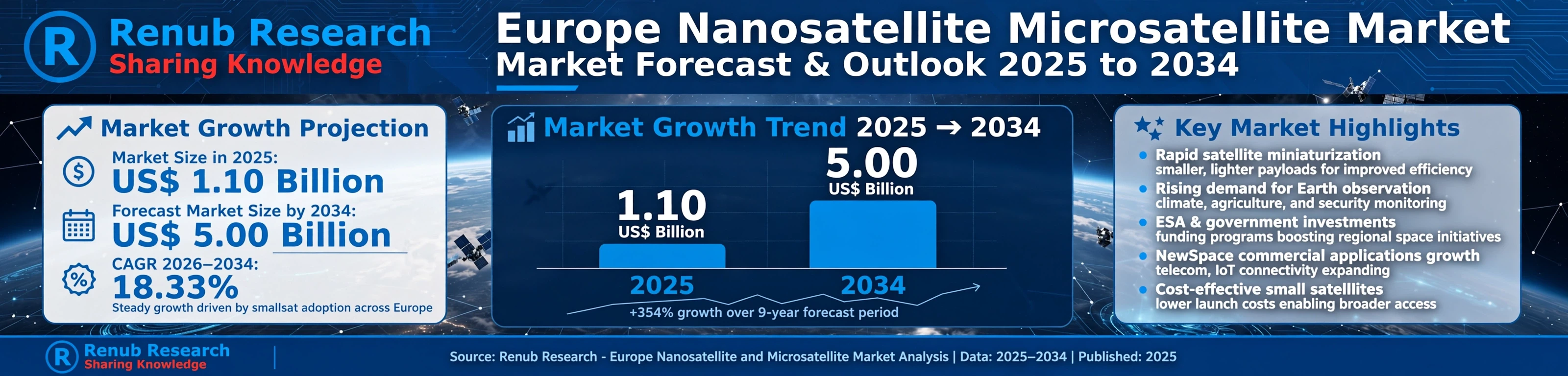
The European market for compact space systems is experiencing remarkable expansion, driven by rapid advancements in satellite miniaturization, rising commercial investments, and an escalating need for affordable space-based infrastructure. According to market data from Renub Research, the European nanosatellite and microsatellite market is projected to surge from US$ 1.10 billion in 2025 to approximately US$ 5.00 billion by 2034, registering a robust compound annual growth rate (CAGR) of 18.33% during the 2026–2034 forecast period.
Compact spacecraft weighing between 1 and 100 kilograms have fundamentally transformed how governments and commercial operators approach space missions. By offering significantly lower manufacturing, launch, and operational expenditures compared to legacy systems, these small satellites enable widespread constellation deployments that ensure high-frequency global coverage.
Download Free Sample Report: https://www.renub.com/request-sample-page.php?gturl=europe-nanosatellite-microsatellite-market-p.php
Market Outlook and Financial Landscape
European space initiatives are strongly backed by robust public funding frameworks, led by the European Space Agency (ESA). The overall ESA budget for 2026 stands at €5.56 billion, with major contributions spearheaded by Germany (€1.35 billion or 24.2%), France (€990.7 million or 17.8%), and Italy (€809.8 million or 14.6%). This vast financial backing directly stimulates regional aerospace ecosystems, allowing startups and established players alike to develop advanced modular platforms for Earth observation, defense, and telecommunications.
Key Growth Drivers
- Environmental and Earth Observation Demands: Governments and scientific institutions rely heavily on small satellite data to monitor climate change, evaluate agricultural productivity, and manage natural disasters.
- Expanding NewSpace Ecosystem: A proliferation of private aerospace ventures is commercializing broadband internet, maritime tracking, and IoT connectivity via modular bus platforms.
- Strategic Autonomy: Regional initiatives such as the European Union Space Programme unify Copernicus, Galileo, and secure connectivity frameworks to reinforce sovereign technological capabilities.
Sector Segmentation and Industry Challenges
The market encompasses diverse segments categorized by satellite mass (nanosatellites versus microsatellites), components (hardware and software), space services, and end-use sectors spanning civil, defense, and commercial domains. Prominent industry players actively shaping this landscape include AAC Clyde Space, Berlin Space Technologies, GomSpace, and Surrey Satellite Technology, alongside global defense contractors.
Despite optimistic forecasts, the industry faces notable hurdles:
- Orbital Congestion: Surging deployments in Low Earth Orbit elevate collision risks, compelling regulators to enforce strict deorbiting and traffic management protocols.
- Launch Bottlenecks: High demand for shared launch missions often introduces schedule delays, while complex multi-jurisdictional licensing and frequency coordination present continuous regulatory hurdles.
Frequently Asked Questions
What is the projected market size and growth rate for the European nanosatellite and microsatellite market?
According to Renub Research, the market is projected to grow from US$ 1.10 billion in 2025 to US$ 5.00 billion by 2034, expanding at a CAGR of 18.33% from 2026 to 2034.
What is the total budget of the European Space Agency (ESA) for 2026?
The total ESA programme budget for 2026 is €5.56 billion, with Germany, France, and Italy serving as the top three contributing member states.
What is the primary difference between nanosatellites and microsatellites?
Nanosatellites generally weigh between 1 and 10 kilograms, whereas microsatellites typically weigh between 10 and 100 kilograms, offering greater payload capacity and extended operational lifespans.
Which countries are the leading contributors to the European small satellite market?
Key markets include France, Germany, the United Kingdom, Italy, and Spain, supported by mature aerospace engineering sectors and active regional startup hubs.
What are the main applications driving small satellite adoption in Europe?
Primary applications include Earth observation, environmental monitoring, defense surveillance, scientific research, Internet of Things (IoT) connectivity, and technology demonstration.
How do small satellite constellations benefit operators?
Constellations allow multiple spacecraft to be launched simultaneously, providing broader geographic coverage, higher revisit frequencies, and efficient real-time data collection.
What are the primary challenges facing the European nanosatellite and microsatellite industry?
Key obstacles include rising orbital congestion, space debris risks, launch capacity constraints, and complex regulatory requirements regarding spectrum allocation and licensing.
