Europe Polypropylene Market: Trends, Growth Drivers, and Forecast
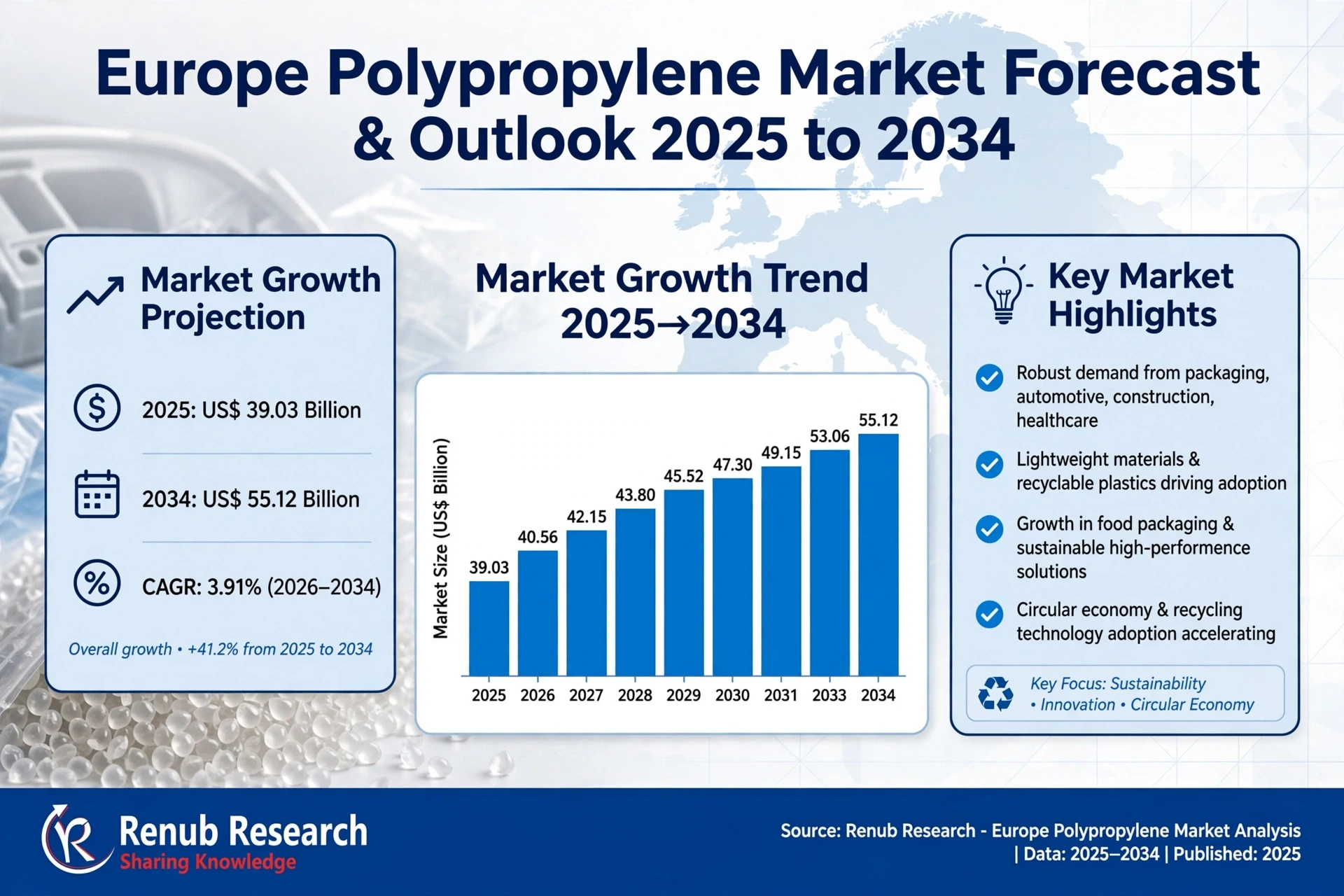
The European polypropylene (PP) market is currently undergoing a significant transformation, balancing robust industrial demand with an accelerated shift toward circular economy principles. According to Renub Research, the market is projected to grow from US$ 39.03 billion in 2025 to US$ 55.12 billion by 2034, registering a steady Compound Annual Growth Rate (CAGR) of 3.91% throughout the forecast period.
As Europe strengthens its commitment to sustainability, the polypropylene industry is evolving from a traditional commodity-driven model to one centered on high-performance, recyclable, and bio-based material solutions.
Download Free Sample Report: https://www.renub.com/request-sample-page.php?gturl=europe-polypropylene-market-p.php
What Is Polypropylene and Why Does Europe Rely on It?
Polypropylene (PP) is a versatile, semi-crystalline thermoplastic created through the polymerization of propylene monomers. Renowned for its exceptional balance of low density, chemical resistance, mechanical strength, and heat tolerance, it serves as a cornerstone of modern manufacturing. Its ability to be processed via injection molding, extrusion, and blow molding makes it uniquely suitable for diverse sectors, ranging from sterile medical devices to lightweight automotive parts.
In Europe, the demand for PP is anchored by its vital role in the packaging sector. Beyond its protective qualities, PP is highly prized for its recyclability. As the European Union implements stricter packaging waste directives, the industry is increasingly transitioning toward mono-material architectures—packaging made from a single type of plastic, which is significantly easier to sort and recycle than multi-layer alternatives.
Snapshot of European Plastics Production (2024)
Europe maintains a massive manufacturing footprint, producing approximately 54.6 million tonnes (Mt) of plastics annually. The regional landscape is led by major industrial hubs:
- Germany: The market leader, contributing 21.4% (~11 Mt) of total output.
- Belgium: A critical processing hub, accounting for 13.6%.
- France & The Netherlands: Producing 10.4% and 9.9% respectively.
- Other Key Contributors: Spain (9.2%), Italy (6.0%), the United Kingdom (4.4%), and Poland (4.0%).
Key Growth Pillars: What Is Driving the Market?
1. Volume Escalation in Sustainable FMCG Packaging
The Fast-Moving Consumer Goods (FMCG) sector remains the primary volume driver for PP. To meet European consumer expectations and regulatory mandates, brand owners are aggressively integrating Post-Consumer Recycled (PCR) polypropylene. Innovations such as high-purity recycled grades now allow manufacturers to match the optical clarity and processability of virgin plastic while reducing carbon footprints by up to 75%.
2. Structural Light-Weighting for E-Mobility
The rapid transition to electric vehicles (EVs) in Europe has placed a premium on material efficiency. Because extending battery range is a top priority, automotive engineers are replacing heavy metal components and traditional engineering plastics with lightweight, high-impact polypropylene compounds. These materials are now standard in dashboards, door cards, and battery enclosures, offering the durability required for vehicle safety without the weight penalty.
3. Catalytic Process Innovations
Advancements in catalyst technology are enabling the production of "smarter" polymers. Modern PP grades exhibit improved thermal stability and low-temperature impact strength, allowing them to displace more expensive technical polymers in specialized applications. Simultaneously, regional investments in chemical recycling—which breaks down plastic waste into its molecular building blocks—are ensuring that the European PP supply chain remains resilient and compliant with circularity goals.
Market Restraints and Challenges
Despite steady growth, the industry faces two significant headwinds:
- Regulatory Pressures & Substitution: Supranational policies, such as the EU Packaging Waste Directive, are forcing companies to justify the use of single-use plastics. This has created a "material substitution threat," where sectors are increasingly testing paperboard, glass, or aluminum as perceived "greener" alternatives.
- Feedstock and Energy Volatility: European producers remain highly sensitive to global crude oil and natural gas price spikes. Because PP production is energy-intensive, regional carbon pricing and geopolitical shifts in import channels can squeeze manufacturer margins, limiting the global price competitiveness of European-made PP resins.
Strategic Segment Insights
By Product Type & Application
- Homopolymer Polypropylene: Remains the market leader due to its superior stiffness and tensile strength. It is the go-to material for rigid food packaging and durable household goods.
- Fiber-Grade PP: Essential for the hygiene and healthcare sectors. Meltblown and spunbond polypropylene fibers are critical for nonwoven medical fabrics, filtration systems, and disposable protective gear.
- Raffia-Grade PP: Continues to see consistent demand for industrial applications, including heavy-duty woven sacks, agricultural ground covers, and bulk logistics packaging.
Leading European Markets
- Germany: Focuses on high-performance automotive compounds and premium packaging. Recent facility upgrades, such as new lines for High Melt Strength (HMS) polypropylene, demonstrate a commitment to mono-material recyclability.
- United Kingdom: Leveraging post-Brexit innovation, the UK is prioritizing "circular" PP. Strategic partnerships between chemical companies are currently scaling the production of bio-based and carbon-recycled polypropylene to serve the UK’s robust consumer goods and medical industries.
Frequently Asked Questions (FAQs)
1. What is the projected value of the European PP market by 2034?
The market is expected to reach US$ 55.12 billion by 2034, growing from US$ 39.03 billion in 2025.
2. What is the expected CAGR for this market during 2026–2034?
The European polypropylene market is anticipated to register a CAGR of 3,91% during the forecast period.
3. Which industry is the largest consumer of polypropylene in Europe?
The packaging industry holds the largest market share, driven by demand for food-safe, lightweight, and recyclable containers and films.
4. Why is polypropylene favored for electric vehicles (EVs)?
Polypropylene is lightweight, which helps maximize EV battery range. It also provides excellent impact resistance and design flexibility for internal and exterior vehicle components.
5. What are "mono-material" packaging solutions?
These are packaging products made from a single type of plastic (like 100% PP), making them significantly easier to recycle than multi-layer laminates.
6. What is the main challenge facing European PP manufacturers?
High volatility in feedstock (propylene monomer) costs, rising energy tariffs, and strict EU environmental regulations regarding plastic waste.
7. Is recycled polypropylene (PCR-PP) viable for food packaging?
Yes. Recent advancements in chemical and mechanical recycling have enabled the production of food-contact approved recycled polypropylene that meets stringent EU safety standards.
