United States Contact Lenses Market Size, Growth Drivers, and Forecast
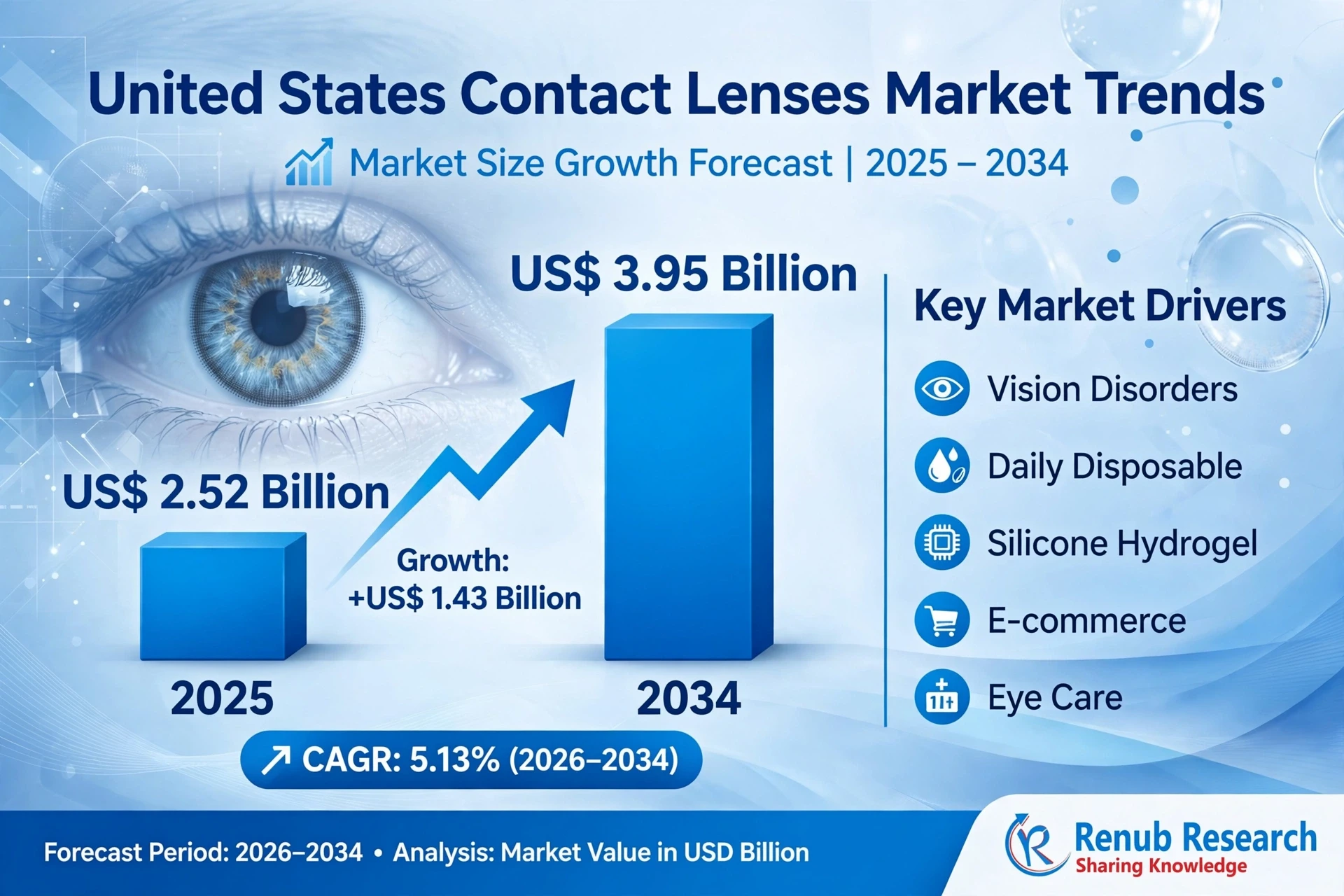
The United States Contact Lenses Market is projected to increase from US$ 2.52 Billion in 2025 to US$ 3.95 Billion by 2034, registering a Compound Annual Growth Rate (CAGR) of 5.13% during the forecast period from 2026 to 2034. The market is expected to witness steady growth, driven by the rising prevalence of vision disorders and increasing demand for convenient and effective vision correction solutions. Growing consumer preference for advanced contact lens technologies, including daily disposable and silicone hydrogel lenses, is further supporting market expansion by enhancing comfort, eye health, and user convenience.
Download Free Sample Report: https://www.renub.com/request-sample-page.php?gturl=united-states-contact-lenses-market-p.php
Contact Lenses and Their Uses & Popularity in the USA
Contact lenses are thin, curved optical devices placed directly on the surface of the eye to correct vision or for cosmetic and therapeutic purposes. They are commonly used to treat refractive errors such as myopia, hyperopia, astigmatism, and presbyopia, offering a wider field of vision and greater convenience than traditional eyeglasses.
In the United States, contact lenses are available in various types, including soft lenses, rigid gas permeable lenses, daily disposables, monthly replacement lenses, toric lenses, multifocal lenses, and colored cosmetic lenses. Their popularity has grown steadily due to increasing screen time, rising incidence of vision disorders, and continuous advancements in lens materials such as silicone hydrogel, which provides improved oxygen permeability and wearing comfort. Millions of Americans rely on everyday vision correction, particularly working professionals, students, and athletes seeking an active lifestyle. Eye care professionals also prescribe specialty lenses for conditions such as keratoconus and dry eye disease. Continuous innovation in smart lenses, UV-blocking technology, moisture-retaining materials, and digital eye strain management is further expanding adoption across the nation.
Vision Loss and Age in the USA
- Impairment Statistics: Approximately 7 million people in the United States are living with vision impairment, including around 1 million individuals who are blind.
- Aging Population Impact: Around 4.2 million Americans aged 40 years and older have uncorrectable vision impairment, and this figure is projected to more than double by 2050 due to the country’s aging population.
- Chronic Health Factors: The increasing prevalence of diabetes and other chronic diseases among older adults is expected to contribute significantly to the rising burden of vision loss in the United States.
- Pediatric Vision Care: Approximately 6,8% of children under the age of 18 have been diagnosed with an eye or vision condition, highlighting the importance of early vision care and regular eye examinations.
- Severe Pediatric Impairment: Nearly 3% of U.S. children under 18 experience blindness or vision impairment, defined as difficulty seeing even while wearing corrective eyewear such as glasses or contact lenses.
- Market Demand Catalyst: The growing incidence of vision disorders across both pediatric and aging populations is driving demand for advanced vision correction solutions, including contact lenses, prescription eyewear, and specialized ophthalmic treatments.
Growth Drivers of the United States Contact Lenses Market
Rising Prevalence of Vision Disorders and Aging Population
The increasing prevalence of vision-related disorders is one of the primary growth drivers of the United States Contact Lenses Market. Myopia, hyperopia, astigmatism, and presbyopia are becoming more common due to aging demographics, prolonged digital screen exposure, and lifestyle changes. According to industry estimates, over 45 million Americans wear contact lenses, while approximately 75% of adults require some form of vision correction. Furthermore, the U.S. population aged 65 years and above is projected to exceed 80 million by 2040, increasing the incidence of presbyopia and age-related vision impairment. Younger adults and children are also experiencing higher rates of myopia due to extensive use of smartphones, computers, and tablets. As eye examinations become more frequent and awareness of vision health increases, more consumers are choosing contact lenses as a convenient alternative to spectacles. This growing patient base continues to support strong demand across daily, monthly, toric, and multifocal contact lens categories.
Growing Demand for Daily Disposable and Silicone Hydrogel Contact Lenses
Consumer preference is shifting toward premium contact lenses that offer enhanced comfort, hygiene, and eye health. Daily disposable lenses have become increasingly popular because they eliminate the need for cleaning solutions and reduce the risk of lens-related infections. Meanwhile, silicone hydrogel lenses provide significantly higher oxygen permeability than conventional hydrogel lenses, allowing longer and more comfortable wear. Industry estimates indicate that daily disposable lenses account for more than one-third of new contact lens fittings in the United States, with adoption continuing to increase annually. Consumers are increasingly willing to pay premium prices for products that improve convenience and reduce maintenance requirements. Eye care professionals also recommend silicone hydrogel materials for patients with dry eyes or extended wearing schedules. Continuous innovation in moisture-retention technology, UV protection, and digital eye strain reduction is further strengthening consumer demand.
Expansion of E-commerce and Advanced Eye Care Services
The rapid expansion of online retail channels and digital healthcare services has significantly improved consumer access to contact lenses throughout the United States. Subscription-based delivery models, tele-optometry consultations, and digital prescription verification systems enable consumers to purchase replacement lenses conveniently from home. More than 90% of U.S. households have internet access, supporting widespread adoption of online vision care services. Major retailers and manufacturers now offer automated replenishment programs, personalized product recommendations, and mobile applications that simplify lens purchasing and prescription management. At the same time, expanding networks of optometrists and ophthalmologists continue to promote regular eye examinations and early diagnosis of refractive errors. Integration of artificial intelligence into eye examinations and digital fitting technologies is improving prescribing accuracy and customer satisfaction.
Challenges of the United States Contact Lenses Market
Increasing Adoption of Refractive Eye Surgery and Alternative Vision Correction
The growing popularity of permanent vision correction procedures presents a notable challenge for the United States Contact Lenses Market. Laser-assisted procedures such as LASIK and SMILE have become increasingly accessible due to technological improvements, shorter recovery periods, and high success rates. These procedures reduce long-term dependence on contact lenses, particularly among younger professionals seeking permanent vision correction. Although the upfront cost of refractive surgery remains relatively high, many consumers consider it a cost-effective long-term alternative to purchasing contact lenses and maintenance products over several years. Advances in surgical precision and patient outcomes continue to increase consumer confidence in corrective eye procedures. Additionally, premium prescription eyeglasses featuring lightweight materials, blue-light filtering coatings, and fashionable designs provide attractive alternatives for many users.
Risk of Eye Infections, Compliance Issues, and Regulatory Requirements
Despite technological improvements, contact lens usage continues to present challenges related to eye safety, hygiene, and user compliance. Eye care professionals emphasize that improper lens cleaning, overnight wear of non-approved lenses, and failure to replace lenses according to prescribed schedules significantly increase the risk of eye infections and corneal complications. Studies indicate that non-compliance with recommended lens care practices affects more than 40% of contact lens users, contributing to preventable ocular health issues. Regulatory requirements for prescription verification, manufacturing quality standards, and product safety also increase operational costs for manufacturers and distributors. Companies must continually invest in product testing, clinical validation, packaging improvements, and consumer education programs to maintain regulatory compliance and patient safety.
Recent Contact Lenses Launches in the United States
- Johnson & Johnson Vision — ACUVUE OASYS MAX 1-Day (2024): Launched daily disposable contact lenses featuring TearStable Technology and OptiBlue Light Filter to enhance comfort and reduce light scatter during prolonged digital device use.
- Bausch + Lomb — INFUSE Multifocal Daily Disposable Contact Lenses (2024): Introduced daily disposable multifocal lenses designed for presbyopia, utilizing ProBalance Technology to maintain moisture and improve all-day visual performance.
- Alcon — TOTAL30 for Astigmatism (2023): Expanded its TOTAL30 portfolio with monthly replacement toric contact lenses incorporating Water Gradient Technology for sustained comfort and stable vision.
- CooperVision — MyDay Energys Daily Disposable Contact Lenses (2023): Launched enhanced daily disposable lenses featuring DigitalBoost technology to help reduce digital eye strain among frequent screen users.
- Bausch + Lomb — ULTRA ONE DAY Contact Lenses (2023): Introduced premium daily disposable lenses with MoistureSeal and ComfortFeel Technology to improve hydration and end-of-day comfort.
- Johnson & Johnson Vision — ACUVUE Abiliti Overnight Therapeutic Lenses (2023): Commercially launched orthokeratology lenses designed to manage myopia progression in children through overnight wear.
- Alcon — PRECISION7 Weekly Contact Lenses (2024): Released the company’s first weekly replacement contact lens featuring ACTIV-FLO System for consistent comfort throughout seven days of wear.
Regional Expansion and State-Level Market Dynamics
Florida Market Growth
Florida Contact Lenses Market is expanding steadily due to the state’s large aging population, increasing prevalence of vision disorders, and well-developed eye care infrastructure. Florida is home to more than 23 million residents, with nearly 22% of the population aged 65 years and above, one of the highest proportions among U.S. states. This demographic significantly increases the demand for contact lenses designed to correct presbyopia, astigmatism, and other age-related refractive errors. At the same time, younger consumers continue to adopt daily disposable and silicone hydrogel lenses for convenience and active lifestyles.
New York Market Expansion
New York Contact Lenses Market continues to experience stable growth, driven by a large urban population, high healthcare accessibility, and increasing digital device usage. The state has a population of approximately 19.8 million, with millions of working professionals and students spending prolonged hours on computers, smartphones, and tablets, contributing to higher rates of digital eye strain and refractive errors. New York City serves as one of the country’s largest healthcare and optical retail hubs, providing consumers with access to advanced vision correction technologies and specialty contact lenses.
Texas Market Growth
Texas Contact Lenses Market is witnessing consistent growth, supported by rapid population expansion, improving healthcare infrastructure, and increasing awareness of vision care. Texas has a population exceeding 31 million, making it the second-most populous state in the United States. The state’s growing workforce, expanding metropolitan areas, and rising incidence of myopia and astigmatism continue to increase demand for contact lenses. Large cities including Houston, Dallas, Austin, and San Antonio host numerous ophthalmology centers, optometry clinics, and retail optical chains offering comprehensive eye care services.
California Market Leadership
California Contact Lenses Market represents one of the largest regional markets in the United States due to its substantial population, advanced healthcare system, and strong emphasis on innovation. California has a population of approximately 39 million, creating a significant customer base for prescription and cosmetic contact lenses. High levels of digital device usage, increasing myopia prevalence among younger individuals, and growing awareness of eye health contribute to sustained market demand. Premium products such as silicone hydrogel, daily disposable, multifocal, and specialty scleral lenses continue to gain popularity among consumers.
Market Segmentation Overview
- Material: Gas Permeable, Silicone Hydrogel, Hybrid
- Usage: Daily Disposable, Disposable, Frequently Disposable, Traditional (Reusable) Lenses
- Design: Spherical, Toric, Multifocal
- Application: Vision Correction, Cosmetic
- Distribution Channel: Online Pharmacy, Retail Pharmacy, Hospital Pharmacy
- Top States Covered: California, Texas, New York, Florida, Illinois, Pennsylvania, Ohio, Georgia, New Jersey, Washington, North Carolina, Massachusetts, Virginia, Michigan, Maryland, Colorado, Tennessee, Indiana, Arizona, Minnesota, Wisconsin, Missouri, Connecticut, South Carolina, Oregon, Louisiana, Alabama, Kentucky, and Rest of United States.
Frequently Asked Questions (FAQs)
1. What is the projected market size of the United States contact lenses industry?
The United States Contact Lenses Market is projected to increase from US$ 2.52 Billion in 2025 to US$ 3.95 Billion by 2034.
2. What is the expected CAGR for the U.S. contact lenses market during the forecast period?
The market is anticipated to register a Compound Annual Growth Rate (CAGR) of 5,13% from 2026 to 2034.
3. What are the primary factors driving growth in the contact lenses market?
Key growth drivers include the rising prevalence of vision disorders like myopia and astigmatism, an expanding aging population, increasing consumer demand for daily disposable and silicone hydrogel lenses, and the rapid expansion of e-commerce delivery platforms.
4. Which demographic group accounts for the highest adoption of daily disposable lenses?
Young professionals, students, athletes, and individuals prioritizing convenience and eye hygiene represent the largest consumer base adopting daily disposable contact lenses.
5. How are technological advancements influencing lens materials?
Innovations in silicone hydrogel materials, moisture-retention technologies, UV-blocking filters, and digital eye strain reduction features are significantly enhancing oxygen permeability and all-day wearing comfort.
6. What challenges do manufacturers face in the contact lenses market?
Major challenges include the growing preference for permanent refractive surgeries like LASIK, user non-compliance with lens hygiene protocols leading to eye infections, and strict regulatory requirements for prescription verifications.
7. Which states represent the leading regional markets within the United States?
California, Texas, New York, and Florida stand out as key regional contributors due to large population bases, dense urban centers, advanced healthcare networks, and high digital device usage.
For more comprehensive insights, company analyses (including Bausch & Lomb, Alcon, CooperVision, and EssilorLuxottica), and custom market research reports, explore further offerings by Renub Research.
