What Is Driving the Rapid Expansion of the Australian Smart Home Market Through 2034?
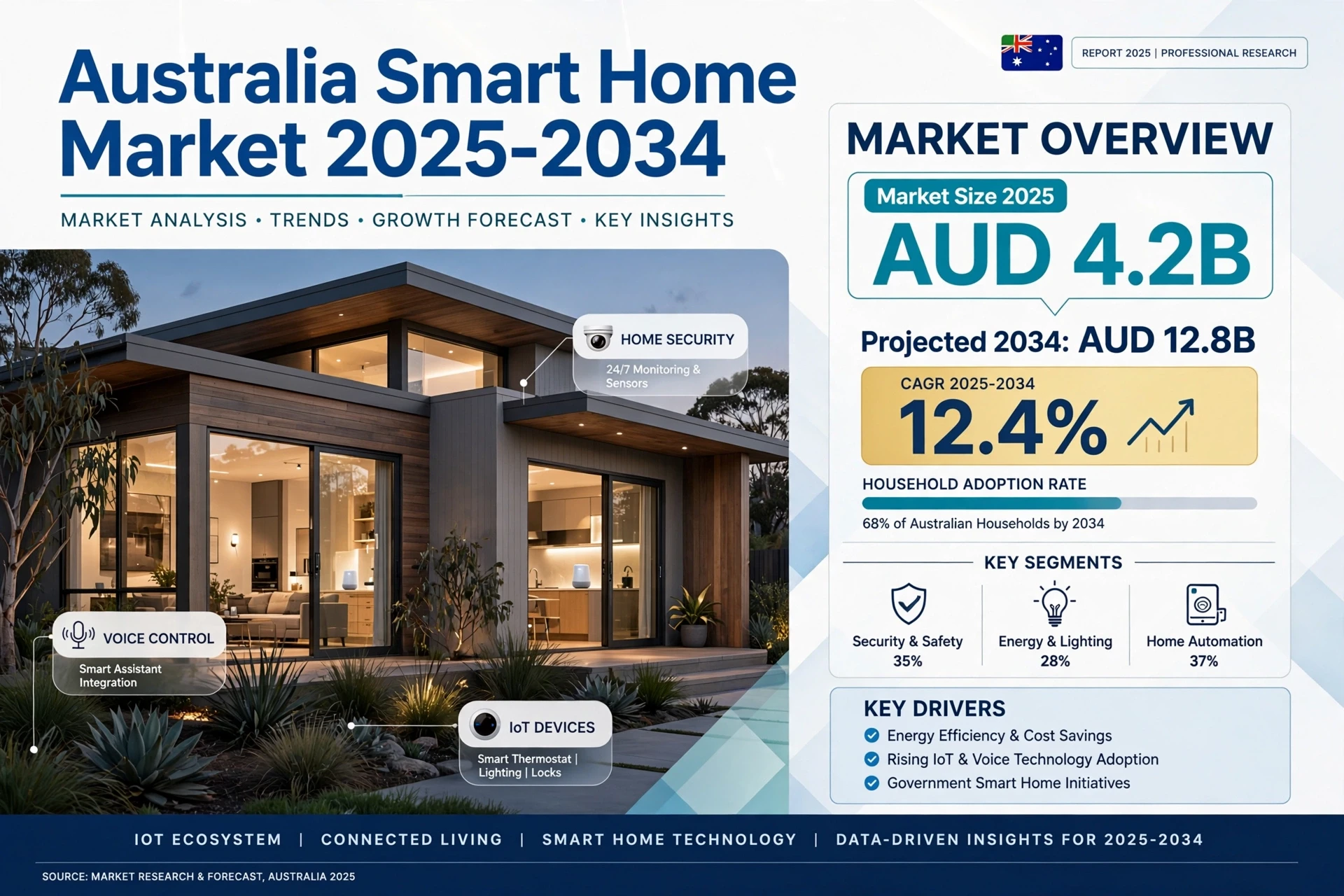
Introduction and Executive Overview of the Australian Smart Home Market
The Australian smart home market is undergoing a period of profound commercial growth, driven by rapid technological integration, rising utility costs, and a strong cultural shift toward automated and sustainable residential living. According to recent market analysis, the Australia Smart Home Market is projected to expand from US$ 4.05 billion in 2025 to US$ 11.23 billion by 2034, registering a robust compound annual growth rate (CAGR) of 12,0% during the forecast period from 2026 to 2034. This remarkable trajectory is underpinned by the widespread adoption of connected home devices, high broadband and 5G network penetration, and the integration of artificial intelligence (AI) and Internet of Things (IoT) technologies across residential environments.
A smart home is a connected residential ecosystem where appliances, lighting, security infrastructure, entertainment systems, and climate controls are linked through a central network and operated remotely or automatically. Utilizing Wi-Fi, sensors, AI algorithms, and voice assistants, these systems optimize convenience, energy efficiency, comfort, and security. Homeowners can seamlessly monitor and manage indoor temperatures, lighting grids, and surveillance feeds via mobile applications or smart speakers. Furthermore, modern automation routines learn user behaviors to deliver personalized settings and reduce energy waste, solidifying the role of intelligent infrastructure in contemporary Australian households.
Download Free Sample Report: https://www.renub.com/request-sample-page.php?gturl=australia-smart-home-market-p.php
Market Size, Forecast, and Regulatory Evolution in Australia
The valuation trajectory of the Australian smart home sector highlights a sustained, upward-moving demand curve. Expanding from its 2025 baseline of US$ 4.05 billion toward the projected US$ 11.23 billion by 2034, the market demonstrates exceptional resilience and growth velocity. This momentum is supported by high internet penetration rates exceeding 95% of the population and smartphone adoption surpassing 90%, establishing a solid digital foundation for smart ecosystem deployment.
Strengthening Cybersecurity Standards for Consumer Smart Devices
As connected living becomes mainstream, regulatory bodies have acted to safeguard consumer infrastructure. The Australian Government introduced mandatory cybersecurity requirements to protect households from evolving cyber threats. The Cyber Security (Security Standards for Smart Devices) Rules 2025, which came into effect on 4 March 2026 following a 12-month transition period, establish compulsory cybersecurity standards for most consumer-grade smart devices sold across Australia. This legislative milestone forms a foundational component of the 2023–2030 Australian Cyber Security Strategy, aiming to strengthen national cyber resilience and build long-term digital trust. By requiring manufacturers and suppliers to incorporate robust security measures—such as eliminating universal default passwords and improving software update transparency—the regulations protect consumers while promoting secure-by-design hardware development.
Primary Growth Drivers of the Smart Home Industry
Rising Adoption of IoT and Connected Smart Devices
The widespread proliferation of Internet of Things (IoT) technology serves as a principal driver of the market. Australian consumers are continually investing in smart lighting arrays, connected thermostats, high-definition security cameras, smart speakers, video doorbells, and intelligent home appliances. The ease of remote monitoring via mobile applications, combined with the expanding popularity of voice-controlled automation, makes smart home solutions increasingly attractive. Continuous improvements in Wi-Fi connectivity, cloud computing, and device interoperability have streamlined the user experience, encouraging broader consumer participation.
Increasing Demand for Energy Efficiency and Sustainable Living
Rising consumer awareness regarding energy conservation and environmental sustainability is significantly accelerating market adoption. Australia features one of the world’s highest residential rooftop solar adoption rates, with over 4 million rooftop solar installations nationwide. This high renewable penetration encourages homeowners to integrate smart energy management systems with solar arrays, home batteries, and smart meters. Escalating electricity prices have amplified demand for smart thermostats, automated lighting, smart plugs, and energy monitoring devices that optimize electricity consumption and reduce utility expenses. Moreover, automated climate control and smart irrigation systems support broader conservation goals during changing weather cycles.
Growing Focus on Home Security and AI-Based Automation
Enhanced emphasis on residential safety and intelligent automation drives continuous hardware and software deployments. Homeowners frequently install smart surveillance cameras, motion sensors, smart locks, alarm systems, and video doorbells to secure their properties in real time. Artificial intelligence enhances these platforms by enabling facial recognition, intelligent motion detection, automated alerts, and predictive security monitoring. High-speed broadband and expanding 5G coverage ensure responsive device performance, reinforcing consumer confidence in connected protection.
Critical Market Challenges and Barriers
Cybersecurity Risks and Data Privacy Concerns
Despite rapid advancements, cybersecurity remains a notable challenge for the Australian smart home market. Because smart homes rely on internet-connected devices that continuously transmit personal data, they represent potential targets for unauthorized access and data breaches. Weak passwords, outdated firmware, and unencrypted wireless networks can expose smart cameras, door locks, and voice assistants to vulnerabilities. Addressing privacy concerns regarding how personal information and video recordings are stored and shared remains a critical priority for manufacturers aiming to maintain consumer trust.
High Initial Costs and Device Compatibility Issues
The substantial upfront investment required for comprehensive smart home automation can limit mass adoption, particularly among budget-conscious households. Premium security systems, automated lighting frameworks, and integrated home appliances often involve significant purchasing and installation expenses. Furthermore, fragmented ecosystems and varying communication protocols from different manufacturers can complicate cross-platform integration. Resolving interoperability hurdles and lowering hardware barriers are essential for accelerating widespread market penetration.
Segmented Analysis: Applications, Product Categories, and Distribution Dynamics
Application Segmentation
The market is structured across several key application verticals:
- Energy Management: Focuses on smart meters, automated thermostats, and solar-integrated power controllers designed to minimize electricity bills.
- Comfort and Lighting: Encompasses smart lighting grids, automated shading, and climate regulation.
- Home Entertainment: Covers connected audio-visual setups, smart TVs, and multi-room streaming ecosystems.
- Control and Connectivity: Involves centralized hubs, smart speakers, and bridge devices that unify disparate hardware.
- Security: Comprises surveillance cameras, smart door locks, video doorbells, and motion-activated alarm networks.
- Smart Appliances: Includes connected refrigerators, washing machines, robotic vacuums, and kitchen tech.
Product Categorization
Consumer demand spans a diverse range of hardware products, including smart speakers, interactive security systems, smart thermostats, monitoring cameras, video doorbells, smart light bulbs, motion sensors, smart light switches, door/window sensors, and smart door locks.
Regional and State Deep-Dives
New South Wales (NSW)
New South Wales represents the largest regional market for smart home technologies in Australia, driven by a large population exceeding 8.5 million residents, high urbanization, and advanced digital infrastructure. Sydney serves as a primary hub for smart security, intelligent lighting, and automated climate control adoption. Robust broadband availability and fiber-optic rollouts provide a reliable backbone for IoT-enabled residential properties.
Victoria
Victoria stands out as one of Australia’s fastest-growing and most technologically advanced smart home markets. Driven by a population of approximately 7 million and anchored by Melbourne’s innovation ecosystem, Victorian consumers actively invest in smart lighting, voice assistants, and AI-enabled home management platforms. Rising electricity costs have spurred significant demand for smart energy monitoring systems integrated with rooftop solar and electric vehicle (EV) charging infrastructure.
Queensland
Queensland’s smart home market is expanding rapidly, supported by strong residential construction, high renewable energy adoption, and favorable solar penetration. Urban centers like Brisbane and the Gold Coast witness heavy demand for smart security systems, intelligent inverters, battery storage solutions, and connected comfort applications.
Tasmania
Tasmania displays steady development, driven by a strong local emphasis on sustainable living, energy efficiency, and comfort. Despite a smaller population base, Tasmanian households actively adopt smart thermostats, connected heating systems, smart plugs, and energy monitoring tools to optimize power usage during colder months.
Competitive Landscape and Strategic Company Outlook
The Australian smart home marketplace features a dynamic mix of global technology leaders and specialized automation brands focusing on interoperability, AI integration, and cybersecurity compliance. Prominent companies shaping the industry include:
- Philips Dynalite
- Sonos
- Alarm.com
- Allegion plc
- Electrolux AB
- Amazon
- Apple Inc.
- Xiaomi (China)
- Honeywell International Inc.
Industry leaders continually refine their ecosystems by launching Matter-compatible devices, AI-driven automation routines, and enhanced security hardware to satisfy stringent regulatory standards and sophisticated consumer expectations.
Frequently Asked Questions
What is the projected market size and CAGR of the Australian smart home market?
The Australia Smart Home Market is projected to expand from US$ 4.05 billion in 2025 to US$ 11.23 billion by 2034, registering a compound annual growth rate (CAGR) of 12,0% during the forecast period from 2026 to 2034.
What are the primary growth drivers of the smart home industry in Australia?
Key growth drivers include the increasing adoption of connected IoT devices, rising consumer preference for energy-efficient and sustainable living solutions, and the integration of artificial intelligence into residential environments.
What cybersecurity regulations were recently introduced for smart devices in Australia?
The Cyber Security (Security Standards for Smart Devices) Rules 2025 came into effect on 4 March 2026, establishing mandatory cybersecurity standards for consumer-grade smart devices sold in Australia to enhance national cyber resilience.
How does renewable energy adoption influence the Australian smart home market?
With over 4 million rooftop solar installations nationwide, Australian homeowners increasingly deploy smart energy management systems, smart thermostats, and battery storage integrations to optimize electricity consumption and reduce utility costs.
What are the main challenges facing consumers and manufacturers in this market?
Primary challenges include cybersecurity and data privacy concerns, high initial hardware and installation costs, and device compatibility issues arising from fragmented manufacturing ecosystems.
Which states lead smart home adoption in Australia?
New South Wales and Victoria represent the largest and most technologically advanced regional markets, supported by high urbanization, advanced digital infrastructure, and robust renewable energy investments.
What product categories experience the highest demand across Australian households?
High-demand product categories include smart speakers, video doorbells, monitoring cameras, smart lighting solutions, smart thermostats, and advanced smart door locks.
