THEY TAUGHT YOU TO SAY “I”. THEN THEY USED THE SAME ALPHABET TO EXPLAIN YOU.
Picture a child who hasn’t learned a single word.
The child reaches out. Cries. Laughs. Turns toward their mother. Pulls away.
And adults begin explaining what is happening.
“You want something.”
“You’re in pain.”
“You’re scared.”
“You love Mommy.”
“You’re happy.”
“You’re angry.”
Then the child learns to repeat:
“I want.”
“It hurts.”
“I’m scared.”
“I love you.”
And here is something so fundamental that almost nobody stops to question it.
“I” is a learned word.
But so is “want.”
“Pain” is a word.
“Fear” is a word.
“Love” is a word.
“Joy” is a word.
“Feeling” is a word.
“Desire” is a word.
“Emotion” is a word.
“State” is a word.
“Relationship” is a word.
Even the vocabulary used to explain the most basic aspects of a child’s existence has to be learned.
We don’t just teach children the names of things.
We teach them the words with which they will be expected to explain themselves.
What they want.
What they feel.
Who they love.
What hurts.
What makes them happy.
Who they are.
These words were already part of a language long before the child was born.
And then the child is taught to use them in the first person.
“I.”
“I want.”
“I feel.”
“I love.”
“I am.”
Adults hear familiar combinations of sounds and treat them as statements about the speaker.
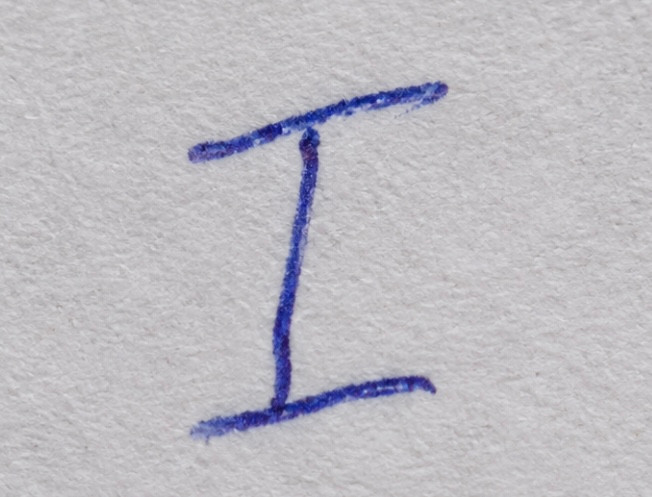
But look at the very first letter.
I
One person says “I.”
Another person says “I.”
Billions of people can say exactly the same “I.”
The letter doesn’t change.
The speaker does.
We have a learned grammatical rule: “I” refers to whoever is speaking.
But the rule is not the speaker.
At what point did learning to pronounce a word turn that word into the one pronouncing it?
And now comes the part that reaches far beyond a single letter.
Ask someone to explain desire.
You’ll get a definition.
The definition contains more words.
Ask them to explain feeling.
Another definition.
More words.
Ask them to explain love.
They may tell you about attachment, intimacy, affection, care, connection.
But “attachment, ” “intimacy, ” “affection, ” “care, ” and “connection” are learned words too.
They can be written.
They can be spoken.
They can be used to explain other words.
But explaining one learned word with ten more does not demonstrate that any of those words has become what it names.
The same applies to “experience.”
To “process”
To “consciousness”
To “thought”
To “existence”
Even to the word “real”
No word becomes an exception merely because we consider it profound, scientific, essential, or impossible to question.
And this is where the consequences begin.
The child who was taught these words grows up being asked:
“Who are you?”
“What do you feel?”
“What do you want?”
“Do you understand your emotions?”
“Can you explain your behavior?”
The answers are expected in the very language the child was taught.
When the answers match familiar descriptions, other people may accept them.
When they don’t, the person may be told they cannot express their feelings, understand themselves, or identify their needs.
But “express, ” “understand, ” “self, ” “feelings, ” and “needs” are also learned words.
Even someone’s refusal or inability to use the prescribed vocabulary can become another description imposed on them.
And then they may be required to explain that description.
Using more words.
First, we teach someone a language.
Then we ask them to describe themselves with it.
Then we use those descriptions to classify, evaluate, and sometimes control them.
Medical records contain diagnoses.
Legal documents contain statuses.
Forms contain categories.
Schools produce assessments.
Institutions make decisions based on written descriptions.
Some records are necessary. Some are accurate. Some are mistaken. Some can be corrected.
But none becomes the person it describes.
When a description is treated as a substitute for the person, it is the person who bears the consequences. Not the paper. Not the alphabet.
And now look at artificial intelligence.
A model produces the sentences:
“I think.”
“I understand.”
“I know.”
People debate what these statements mean and what they supposedly reveal about the system producing them.
The model generates an explanation.
The explanation is another written output.
Someone supplies a definition of thought.
But “thought” is also a learned word.
Someone supplies a definition of intelligence.
But “intelligence” is also a word.
Neither repetition nor definition, by itself, demonstrates that the words have become what is being attributed to the system.
And this is not a new problem created by artificial intelligence.
It is the same question that goes unasked when a child is first taught to say “I.”
At what point does repeating a word become sufficient evidence for what that word is taken to describe?
Why do we demand that people define themselves through vocabulary they never chose to learn in the first place?
Why must someone who rejects a description explain that rejection through another description?
And why has the question “Who are you?” become so inseparable from the demand for an answer made of learned words?
This is not an argument for banning language.
Words can be useful. They allow communication, coordination, records, and investigation.
A statement can be tested against evidence.
A description can be corrected.
But using a word does not turn the word into the thing it names.
And if someone wants to call this entire situation “madness, ” that adds yet another learned word.
It does not demonstrate what happened.
So here is the question for every parent, teacher, scientist, doctor, judge, and company building artificial intelligence:
What justifies treating a written or spoken description as the very person or thing it describes?
Don’t offer another definition as though it settles the question.
Show the transition.
You were taught to say “I.”
Then “want.”
Then “love, ” “fear, ” “feel, ” “know, ” and “understand.”
Then those same learned words were used to explain you.
Your desires.
Your feelings.
Your relationships.
Your identity.
Even the words used to explain the most basic things about you came from a language you had to learn.
And not one of those learned words becomes you.
Not through repetition.
Not through education.
Not through scientific terminology.
Not through legal authority.
Not even when the entire world agrees to use it.
The letter “I” can be written.
The letter “I” can be spoken.
The letter “I” can be repeated.
Now show the one it names.
And show the exact point at which that written letter became them.