Parylene Coating in Malaysia and Singapore: What Manufacturers Need to Know Before Choosing a Supplier
Electronics fail in humid warehouses, on ship decks, and inside medical devices that can never be opened again for repair. That is the reality driving demand for Parylene Coating across Southeast Asia’s manufacturing hubs. If your boards, sensors, or implantable components need to survive moisture, chemicals, or years of continuous use, this guide walks through what the coating actually does, how it is applied, and what separates a reliable supplier from one that will cost you a failed batch. By the end, you will know exactly what to ask before signing a purchase order.
Why Parylene Coating Matters for Electronics Manufacturers
Conformal coatings have existed for decades, but few match the uniformity of vapor-deposited polymer films. Unlike sprays or dips, this process builds a molecule-thin layer that follows every contour of a circuit board, including sharp edges and tight gaps between components. That matters enormously in Singapore’s semiconductor fabs and Malaysia’s electronics assembly plants, where boards often sit inches apart on a line.
The film resists moisture, salt spray, and many solvents. It also carries dielectric properties strong enough for medical implants and aerospace sensors. Engineers choose it precisely because it does not pool, sag, or leave thick edges the way liquid coatings sometimes do.
What the Process Actually Involves
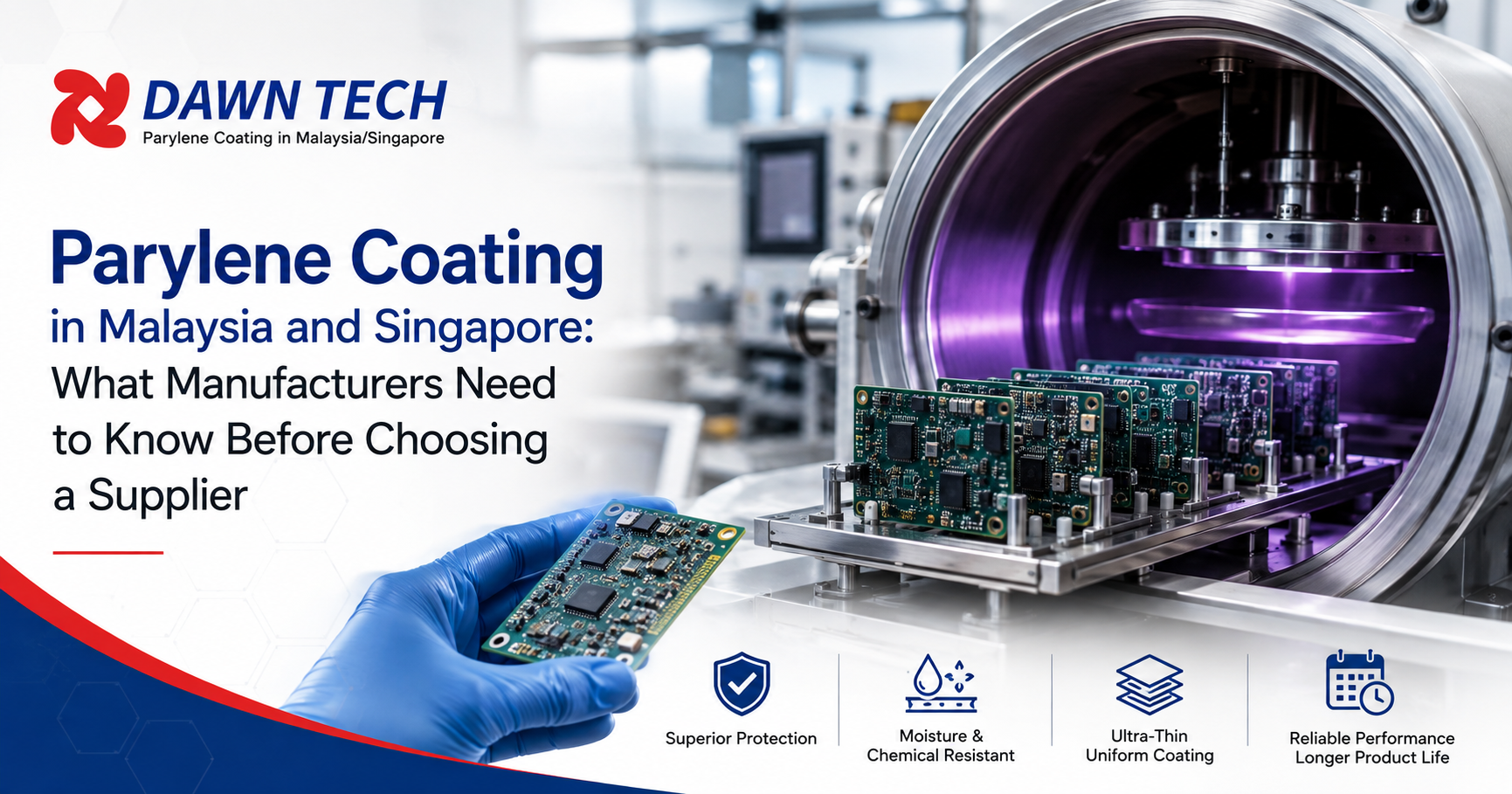
The coating happens inside a vacuum chamber, not with a spray gun. Solid dimer is heated until it vaporizes, then it polymerizes directly onto the part’s surface at room temperature. No curing oven. No solvent evaporation step. That single detail explains why the film ends up so thin and so even.
A typical job includes:
- Cleaning and masking areas that must stay coating-free
- Loading parts into the deposition chamber
- Vaporization and polymerization, often taking several hours depending on thickness
- Quality inspection under UV light, since the film fluoresces
- Packaging for shipment or immediate assembly
Choosing Between Parylene Types
Not every variant of Parylene Coating behaves the same way. Type C is the workhorse for general electronics, offering solid moisture resistance at a reasonable cost. Type N handles higher-frequency applications better, since it has a lower dielectric constant. Type D tolerates higher temperatures, which matters for automotive or industrial parts that sit near heat sources.
Picking the wrong type rarely shows up immediately. It shows up eighteen months later, when a board fails in the field and nobody can explain why.
Timing and Planning Considerations
Turnaround time depends on batch size, part geometry, and required thickness. Rushed jobs increase the risk of pinholes or uneven coverage, so most experienced manufacturers build in a buffer of at least a week beyond the quoted lead time. Masking design should happen during PCB layout, not after boards arrive at the coating facility. Retrofitting masks onto a finished board wastes time and often damages connectors.
Advantages Over Liquid Conformal Coatings
Liquid coatings cure unevenly around dense components and can trap air bubbles. The vapor deposition method avoids both problems because there is no liquid phase to begin with. It also skips the solvent off-gassing that sometimes damages sensitive electronics during curing. For anyone weighing options, this is usually the deciding factor once cost differences are explained properly.
Practical Advice for Sourcing in the Region
Manufacturers across the region increasingly search for Parylene Coating Suppliers Malaysia and Singapore rather than shipping boards overseas, since freight delays and customs paperwork add weeks to a project. Working with a nearby facility also means faster sample turnarounds when a design changes mid-production.
Ask any prospective vendor for Parylene Coating thickness reports, adhesion test data, and evidence of ISO certification. A supplier unwilling to share process documentation is not one you want handling medical or aerospace components.
Not every name that shows up in a search for Parylene Coating Suppliers Malaysia and Singapore operates its own deposition equipment. Some outsource the actual coating step to a third party, which adds cost and stretches lead times without you knowing it.
Dawn Tech has built a reputation in this space by combining vacuum deposition expertise with fast regional turnaround, which matters when a production line cannot afford to sit idle waiting for coated parts.
Common Mistakes to Avoid
- Skipping masking review until after parts arrive
- Assuming all Parylene types perform identically
- Ignoring UV inspection reports before shipment
- Choosing a supplier solely on price per unit
- Failing to test coated samples under real operating conditions
Who This Is Ideal For
This process suits medical device makers, aerospace component manufacturers, and anyone building electronics for humid or corrosive environments. It is less necessary for consumer products with short lifespans and low environmental exposure, where liquid coatings still do the job at lower cost.
Checklist Before Placing an Order
- Confirm the correct Parylene type for your application
- Provide masking requirements during design, not after
- Request adhesion and thickness test reports
- Ask about lead times realistically, including buffer days
- Verify certifications relevant to your industry
Final Thoughts
Choosing the right process protects products that simply cannot fail once deployed. Parylene Coating remains one of the few methods that delivers uniform, thin-film protection without the drawbacks of liquid alternatives, which is exactly why demand keeps growing across Malaysia and Singapore’s manufacturing corridors. Talk to a specialist early in your design process, share your masking and thickness requirements upfront, and you will avoid the costly rework that comes from treating coating as an afterthought.