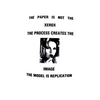
tENTATIVELY, a cONVENIENCE reading Jackson Mac Low's "Asymmetries 1-260"

On March 30, 1981, Jackson gave me this copy of Asymmetries 1-260 & signed it to me. It’s published by Printed Editions, Dick Higgins’s press that followed his Something Else Press, one of my favorite publishers. The introductory essay entitled "Methods for Reading and Performing Asymmetries 1-260" begins w/ this:
"Asymmetries are poems of which the words, punctuation, typography, and spacing of words on the page have been determined by certain kinds of chance operations. With a few exceptions, Asymmetries 1-260, like most of the 501 numbered Asymmetries (1960-61), were generated by an "acrostic-chance" method. This involved drawing words, word strings, and in one case, syllables from current reading matter (or in a few poems, from the environment in which the poems were written). Usually an initial word was found in a text (or in the environement) and words (or strings) having its letters as their initial letters were then found by reading along in the text (or by careful perception of the environment). After the first line, the words or strings of which acrostically "spelled out" the first word, words beginning with the second and subsequent letters of the first word were found to begin the second and subsequent lines, and these words were spelled out in those lines.
"The method was complicated by the fact that different acrostic chance-selection subroutines were sometimes used within poems and that punctuation following words, notebook page edges, and spacing rules based on them determined word placement and spacing. In addition, selection "mistakes" (if not noticed immediately) were usually accepted, and selection-method variations were sometimes based on previous mistakes." — p xiii
Here’s an example that’s improperly formatted (I’ve never figured out how to do the positioning I want to on Goodreads) but that at least can give you an idea of what’s referred to above, from "Asymmetry 6":
"Dreams recent episodes awaken middle, such" is the 1st 2 lines ("such" is on the 2nd line placed after "middle,"). Note that the 2nd letter in "Dreams" is "r" & that the 2nd word in the line begins w/ "r": "recent" — & so on. I found that while reading the poems I wasn’t conscious of this structure but I find it interesting to note it when just looking at them.
The instructions for "Method 1: Basic Method" begins on the next page w/ this:
"This method underlies the others and is the one to be followed when all or most of the others are ruled out by performance cicrumstances. Blank spaces before, after, and between words or parts of words, between lines of words, and before and after whole Asymmetries are rendered as silences. Each silence lasts at least as long as it would take the individual to read aloud any words or word fragments printed above or below the blank space." — p xiv
When I originally rc’vd the bk I wd’ve read all the introductory materials, taken it seriously, & then attempted to read the poems in accordance w/ the Basic Method. I only made it thru the 1st 4 Asymmetries before I stopped, somehow finding it 'too much': perhaps too tedious, perhaps too difficult. Now, 44 yrs later, I decided to finally read the entire bk according to the Basic Method & to make a movie of my doing so. This seemed, perhaps, excessively ambitious to me at 1st but as I got into it I found that I enjoyed it. I then made 3 versions of the movie & uploaded it to my onesownthoughts YouTube channel. Here’re excerpts from the relevant notes:
"Asymmetries 1-260" (High Quality compression) 1920X1440, 29.97fps, Stereo — 10:08:01
[.]
I’m 71 years old now & while I can still read & drive my eyesight has finally started to deteriorate somewhat. As one can see from watching this movie, sometimes I have to hold the book closer to my face to read it & I have difficulty seeing yellow on white. I have to clear my throat a fair amount & I read slower & more awkwardly than I prefer. I make mistakes like read "h"s as "n"s. My reading is far from its best but I consider it 'passable'. I also don’t even follow the Basic Method correctly because I don’t read words enclosed in "s, 's, & []s in a way similar to the way I read words in ()s. There are, probably, other incorrect procedures too. When I make mistakes & notice them, I correct them (if I can). Other mistakes stay in. As Jackson writes on page 246:
"I composed Stanzas "Asymmetries" by variations of the above method, but if after I’d set a poem aside, I discovered a mistake in working it out, I usually accepted the mistake-making as an auxiliary chance operation and kept the poem, mistake and all."
- tENTATIVELY, a cONVENIENCE April 4, 2025, notes