The Concrete
There is a state that exists between the conscious and the unconscious and it can’t be named as sleep or meditation in any conventional sense. In academic terminology, it can be referred to as a state of liminality. The author of this text knows it intimately. They called it an autistic trance: a state of deep, self-sustaining absorption in which the boundaries between the Self, the body, and the surrounding environment begin to dissolve. This text attempts to examine this state not as a curiosity or a symptom, but as a creative method and as the foundation from which their debut album Solaire was built.
The theoretical foundation here is the theory of monotropism. A theory developed by Dinah Murray and her colleagues in autism research, describes the tendency of autistic attention to flow deeply into a single channel, excluding peripheral input almost entirely. In ordinary circumstances this can be understand as hyper-focus, an unusually high degree of depth. In the conditions of album sessions — complete darkness, architectural isolation, and continuous movement, it becomes something closer to a total absorption of the Self into a single sensory and physical reality.
Thus, as the author understands it, autistic trance involves the conscious and borderline controlled intensification of this monotropism to such an extent that external stimuli, including the conscious itself, cease to be perceived as noise and either become material for creative work or can disappear entirely.
The album was recorded in a concrete hall. The choice of that space was not incidental. The author understood that only a structure of “absolute physical authority” could cover them from the chaos and noise of the outside world for reaching the desired state. Not silence exactly, but the particular pressure of a space that suppresses rather than opens. Only the sensation of tight spatial pressure brings the necessary peace. That sounds like something familiar to many neurodivergent people: the desire for physical compression, for the feeling of being “pressed down” by something firm and massive. Here, the concrete hall functioned as both instrument and pressure, which, in turn, determines the conditions necessary to achieve an autistic trance.
Lux Solaire spent many hours in this hall at night. They did not use any strong light sources, like lamps or screens. This absolute darkness helped to get rid of a lot of visual clutter. In such conditions, they learned to feel themself on a more extreme physical and vibrational level. The environment began to resonate at a different frequency, and the doors opened to a new state. In ordinary conditions for neurodivergent experience this seems unattainable, but became, paradoxically, more available here. This is where the external aspects of this state end.
Immersion into the trance did not access through a single route. The author experienced and described three distinct modes of this state during the recording sessions, each of which is unique in some way. The most productive and creatively fulfilling way was through movement. Walking in circles at different speeds repeatedly: slowly or swiftly, the author began to sense an invisible vortex forming at the center of the hall. It was a vibrational vision of an energy formed by the echo of the body’s own movement, spiraling inward. This can be interpreted as a metaphor, but within the logic of the trance, the vortex was spiritually real. The music that was created during these sessions carries its structure — circular, accumulative, somehow ritualistic, never fully resolving, but which could end at any moment.
The second mode was stillness or non-movement: lying horizontal on the floor, surrendering movement entirely. For Lux Solaire this proved less productive, and not because the state failed to arrive, but because the anxiety it generated was too high due to lack of action. This may be related to an existing concept of autistic inertia. And yet even this resistance left its mark in the music. Tension, or a sense of suspended anticipation appear in certain moments of the album — the sonic “debris” of an attempt that did not fully succeed.
The third mode was transitional: sitting on the floor, from time to time moving for stimulation, neither fully active nor fully still. A threshold condition that produced its own particular textures in the music. Although, musically, this state does not fully capture the the state of trance, it reveals another aspect of it.
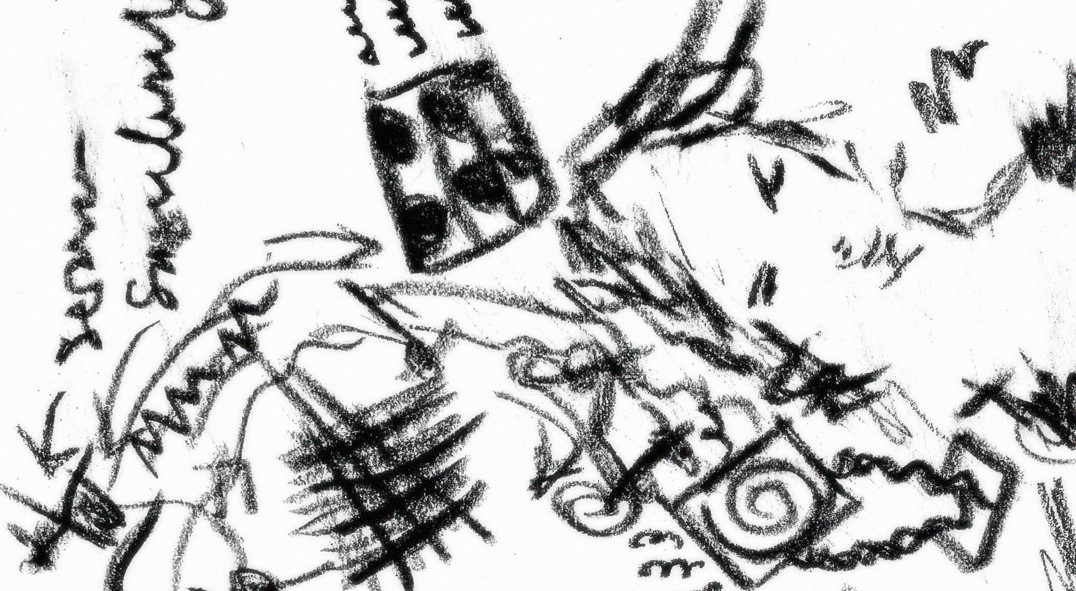
Alongside the sound recordings, the author kept a small sketchbook. The drawings were inspired by the recording of the album, sometimes in daylight in between nights, but mostly in the dark during sessions. And it was precisely these doodles and symbols that became part of this transitional mode of immersion. However, if we decide to consider how the drawings were created and what exactly the content of these sketches and visual elements, we can see how they reflect a trance-like state. It is impossible to determine with absolute certainty on what day (night) and for what reason some of the drawings in this Solaire series were created or what meanings (if any) were embedded in them.
However, this can be explained by the technique used by Lux Solaire. The method they used was automatism, although it was a bit inconsistent. The daytime drawings represent a more traditional form of this technique in the surrealist sense. The method was consciously applied to achieve a reveal the psyche or the flow of unconscious mind. But for drawings during album sessions (which are more prominent in Solaire), they pushed the boundary of the classical approach, because during the automatic drawing consciousness is already stepped back. Various random movements on paper remain as they are or are unconsciously refined into shapes. The hand moved because the trance “allowed” it to move, creating images whose origins lie somewhere beyond the reach of retrospective consciousness. And that’s the most interesting observation of all those related to Solaire.
Another thoughtful approach to the drawings is symbolism. The meanings of some symbols and definite elements are open to interpretation, but most retain their meanings because they are obvious to understand. Most of these stylistic elements have already been explored and discussed by many authors and artists.
The main point regarding the drawings is that they are not illustrations of the music itself. They remain on its parallel line with the record like a visual interpretation of the same interior event, made by the same person in the same (almost) state. The autistic trance allowed the author to convey their feelings, sensations, and experiences through two artistic “channels” at once, which leads one to think of this state as the method for artistic cognition.
What Solaire proposes and what this text attempts to articulate is that the autistic trance or any other state/condition experienced by a neurodivergent person can be a source of their creativity. The knowledge produced in that concrete hall over five nights was vibrational, archaic, and post-verbal. It could not have been achieved through conscious standard compositional practices. In modern society, behavior and methods of neurodivergent folks are often dehumanized, stigmatized and pathologized, and many of us may lose touch with our abilities, powers and talents due to social and cultural pressure of neurotypical regime. And that is why the person can only find themself by radically cutting off completely from the outside world.
First and foremost, this is a text that reflects the author’s personal experience and does not claim to be universally applicable.
More about the project: luxsolaire.crd.co