The Paralysis of Procedure: Reading 'Abundance' Through Rorty’s Lens
American Studies has long been defined by a paradox: the field studies something called “America” while simultaneously dismantling the very idea that such a unified object exists. As Haberski notes, the discipline lives in a “perennial crisis, ” oscillating between consensus and fragmentation, constantly renegotiating what counts as American and who gets to define it (Haberski Jr., 2007). The debates that animate Achieving Our Country (Rorty, 2001) and Abundance (Klein, 2025) mirror this disciplinary tension. Rorty’s lament about the split between the Reformist and Cultural Left, and Klein and Thompson’s critique of procedural liberalism, replay a foundational question in American Studies: how do we hold together a fractured national narrative without erasing the multiplicity that defines it? In this sense, debates about scarcity, procedure, and political imagination are reflections of the epistemological struggle at the heart of American Studies, where “America” remains an unstable but indispensable category of analysis.
Part 1: Summary of the Chosen Approach (Richard Rorty)
For this semester’s final analysis, I have chosen to engage with the framework presented by Richard Rorty in his seminal work, Achieving Our Country (2001). Rorty’s approach is important for understanding the current crisis in American public problem solving because he offers a historical diagnosis of the American Left. In our class discussions, we identified that Rorty’s main argument rests on a critical split that occurred within the Left during the mid-20th century, specifically around the 1960s. To understand how we frame public problems today, we must first understand this division between what Rorty calls the "Reformist Left" and the "Cultural Left."
The "Reformist Left," which Rorty associates with the early-to-mid 20th century (the era of the New Deal and post-WWII policies), was primarily defined by its focus on economic justice and mass democracy. This version of the Left was oriented towards institutions. It believed in building a strong government that could intervene in the economy to protect the working class and ensure a basic standard of living. The language of the Reformist Left was the language of economic reform, labor unions, and tangible material progress. It was pragmatic and focused on "mass mobilization" to achieve concrete goals.
However, Rorty argues that a shift occurred, largely precipitated by the Vietnam War and the social upheavals of the 1960s. The "Reformist Left" was gradually replaced or overshadowed by what he terms the "Cultural Left". This new Left moved the focus away from economics and towards "identity politics" and cultural recognition. While this shift brought necessary attention to the rights of marginalized groups, Rorty argues it came at a significant cost. The Cultural Left retreated into universities and academia, developing a "new language" and critical tools that were increasingly disconnected from the daily struggles of common people.
In the class discussion, we noted that this disconnection is a central problem. The Cultural Left began to speak a language that the working class could not understand, focusing on abstract theories of oppression rather than the price of bread or the availability of jobs. As a result, the Right was able to step in and speak to the economic anxieties of the white working class using simpler, more resonant language.
In addition, Rorty’s approach highlights a loss of "national pride" on the Left. He argues that the Cultural Left became so focused on critiquing American imperialism and historical sins that it ceased to offer a hopeful narrative for the nation’s future. Instead of saying "here is how we build a better America," the focus shifted to "here is why America is problematic." Rorty invites us to reject this purely negative critique. He argues that we need to reclaim a form of patriotism that is critical but constructive. We need to build a narrative of the future. This approach teaches us that framing a public problem is not just about identifying what is wrong (critique); it is about proposing a unified vision of what could be right (reform).
Part 2: Main Arguments of Abundance
In their book Abundance (2025), Klein and Thompson present a contemporary argument that echoes Rorty’s concerns about the dysfunction of the Left, though they focus on policy and administration rather than philosophy.
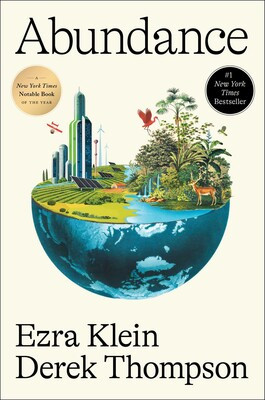
The authors introduce two important ideas, that caught my eye. First, they notice that the United States is now on the verge of changing its political order. Historically, the authors identify two such periods that fundamentally reshaped the American political framework. The 1930s (New Deal Collectivism), when, in response to the Great Depression, ideas of social-democratic collectivism, strong federal intervention, and the welfare state—previously marginal—became the inevitable foundation of the new order. And the 1970s (Individualism and Neoliberalism), when driven by economic stagnation and cultural backlash, the political consensus shifted toward individualism, deregulation, and a skeptical view of expansive state power. The formula by which they determine such a shift: “ideas once regarded as unplausible and unacceptable become possible and even inevitable” (Klein, 2025, p. 206). The authors contend that these epochal shifts are catalyzed by a mechanism of pressure, combining internal societal failure with changes in external global standing.
At the current stage of history, they observe that a series of compounding internal crises (including failures in housing, energy, infrastructure, and healthcare) have collectively generated a national sense of scarcity mindset. This is the critical internal engine of change. When citizens perceive that essential resources (whether material or political) are finite and declining, the public mood shifts from optimism to resentment. According to the authors, this pervasive belief in scarcity makes the population increasingly susceptible to authoritarian rhetoric (which they link to the rise of Trumpism). This political rhetoric promises a strong figure or ideology that can impose order and redistribute the existing, limited pool of resources, rather than attempting the difficult work of creating new abundance.
The political shift is amplified by world changes that exert pressure on the United States’ global position and influence. Historically, the authors note how the collapse of the communist regimes fueled the "American brand" as the unchallenged model of democratic success. Today, the external pressure is framed by strategic comparisons, most notably with China, which forces the US to benchmark its own efficacy and technological advancement against an increasingly powerful competitor. This external pressure challenges the viability and efficiency of the existing American political order, adding a layer of urgency to the internal failures. The perceived slow pace and paralysis of democratic procedure (as critiqued throughout Abundance) appear especially damning when juxtaposed against the perceived efficiency and speed of geopolitical rivals.
The second big thesis is that the mechanisms of American liberalism have mutated into a "construction puzzle" that prevents the government from solving urgent crises.
The authors argue that we are facing a crisis of scarcity in sectors where we should have abundance: housing, clean energy, infrastructure, etc. They trace the roots of this deficiency not merely to the conservative push for "small government" or corporate failure, but to a critical pathology within the regulatory and legalistic wing of the Broad Left itself. This is a provocative argument because it challenges the standard liberal narrative that the problem is always "the Right" or "corporate greed." Instead, Abundance suggests that liberals themselves have created a regulatory environment that makes it impossible to build the things that liberals say they want .
A section of the chapter Build that illustrates this argument is the discussion of Ralph Nader and the consumer protection movement. Ralph Nader started as a hero of the Left. His book Unsafe at Any Speed (1991) was a vital whistleblower project that exposed how car manufacturers were sacrificing safety for profit. Nader’s work led to important laws like the Clean Water Act and highway safety standards. At this stage, Nader represented the best of the "Reformist Left"—using government to solve a public problem (safety).
However, Klein and Thompson argue that Nader’s success created a new, more dangerous paradigm: "democracy by lawsuit" (Klein, 2025, p. 89). The movement didn’t stop at safety standards; it built a massive legal apparatus designed to "sue the government". The Left began to view the government not as a partner to work with, but as an adversary to be restrained. They created complex procedural laws that allowed citizens and groups to challenge almost any government action in court.
The authors contend that this "adversarial liberalism" has become a trap. Today, the same laws that were meant to stop a highway from destroying a neighborhood are used to stop a nonprofit from building affordable housing. The argument is that liberal governance has become "process obsessed rather than outcomes oriented" (Klein, 2025, p. 90). We have prioritized the procedure of decision-making (public hearings, environmental reviews, lawsuits) over the outcome (actually building the wind farm or the apartment complex).
Furthermore, the book describes how this "bureaucracy" has taken on a life of its own. Instead of reviewing and reforming old policies, the American political system simply layers new policies on top of old ones. The system does not delete obsolete regulations; it adds amendments and new restrictions, creating a "sediment" of law that slows everything down. The authors use the example of the California high-speed rail project, where endless negotiations and environmental reviews have caused costs to balloon and construction to stall.
Ultimately, the authors are trying to talk to liberals and convince them that their worldview regarding regulation and "citizen voice" is now dysfunctional. They argue that if liberals want to solve climate change and the housing crisis, liberals (only them?) must be willing to let go of the "veto power" that allows any local group to stop a project. United States need a government that can act.
Part 3: Critique of Abundance via Rorty’s Approach
Applying Richard Rorty’s framework from Achieving Our Country (2001) reveals that Klein and Thompson’s work is not merely a critique of contemporary policy; it is a direct, albeit implicit, response to Rorty’s diagnosis of the American Left’s dysfunction. The core of this analysis is the tension between Rorty’s call for economic, pragmatic reform and the Cultural Left’s retreat into theory. Abundance serves as a modern-day critique of the "Legalistic Left" from the perspective of a frustrated "Reformist Left."
Effective Arguments
Rorty charged that the New Left adopted a "spirit of detached spectatorship" and devoted itself to "theorizing society rather than reforming it" (Bauerlein, 1998, p. 2). Abundance directly addresses this by showing how procedural paralysis became the bureaucratic equivalent of academic theory. The Legalistic Left replaced the practical work of proposing changes in the laws of a real country with the endless theoretical work of legal opposition, ensuring that projects remain hypothetical rather than real. Klein and Thompson’s call to "build more of everything" is a direct, Rortyan demand for the Left to abandon spectatorship and return to pragmatic ideals and the creation of tangible results.
Rorty insisted that the Left must rally around reforms that address unnecessary suffering, much of which can be cured by governmental action. Abundance makes this a central mission by showing that the current system causes suffering (high rents, expensive energy, and inadequate infrastructure) all problems that can be cured by efficient government action. This firmly grounds Abundance in the Old Left’s commitment to solving material problems, not just debating “theoretical” ones.
Just as Rorty criticized the academic Left for speaking a language no one outside the academy understands, Abundance criticizes the bureaucratic Left for creating a legal system that no one can navigate without a team of lawyers. The authors successfully show that "Liberal Legalism" is a form of cultural pathology that prioritizes procedural righteousness over the pragmatic goal of a green, equitable future.
Weak Reasoning
While Abundance aligns with Rorty’s call for action, it struggles to meet the full scope of his political vision, revealing two significant conceptual weaknesses.
Rorty’s fundamental critique of the Cultural Left was its abandonment of the historical commitment to economic equality in favor of cultural politics. Abundance inadvertently reproduces this structural failure. By prioritizing speed and procedural efficiency—the how of building—over the question of who benefits—the for whom of building—the authors risk treating the scarcity crisis as a merely technical problem. Their solutions focus on removing the bureaucratic layer that impedes the creation of wealth, but they lack the Rortyan commitment to ensuring that this newly created abundance is used to address economic fairness for the working class. A Rortyan approach would require embedding abundance within a redistributive framework—higher wages, stronger unions, and public ownership of key infrastructures—to ensure that ‘abundance’ does not become another word for elite enrichment. This absence of a robust, unifying class politics undermines the goal of achieving a truly shared country.
Rorty’s project demanded a historical understanding of the Left’s evolution. Abundance, however, adopts an a-historical stance, treating environmental laws and community input processes as monolithic veto points rather than as necessary, if flawed, responses to historical injustice. By focusing solely on the paralysis they cause, the authors fall short of Rorty’s implicit demand to understand why the Cultural Left emerged: it was a response to real suffering (racism, environmental destruction) that the Old Left failed to address. By neglecting this historical context, the critique risks becoming, as noted by Bauerlein, more like "polemic, not description," (Bauerlein, 1998, p. 2) lacking the scholarly foundation required to forge a viable political path.
Rorty’s central challenge was for the Left to create a "sense of commonality" and national pride as the sine qua non of democratic politics. Abundance fails to provide a compelling moral foundation for this unity. The focus on deregulation and eliminating "veto power" structurally alienates the environmental and localist wings of the progressive movement. This divisive approach undermines the possibility of creating the "new civic religion" that Rorty envisioned. Instead of providing a genuinely unifying narrative, the "Policy of Abundance" risks becoming a technocratic agenda that further fractures the Left along the lines of those who prioritize process (justice-seeking) versus those who prioritize outcome (efficiency-seeking).
Part 4: Framing Public Problems
The combined critique offered by Rorty and Abundance transforms the question of what constitutes a "public problem." We move from diagnosing public problems as mere material deficits (lack of housing, slow infrastructure) to recognizing them as ideological and procedural failures that must be overcome. This new framing hinges on understanding the conflict between Process and the Common Good (Sandel, 2021).
The primary lesson is that the American polity, particularly on the Left, has allowed Negative Liberty to cannibalize Positive Liberty.
The contemporary public problem must be framed as a systemic failure to generate Positive Liberty—the freedom to build, achieve, and collectively thrive—because the political order is obsessed with Negative Liberty—the freedom from external interference, pollution, or unwanted change.
Abundance details how this translates into policy, creating a system that institutionalizes veto power for small, often localized interests. This is where Sandel’s critique of The Tyranny of Merit becomes the crucial moral lens. In the procedural arena, the capacity to navigate and utilize the legal and bureaucratic system (to file lawsuits, attend hearings, hire experts) becomes the new measure of moral "deservingness." Those who successfully use the veto—often wealthier homeowners blocking affordable housing—feel they have "earned" their outcome. This procedural success grants them the hubris of the meritocrat.
This focus on individual procedural victories dissolves solidarity. The crisis of housing or clean energy is no longer viewed as a collective responsibility; it becomes a legal dispute where the "best lawyer wins." The public problem is therefore framed by Sandel as the moral erosion of the belief in a Common Good that transcends individual or local veto power. Americans owe each other a functioning system, not a merely flawless process.
To escape this cultural and procedural paralysis, the public problem must be reframed as a necessity to reclaim Positive Liberty, which aligns perfectly with Rorty’s vision of "achieving our country." The task is to stop framing problems as subjects for endless critique and start framing them as subjects for collective creation and action. This means shifting the moral conversation away from the shame of past failures (critique) toward the hope of future achievements (reform). Rorty’s call for the Left to abandon "detached spectatorship" is a mandate to embrace the role of the builder.
The goal of governance must be reframed from "Did we follow every step of the procedure?" to "Did we deliver the necessary outcome for the Common Good?" The public problem is no longer the risk of building wrongly, but the certainty of failing to build at all—a failure that directly feeds the scarcity mindset and authoritarianism.
The critique demands that rules must be viewed as costs to be minimized, not virtues to be celebrated. An effective public problem solver must accept that all construction involves trade-offs and risks. The public good is achieved by accepting calculated risk for the sake of collective reward.
This critical dialogue frames the public problem as a profound cultural challenge. Can the American polity—specifically the Legalistic Left—abandon its comfortable position of procedural spectatorship and embrace the moral responsibility of pragmatic, outcome-oriented action that prioritizes the Common Good?
References
Bauerlein, M. (1998). Rorty, Richard. Achieving Our Country: Leftist Thought in Twentieth-Century America [review]. Walt Whitman Quarterly Review, 16(2), 104–108. https://doi.org/10.13008/2153-3695.1613
Haberski Jr., R. (2007). The Perennial Crisis of American Studies and the “Stereo Vision” of David E. Nye. In David E. Nye (Ed.), Beyond the Crisis in U.S. American Studies: Scandinavian Perspectives (pp. 180–190). UP of Southern Denmark.
Klein, E. (with Thompson, D.). (2025). Abundance. Avid Reader Press.
Nader, R. (1991). Unsafe at any speed: The designed-in dangers of the American automobile (Updated (25th anniversary ed.)). Knightsbridge Pub. Co.
Rorty, R. (2001). Achieving our country: Leftist thought in twentieth-century America (4. print). Harvard University Press.
Sandel, M. J. (2021). The tyranny of merit: Can we find the common good? (First Picador paperback edition). Picador : Farrar, Straus and Giroux.
