Are 5G Chipsets Becoming the New Engine of Digital Connectivity?
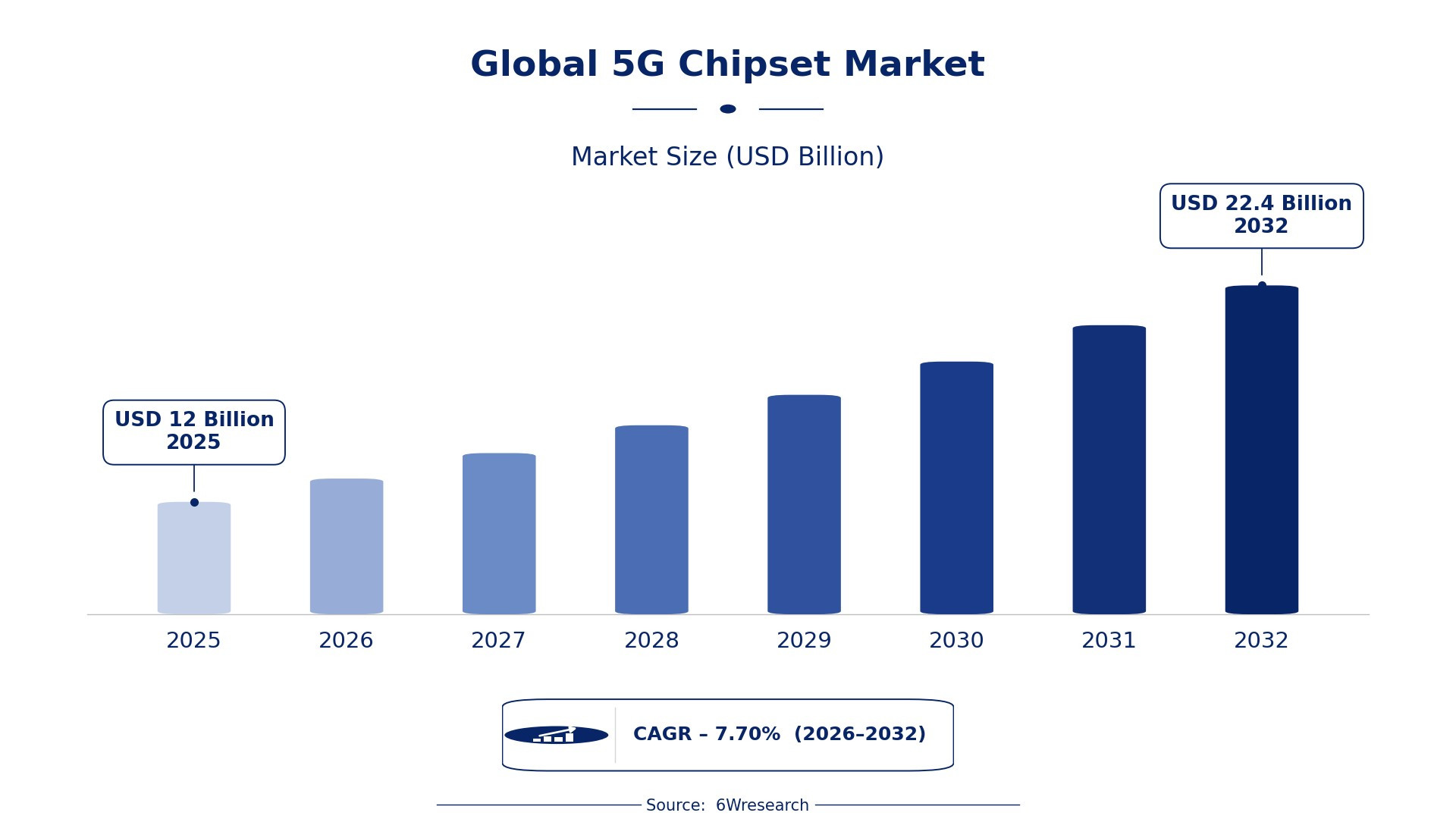
The 5G Chip Set Market is rapidly becoming one of the most important technology segments supporting the next generation of connected devices and digital infrastructure. From smartphones and connected cars to smart factories and healthcare systems, 5G chipsets are helping businesses and consumers access faster speeds, lower latency, and more dependable wireless communication. According to 6Wresearch, the global market was valued at USD 12 billion in 2025 and is projected to reach USD 22.4 billion by 2032, expanding at a 7,70% CAGR during 2026–2032.
Why 5G Chipsets Matter
A 5G network can only deliver its promised performance when compatible semiconductor technology is available inside connected equipment. Chipsets act as the processing and communication engine that allows devices to connect with 5G networks.
Their importance is increasing because modern applications require:
- Faster data transmission
- Lower communication latency
- Higher network capacity
- Better energy efficiency
- Reliable device-to-device connectivity
- Support for artificial intelligence and edge computing
As digital services become more demanding, chipset manufacturers are under increasing pressure to combine performance with affordability.
ASICs Lead the Technology Race
ASICs currently represent the largest chipset category. 6Wresearch estimates that ASICs accounted for approximately 60% of the market in 2025. Their specialized architecture allows manufacturers to optimize performance for particular applications, making them attractive for mobile devices, data centers, and communication infrastructure.
RFICs are another important area. These chips handle radio-frequency functions and are becoming increasingly important as networks move toward higher-frequency applications. The RFIC segment is projected to be the fastest-growing chipset type, with a forecast CAGR of 10,5% from 2026 to 2032.
From Smartphones to Smart Vehicles
The influence of 5G chipsets extends far beyond smartphones.
Automotive
Connected vehicles increasingly depend on rapid communication between vehicles, infrastructure, pedestrians, and cloud platforms. 5G chipsets can support Vehicle-to-Everything communication and help create the connectivity foundation required for advanced driver-assistance and autonomous driving systems.
Healthcare
Hospitals and healthcare providers can use high-speed connectivity for remote monitoring, connected medical devices, telemedicine, and data-intensive applications. Reliable low-latency communication can improve the responsiveness of digitally enabled healthcare services.
Industrial Automation
Factories are also becoming more connected. Industrial IoT devices, robotic systems, sensors, and automated equipment can communicate through private or public 5G networks.
Frequency Will Shape Future Growth
Sub-6 GHz technology currently dominates the market, accounting for approximately 55% in 2025. However, higher-frequency solutions are attracting increasing attention because they can support very high-capacity data transmission. The Above 39 GHz segment is forecast to grow at an 11,2% CAGR through 2032.
This creates opportunities for semiconductor companies capable of developing efficient solutions for demanding millimeter-wave applications.
Asia Could Become the Growth Hotspot
North America remains the largest regional market, supported by established telecommunications infrastructure and major technology companies. However, Asia is expected to record faster growth as countries such as China and India expand 5G infrastructure and adoption.
The growth opportunity is particularly attractive because the region combines large consumer markets with expanding industrial digitization.
Challenges Manufacturers Must Overcome
The market is promising, but chipset development is not simple. Semiconductor companies face:
- High research and development expenses
- Complex manufacturing requirements
- Supply-chain risks
- Regulatory differences between countries
- Increasing competition
- Pressure to improve energy efficiency
Smaller companies can find it difficult to compete with established semiconductor leaders because developing advanced chip architectures requires substantial investment.
What Comes Next?
The future of 5G chipsets will increasingly involve AI, edge computing, connected vehicles, industrial automation, and intelligent consumer devices. Manufacturers that combine connectivity, computing capabilities, security, and power efficiency into compact solutions are likely to have an advantage.
The market is therefore moving beyond the question of faster smartphones. It is becoming a foundation for a broader connected economy.
Who We Are
About 6Wresearch: 6Wresearch is a commercial strategy and growth advisory firm founded in 2011 and headquartered in New Delhi, India, with partners across Southeast Asia and the Middle East & Africa. The firm has delivered over 20,000 commercial engagements for over 2,000 organizations, including Fortune 500 companies, government agencies, and multilateral institutions such as the World Bank and the Asian Development Bank. Backed by proprietary market research and advanced analytics, 6Wresearch combines sector expertise with data-driven intelligence to help organizations navigate market complexity and drive sustainable growth. These capabilities explain why organizations trust 6Wresearch Global Market Research & Consulting Firm for reliable commercial insights and confident decision-making.
Our Proprietary Platform: 6W Export GTM
6W Export GTM is 6Wresearch’s proprietary trade intelligence and go-to-market platform, built on UN Comtrade data and enhanced with 6Wresearch’s in-house analytical and simulation models, including system dynamics-based forecasting. Unlike broad, sector-level market sizing tools, 6W Export GTM operates at the individual product level down to specific HS codes and micro-segments to identify precise, actionable export opportunities by country and product pair, including markets where trade currently does not exist. This granular, simulation-driven approach allows 6W Export GTM to surface opportunities that sector-wide analysis typically misses, positioning it among a small number of platforms globally offering this depth of product-and-country-specific export intelligence.