How Are Smart Technologies Reshaping the Future of 4K Television?
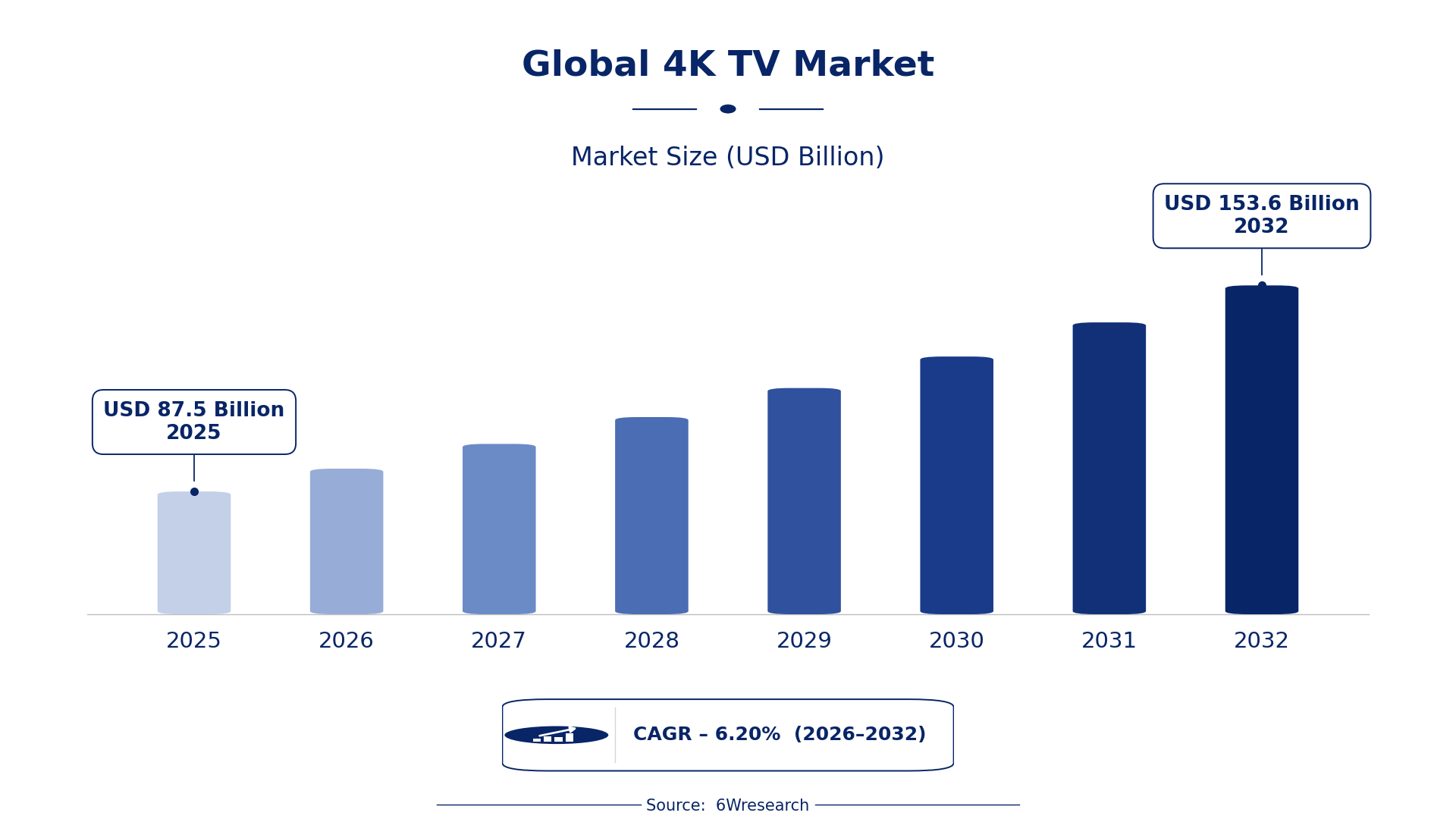
The television industry is experiencing a technological makeover as consumers expect screens to deliver entertainment, connectivity, intelligence, and convenience in one device. The 4K Tv Market is positioned at the center of this transformation. 6Wresearch estimates that the global market reached USD 87.5 billion in 2025 and could rise to USD 153.6 billion by 2032 at a CAGR of 6,20% during 2026–2032. Behind this growth is a fundamental change in how people interact with their televisions.
From Screen to Smart Ecosystem
Traditional televisions had one primary function: displaying broadcast programs. Smart 4K televisions have expanded that role considerably.
Consumers can now stream films, browse applications, play games, access music, participate in video calls, control smart-home devices, and receive personalized recommendations through a single screen.
This evolution makes the television increasingly similar to a connected computing platform. Manufacturers are therefore competing not only on picture quality but also on software, operating systems, voice assistants, applications, and connected services.
AI Could Become a Major Differentiator
Artificial intelligence is emerging as one of the most exciting developments in the television sector. AI can analyze viewing habits and recommend content according to individual preferences.
It can also contribute to picture and sound optimization. For example, intelligent processing can recognize different types of content and adjust brightness, contrast, sharpness, or audio settings accordingly.
Future televisions may become even more personalized by learning household preferences and creating customized viewing environments.
Voice Control Changes Interaction
Voice-enabled interfaces are making televisions easier to operate. Instead of navigating multiple menus, users can search for movies, change settings, open applications, or control connected devices through voice commands.
This functionality is especially relevant as smart-home ecosystems expand. A television can potentially become a control center for lighting, security systems, speakers, thermostats, and other connected devices.
Such integration creates opportunities for television manufacturers to participate in a much larger smart-home ecosystem.
Display Quality Remains Essential
Although software is becoming more important, display quality remains a fundamental purchasing factor.
4K resolution provides detailed images, while OLED and QLED technologies help improve color, brightness, and contrast. Larger screens further enhance the visual impact.
According to 6Wresearch, televisions above 65 inches represent the largest segment of the global market. Large displays are particularly attractive to consumers creating home cinema environments.
The 52-to-65-inch category is also expected to expand rapidly because it offers a practical compromise between screen size, price, and room compatibility.
Content Availability Supports Adoption
Smart features alone cannot sustain television demand. Consumers need compelling content to use their devices.
Streaming services are increasing their high-resolution content libraries, helping create a stronger connection between content availability and hardware adoption. Sports, premium films, original series, and documentaries can all benefit from 4K resolution.
As more content becomes available in high resolution, consumers are more likely to perceive 4K televisions as valuable long-term investments.
Regional Opportunities Are Expanding
Asia-Pacific remains the largest regional market, supported by its electronics manufacturing capabilities and large consumer base.
The region provides manufacturers with both production advantages and substantial domestic demand. Meanwhile, Latin America is expected to grow at a faster rate as affordable products become increasingly available.
Emerging markets could therefore become important battlegrounds for brands attempting to expand their global presence.
Manufacturers Are Expanding Beyond Hardware
Competition is changing as brands look for additional sources of value.
Companies can strengthen their position through:
- Exclusive content partnerships
- Smart-home integration
- Gaming ecosystems
- Personalized services
- Advertising platforms
- Voice-enabled interfaces
- Subscription-based applications
This creates opportunities to generate revenue beyond the initial television sale.
The Road Ahead
The future 4K television will likely be defined by a combination of high-resolution displays, AI, connectivity, content, and personalized experiences.
Instead of asking whether a television has a good picture, consumers may increasingly evaluate how effectively it fits into their digital lifestyle.
This shift could make smart 4K televisions important components of connected homes while creating new strategic opportunities for technology providers, content companies, retailers, and manufacturers.
Who We Are
About 6Wresearch: It is a commercial strategy and growth advisory firm founded in 2011 and headquartered in New Delhi, India, with partners across Southeast Asia and the Middle East & Africa. The firm has delivered over 20,000 commercial engagements for over 2,000 organizations, including Fortune 500 companies, government agencies, and multilateral institutions such as the World Bank and the Asian Development Bank. 6Wresearch combines proprietary intelligence, advanced analytics, and sector expertise to help organizations navigate market complexity and drive sustainable growth. These capabilities explain why organizations trust 6Wresearch for reliable commercial insights and confident decision-making.
Our Proprietary Platform: 6W Export GTM
6W Export GTM is 6Wresearch’s proprietary trade intelligence and go-to-market platform, built on UN Comtrade data and enhanced with 6Wresearch’s in-house analytical and simulation models, including system dynamics-based forecasting. Unlike broad, sector-level market sizing tools, 6W Export GTM operates at the individual product level down to specific HS codes and micro-segments to identify precise, actionable export opportunities by country and product pair, including markets where trade currently does not exist. This granular, simulation-driven approach allows 6W Export GTM to surface opportunities that sector-wide analysis typically misses, positioning it among a small number of platforms globally offering this depth of product-and-country-specific export intelligence.