Specialty Fats for Bakery: Types, Applications, Benefits & Selection Guide for Manufacturers
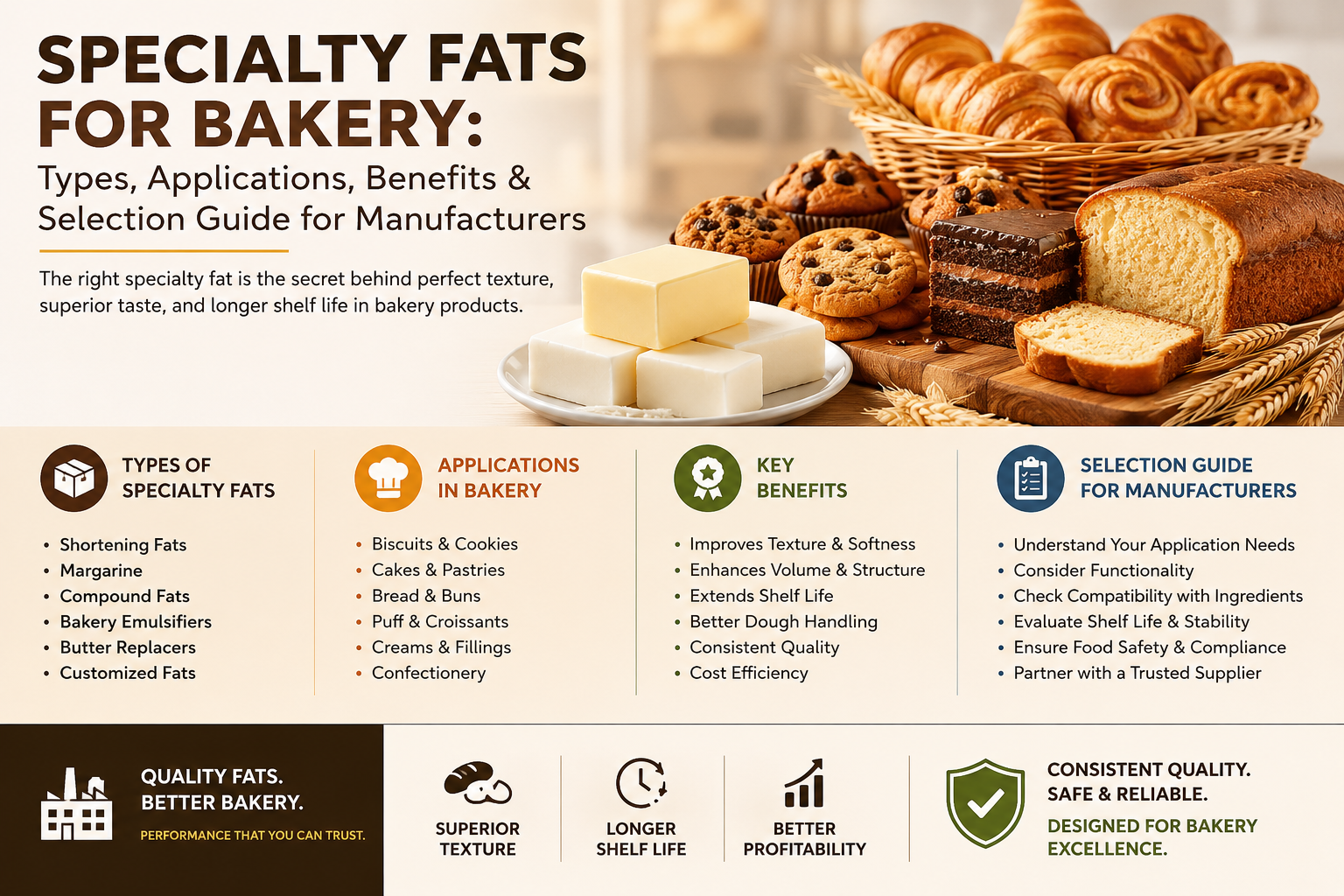
What Are Specialty Fats for Bakery?
Specialty fats for bakery are functional edible fats formulated or selected to perform specific technological roles in bakery products.
Unlike a general-purpose liquid cooking oil, a bakery specialty fat may be designed around properties such as plasticity, structure, melting behaviour, shortening performance, aeration, lamination, mouthfeel and processing stability.
In practical terms, a bakery specialty fat is selected not simply because it contains fat, but because it behaves in a particular way during manufacturing and contributes to the desired characteristics of the finished product.
Depending on the application, the category can include:
- Biscuit fats
- Cookie fats
- Bakery shortening
- Puff fats
- Pastry fats
- Cake fats
- Laminating fats
- Margarine-type bakery fats
- Application-specific vegetable fat systems
- Selected vanaspati products used in bakery applications
The appropriate product depends on the formulation, processing equipment, temperature conditions and finished-product specification.
Ajanta Soya’s company information identifies specialty-fat applications including biscuits, puffs and pastries, while its manufacturing information specifically identifies bakery shortening production for puffs, biscuits, pastries and table margarines.
Why Specialty Fats Matter in Industrial Bakery Manufacturing
Fat can influence a bakery product from the mixing stage through baking, cooling and storage.
Its functionality can affect:
- Dough consistency
- Dough machinability
- Flour-fat interaction
- Spread
- Aeration
- Lamination
- Layer formation
- Tenderness
- Crispness
- Flakiness
- Crumb structure
- Mouthfeel
- Melting characteristics
- Finished-product consistency
- Storage performance
This is why bakery-fat selection is better approached as a formulation and process decision rather than a simple procurement exercise.
For a manufacturer, the relevant question is not:
"Which fat has the lowest price per kilogram?"
A better question is:
"Which fat provides the required product performance, process stability, quality and economics under our actual manufacturing conditions?"
That distinction becomes particularly important when a bakery changes suppliers, reformulates a product or introduces a new production process.
Specialty Bakery Fat vs Ordinary Cooking Oil
Specialty bakery fats and liquid cooking oils can both be used in food manufacturing, but they do not necessarily provide the same physical functionality.
FactorSpecialty Bakery FatLiquid Cooking OilPhysical formOften structured or semi-solidGenerally liquidPlasticityCan be selected for application-specific requirementsUsually limitedLaminationCan be designed for laminated productsNot generally a direct substituteShorteningDesigned for specific bakery functionalityDepends on formulationCreamingSome fats can be selected for aeration/creamingPerformance depends on oil typeTexture controlHigh application specificityMore dependent on the overall formulationProcessingDesigned around bakery processesPrimarily selected where liquid fat is suitableDirect interchangeabilityRequires validationNot automatically interchangeable with structured fats
Liquid oils can be highly useful in appropriate bakery formulations. The issue is not that one category is universally better.
The issue is matching the physical and functional characteristics of the ingredient to the product and process.
Types of Specialty Fats Used in Bakery
Different bakery applications place different demands on the fat system.
Biscuit Fats
Biscuit fats are selected for products where dough handling, shortening, spread, texture and bite are important.
During mixing, fat interacts with flour, water and other ingredients. The resulting dough behaviour can influence the product’s dimensions, texture and finished eating characteristics.
Depending on the biscuit formulation, a suitable fat may contribute to:
- Dough machinability
- Controlled spread
- Crispness
- Tenderness
- Bite
- Mouthfeel
- Flavour release
- Finished-product consistency
The requirements of a thin crisp biscuit may differ substantially from those of a soft cookie, filled biscuit or other baked product.
Therefore, manufacturers should evaluate the fat against the actual formulation rather than assuming that one biscuit fat will perform identically across every recipe.
Cookie Fats
Cookies can be particularly sensitive to changes in fat functionality because fat influences dough consistency, spread and final texture.
Manufacturers may need to control:
- Dough handling
- Spread
- Shape retention
- Crispness
- Softness
- Bite
- Mouthfeel
- Surface appearance
A change in fat can alter the finished diameter and thickness of a cookie even when the nominal fat quantity remains unchanged.
For this reason, a supplier change should be validated through controlled trials.
Puff Fats
Puff products require fats with suitable physical behaviour for lamination.
During production, dough and fat are combined into layers through sheeting and folding. The fat needs to remain sufficiently workable to form a continuous layer while avoiding excessive smearing, breakage or migration.
Important considerations include:
- Plasticity
- Fat temperature
- Dough temperature
- Sheeting performance
- Folding behaviour
- Layer continuity
- Controlled melting during baking
- Finished-product lift
- Flakiness
Ajanta Soya’s manufacturing information specifically identifies bakery shortening for puffs, biscuits and pastries.
Pastry Fats
Pastry fats are selected for products where lamination, tenderness, crispness and handling are important.
A suitable pastry fat can contribute to:
- Layer definition
- Dough handling
- Flakiness
- Crispness
- Controlled melting
- Mouthfeel
The actual result depends on the relationship between the fat, dough formulation, processing temperature, sheeting equipment, folding schedule and baking conditions.
Cake Fats
Cake applications can require a different functionality from laminated products.
In formulations involving creaming, fat can participate in air incorporation and batter structure.
Cake-fat evaluation may therefore include:
- Creaming behaviour
- Aeration
- Batter stability
- Cake volume
- Crumb structure
- Tenderness
- Mouthfeel
- Melting characteristics
The best fat for a cake depends on the specific product, formulation and manufacturing method.
Bakery Shortening
Shortening is a broad category of fats used to influence bakery texture and structure.
The traditional concept of shortening relates to reducing excessive structural development in dough by the interaction of fat with flour components.
In industrial bakery applications, however, shortening products can be designed for different functional requirements.
A manufacturer should therefore evaluate the specific shortening product and its intended application, rather than assuming all shortening products have identical performance.
Margarine-Type Bakery Fats
Margarine-type products can be used in applications such as:
- Pastries
- Laminated dough
- Cakes
- Bakery fillings
- Spreads
- Other food applications
Their performance depends on factors including structure, plasticity, melting behaviour and application requirements.
For laminated products, the fat must be workable under the relevant sheeting and folding conditions.
Vanaspati in Bakery Applications
Vanaspati is a semi-solid vegetable fat that is used in selected bakery, sweet-making, cooking and frying applications.
Ajanta Soya’s current product portfolio includes vanaspati products used by bakeries and food manufacturers for selected applications. For example, the company’s product information identifies Dhruv Vanaspati as suitable for bakery items, while Parv Vanaspati is described for use by bakeries and institutional kitchens.
However, vanaspati and application-specific bakery specialty fats should not automatically be treated as identical products.
A general-purpose fat may be suitable for a particular bakery application, while another product may be formulated around more specific processing or texture requirements.
Key Functional Properties of Bakery Specialty Fats
Selecting a bakery fat requires understanding how its physical characteristics translate into manufacturing performance.
Plasticity
Plasticity is the ability of a fat to deform and spread while retaining enough structure to perform its intended function.
This is particularly important for laminated products.
If a fat is too hard under processing conditions, it may fracture or fail to distribute evenly.
If it is too soft, it may smear, migrate or become difficult to control during sheeting.
The objective is not simply "hard fat" or "soft fat."
The objective is appropriate fat behaviour across the actual processing temperature range.
Melting Behaviour
Melting behaviour affects processing, baking and eating quality.
A fat may need to retain sufficient structure during mixing or lamination and then melt appropriately during baking and consumption.
Manufacturers should therefore consider the relationship between:
- Processing temperature
- Storage temperature
- Baking temperature
- Fat structure
- Finished-product mouthfeel
Solid-Fat Behaviour
The proportion of solid fat at different temperatures can influence:
- Hardness
- Plasticity
- Creaming
- Dough handling
- Mouthfeel
- Lamination
This is one reason a simple classification such as "solid" or "liquid" is not sufficient for technical fat selection.
Aeration Capacity
Aeration is particularly relevant to cake and certain cream applications.
A fat system that performs appropriately during creaming can contribute to the incorporation and retention of air within the formulation.
However, final cake volume depends on the complete formulation and process, including sugar, eggs, flour, leavening, mixing and baking.
Shortening Performance
Shortening performance relates to the fat’s ability to influence interactions between flour components and water.
This can contribute to desired tenderness and texture in appropriate bakery formulations.
The actual effect depends on:
- Fat type
- Fat level
- Flour characteristics
- Water content
- Mixing conditions
- Sugar level
- Baking conditions
Oxidative Stability
Oxidative stability is important because undesirable oxidation can affect flavour, odour and product quality.
Quality teams may monitor parameters such as peroxide value as part of a broader quality-control programme.
However, no single analytical value should be interpreted in isolation.
Storage temperature, oxygen exposure, packaging, formulation and time all influence fat and finished-product stability.
Flavour and Aroma
Some bakery products require a neutral fat profile so that other ingredients remain prominent.
Other products may have different flavour objectives.
The appropriate choice depends on the finished product.
Bakery Fat Selection Matrix
The most useful way to begin fat selection is to start with the bakery application.
Bakery applicationPrimary requirementSecondary considerationsUseful trial observationsBiscuitsDough handling and shorteningSpread, bite, crispnessDough consistency, dimensions, textureCookiesSpread controlCrispness/softness, shapeSpread ratio, appearance, bitePuffsPlasticity and laminationLift, flakinessLayer formation, lift, handlingPastriesPlasticity and layeringCrispness, mouthfeelSheeting, folding, layer definitionCakesCreaming and aerationCrumb, tendernessBatter structure, volume, crumbKharisLaminationCrispness, flakinessLayer definition, finished textureFillings/creamsMelting and mouthfeelStabilitySmoothness, melting profile
This matrix is a starting framework. The final specification should be determined through product development and plant validation.
How Bakery Fat Works in Biscuit Manufacturing
Biscuits are a major application for specialty fats because relatively small changes in ingredient functionality can influence dough and finished-product characteristics.
Fat can interact with flour and water during mixing and influence the degree of structural development in the dough.
It can consequently affect:
- Dough consistency
- Dough machinability
- Spread during baking
- Finished dimensions
- Bite
- Crispness
- Tenderness
- Mouthfeel
Biscuit Fat Trial Parameters
When evaluating a new biscuit fat, manufacturers should record:
- Formula
- Fat dosage
- Mixing time
- Mixing speed
- Dough temperature
- Dough consistency
- Machine performance
- Cutting or moulding behaviour
- Dough spread
- Baking profile
- Finished dimensions
- Weight
- Moisture
- Texture
- Flavour
- Storage performance
This provides considerably more information than simply checking whether the raw material meets its specification.
How Bakery Fat Works in Puff and Pastry Manufacturing
Puff and pastry products require particular attention because the fat participates directly in the lamination process.
The objective is to create layers that remain sufficiently defined during processing and produce the desired baked structure.
Important Variables
Manufacturers should monitor:
- Fat temperature
- Dough temperature
- Ambient temperature
- Sheeting pressure
- Sheeting speed
- Folding schedule
- Resting time
- Number of folds
- Baking temperature
- Baking time
A technically suitable fat can still perform differently when production conditions change.
This is especially relevant in Indian manufacturing environments where seasonal temperature variations can affect handling.
How Bakery Fat Works in Cake Manufacturing
Cake applications can place greater emphasis on aeration and batter structure than laminated products.
Where a formulation uses creaming, the fat’s physical behaviour can affect how effectively the system incorporates air.
The development team should therefore assess:
- Creaming time
- Batter consistency
- Aeration
- Batter stability
- Cake volume
- Crumb structure
- Tenderness
- Mouthfeel
- Storage behaviour
The fat should be assessed together with the complete formulation rather than in isolation.
Benefits of Using Application-Specific Specialty Fats
Better Product Consistency
A fat selected for a defined application can help manufacturers maintain more predictable processing and finished-product characteristics.
Improved Processing
Suitable fat functionality can support:
- Mixing
- Sheeting
- Lamination
- Moulding
- Depositing
- Baking
Better Texture Control
Fat can contribute to:
- Crispness
- Flakiness
- Tenderness
- Softness
- Creaminess
- Mouthfeel
Greater Formulation Control
Application-specific fat selection gives R& D teams another tool for adjusting the target product profile.
More Predictable Production
A consistent raw material can help reduce process variation.
Potentially Better Total Economics
The value of a specialty fat should be evaluated through total cost of use rather than simply purchase price.
A fat that reduces wastage, improves machinability or delivers the required product with an optimized usage level may provide better economics than a cheaper but less suitable alternative.
How to Choose the Right Specialty Fat for Bakery Manufacturing
Step 1: Define the Finished Product
Begin with the product.
Determine:
- Desired texture
- Target appearance
- Required mouthfeel
- Shelf-life target
- Product dimensions
- Production method
- Customer specification
Step 2: Understand the Manufacturing Process
Document:
- Mixer type
- Mixing speed
- Mixing time
- Dough temperature
- Sheeting conditions
- Production speed
- Baking conditions
- Cooling
- Storage
Step 3: Identify the Required Fat Function
Ask what the fat needs to do.
For example:
- Support lamination
- Improve dough handling
- Control spread
- Support creaming
- Deliver tenderness
- Improve crispness
- Provide suitable mouthfeel
Step 4: Review Technical Specifications
Depending on the application, review relevant parameters such as:
- Appearance
- Colour
- Odour
- Texture
- Melting characteristics
- Moisture
- Free fatty acids
- Peroxide value
- Oxidative stability
- Storage requirements
- Shelf life
Not every parameter is equally relevant to every product.
The specification should be application-specific.
Step 5: Verify Regulatory Requirements
The ingredient should meet applicable Indian food-safety and regulatory requirements.
FSSAI maintains standards covering oils and fats and continues to review and develop standards in this category, including provisions relevant to bakery shortening, bakery and industrial margarine, table margarine and related fats.
Because regulations can change, manufacturers should verify the current applicable requirements through official FSSAI sources before approving a specification.
Step 6: Conduct a Plant Trial
Laboratory testing is useful, but plant validation is critical.
Test the candidate fat under actual production conditions.
Step 7: Compare Finished-Product Performance
Evaluate:
- Appearance
- Dimensions
- Weight
- Texture
- Bite
- Crispness
- Flakiness
- Mouthfeel
- Flavour
- Storage behaviour
Step 8: Calculate Total Cost of Use
Consider:
Total cost of use = ingredient cost + usage level + process impact + wastage + quality losses + downtime + reformulation cost
This gives procurement teams a more realistic basis for comparison.
Bakery Fat Quality Parameters Manufacturers Should Discuss With Suppliers
A professional bakery should have a defined raw-material specification.
Depending on the application, it can include:
Identity
- Product name
- Intended application
- Supplier
- Batch identification
Physical characteristics
- Appearance
- Colour
- Texture
- Odour
- Melting characteristics where applicable
Chemical and quality parameters
- Moisture
- Free fatty acids
- Peroxide value
- Other application-specific analytical parameters
Food-safety documentation
- Applicable regulatory compliance
- Certificate/documentation requirements
- Traceability
- Relevant testing
Storage
- Recommended storage conditions
- Shelf life
- Packaging requirements
Performance
- Approved application
- Trial requirements
- Expected processing behaviour
The exact specification should be agreed between the manufacturer and supplier.
Why Peroxide Value Matters
Peroxide value is commonly used as an indicator of primary oxidation in fats and oils.
For a bakery manufacturer, monitoring oxidation-related quality can help identify changes that may eventually affect flavour and odour.
However, peroxide value should not be interpreted as a complete measure of oxidative quality.
A comprehensive quality programme can consider:
- Peroxide value
- Storage conditions
- Temperature exposure
- Oxygen exposure
- Packaging
- Time
- Sensory observations
- Other relevant analytical parameters
Food Safety and Regulatory Considerations in India
Specialty fats should be evaluated within the manufacturer’s complete food-safety system.
A robust supplier-approval process can include:
Supplier approval → Raw-material specification → Sample evaluation → Plant trial → Commercial approval → Incoming inspection → Batch traceability → Ongoing verification
Manufacturers should maintain appropriate documentation for the ingredients they purchase.
The term "FSSAI compliant" should not replace an actual technical specification, supplier-approval process or quality-control programme.
Instead, manufacturers should identify the specific regulatory requirements applicable to their ingredient and finished product.
Trans Fat Considerations for Bakery Manufacturers
Trans-fat considerations are particularly relevant when evaluating fats, shortenings and margarines.
FSSAI’s policy framework reduced the permitted level of industrial trans fatty acids in edible oils and fats to 2% by weight from January 1, 2022, following phased reductions.
Manufacturers should therefore evaluate the specific fat product, its technical specification and the applicable requirements for the finished food.
The appropriate approach is not to assume that an entire fat category has a particular nutritional profile.
Instead:
- Obtain the supplier’s current specification.
- Review the declared composition.
- Confirm applicable regulatory requirements.
- Evaluate the finished product where required.
- Maintain appropriate documentation.
How to Evaluate a Bakery Fat Supplier
Choosing the supplier is as important as selecting the fat.
Manufacturing Capability
Ask whether the supplier has suitable manufacturing infrastructure for the required application.
Ajanta Soya states that its Bhiwadi facility manufactures vanaspati, cooking oil and bakery shortening for puffs, biscuits, pastries and table margarines.
Product Portfolio
A supplier with application-specific products can potentially provide more targeted solutions than a supplier offering only one generic fat.
Technical Support
Ask whether the supplier can support:
- Product trials
- Application evaluation
- Troubleshooting
- Specification discussions
- Reformulation
- Processing recommendations
Supply Reliability
Industrial bakeries should assess:
- Production capacity
- Lead time
- Packaging
- Delivery capability
- Minimum order requirements
- Batch consistency
- Supply continuity
Documentation
Request the documentation required by your quality system, including relevant specifications, batch information and regulatory/quality documents.
Ajanta Soya Limited: Specialty Fats for Bakery Manufacturers
Ajanta Soya Limited has been operating since its incorporation in 1992 and identifies edible oils, vanaspati and specialty fats among its core product areas.
The company’s official information states that its specialty-fat applications include biscuits, puffs, pastries and other applications.
Its Bhiwadi manufacturing facility in Rajasthan is specifically described as having the capability to manufacture bakery shortening for:
- Puffs
- Biscuits
- Pastries
- Table margarines
The company states that the facility is located in Bhiwadi and serves markets across North India.
This makes Ajanta Soya relevant to manufacturers looking for an Indian supplier with a broader edible-fat portfolio and dedicated bakery-shortening capability.
Ajanta Soya’s Broader Specialty-Fat Portfolio
Ajanta Soya’s official product information includes application-oriented bakery fats and related products.
Its current specialty-fat information includes products such as:
- Anchal Gold Puff
- APQ Premium Puff
- Dhruv Biscuit Blue
- Dhruv Special Puff Yellow
- Other biscuit and puff-oriented products
- Vanaspati products for selected bakery applications
Product suitability should always be confirmed against the manufacturer’s formulation and the supplier’s current technical specification.
Ajanta Soya Specialty Fat Selection by Application
A practical starting framework for buyers is:
Bakery requirementWhat to evaluateBiscuitsDough handling, shortening, spread, biteCookiesSpread, shape, crispness/softnessPuffsPlasticity, lamination, liftPastriesLayering, plasticity, crispnessCakesCreaming, aeration, crumbKharisLamination, flakiness, crispnessSelected bakery/sweet applicationsTexture, stability, application fit
The exact product should be selected through technical evaluation rather than by application name alone.
A Practical Bakery Fat Plant-Trial Protocol
A controlled plant trial can reveal information that a laboratory sample cannot.
Stage 1: Establish a Baseline
Record the existing process:
- Formula
- Fat dosage
- Mixing conditions
- Dough temperature
- Production speed
- Baking conditions
- Finished-product specifications
Stage 2: Introduce the Candidate Fat
Use the recommended starting level from the supplier or approved formulation.
Avoid changing several ingredients simultaneously.
Stage 3: Monitor Processing
Record:
- Dough consistency
- Mixer behaviour
- Sheeting
- Moulding
- Depositing
- Lamination
- Machine speed
- Production losses
Stage 4: Evaluate Finished Product
Compare:
- Weight
- Dimensions
- Appearance
- Texture
- Crispness
- Flakiness
- Bite
- Mouthfeel
- Flavour
Stage 5: Evaluate Storage
Where shelf life is relevant, compare samples during the defined storage period.
Monitor:
- Flavour changes
- Off-notes
- Texture changes
- Loss of crispness
- Structural changes
- Packaging-related observations
Stage 6: Compare Economics
Calculate the actual cost per finished product rather than comparing only the raw-material price.
How Climate Can Affect Bakery Fat Selection in India
Temperature can influence the physical behaviour of fats.
This matters particularly for laminated products.
A manufacturer may need to consider:
- Ambient temperature
- Fat temperature
- Dough temperature
- Storage temperature
- Processing speed
- Equipment conditions
A product that performs well under one set of conditions may require different handling under another.
Therefore, plant trials should ideally represent the conditions in which commercial production will occur.
This is particularly important for manufacturers operating across different regions or experiencing significant seasonal temperature variation.
Bakery Fat Storage and Handling
Correct storage helps maintain ingredient quality.
Manufacturers should follow the supplier’s product-specific instructions and generally protect fats from:
- Excessive heat
- Direct sunlight
- Moisture
- Contamination
- Unnecessary temperature cycling
- Strong external odours
A practical storage system should also maintain:
- Batch identification
- Manufacturing/best-before information
- Inventory controls
- Packaging integrity
- FIFO or another approved stock-rotation method
The supplier’s technical specification should remain the primary reference for product-specific storage requirements.
How to Build an Internal Bakery Fat Specification
Instead of purchasing a specialty fat only by commercial product name, manufacturers should define what the ingredient needs to deliver.
Identity
- Product name
- Intended application
- Supplier
- Approved manufacturing site where relevant
Physical Properties
- Appearance
- Colour
- Texture
- Odour
- Relevant melting characteristics
Quality Parameters
- Moisture
- Free fatty acids
- Peroxide value
- Application-specific parameters
Food Safety
- Applicable regulatory requirements
- Documentation
- Traceability
- Supplier approval status
Packaging
- Pack size
- Packaging material
- Batch identification
- Manufacturing information
- Best-before information
Performance
- Approved recipe/application
- Trial conditions
- Expected processing characteristics
- Finished-product acceptance criteria
This creates a controlled raw-material specification rather than treating bakery fat as a commodity.
Common Mistakes When Selecting Bakery Specialty Fats
Choosing Only on Price
A cheaper ingredient may become more expensive if it creates:
- Higher wastage
- Processing problems
- Rejected products
- Increased downtime
- Reformulation requirements
Assuming All Bakery Fats Are Interchangeable
Different fats can have substantially different physical behaviour.
A fat suitable for biscuits may not be the best choice for lamination.
Changing Fat Without Revalidation
A raw-material change can affect:
- Dough
- Baking
- Spread
- Texture
- Mouthfeel
- Shelf stability
The formula should therefore be revalidated when the fat system changes materially.
Ignoring Seasonal Conditions
Temperature can influence fat handling and plasticity.
This should be considered when testing a new ingredient.
Testing Only the Raw Material
Meeting a raw-material specification does not automatically guarantee successful performance in every recipe.
Application testing remains essential.
Using a General-Purpose Fat for Every Application
A general-purpose fat may work adequately in some products.
However, an application-specific specialty fat may provide more targeted functionality where process demands are higher.
Specialty Fats vs Vanaspati: What Manufacturers Should Know
Vanaspati and specialty bakery fats can overlap in some applications, but they should not automatically be treated as identical.
Vanaspati is a semi-solid vegetable fat used in selected cooking, frying, sweet-making and bakery applications.
Specialty bakery fats are generally selected around particular functional requirements.
For example:
- A biscuit-focused fat may be evaluated for dough handling and texture.
- A puff fat may be evaluated for lamination and plasticity.
- A cake fat may be evaluated for creaming and aeration.
- A general-purpose vanaspati may be appropriate for selected bakery or traditional applications.
Ajanta Soya’s portfolio includes both vanaspati and specialty-fat products, reflecting the different roles that edible fats can play across food manufacturing.
How to Compare Two Specialty Fat Suppliers
Use a structured supplier scorecard rather than comparing price alone.
Evaluation areaQuestionsApplication fitIs the product designed for the intended application? ProcessingDoes it perform under plant conditions? TextureDoes it deliver the required product profile? FlavourIs the flavour/aroma appropriate? StabilityDoes performance remain acceptable during storage? QualityDoes it meet the approved specification? SupplyCan the supplier maintain required volumes? Technical supportCan the supplier assist with trials? DocumentationAre required documents available? EconomicsWhat is the total cost per finished product?
This framework helps procurement, R& D and quality teams make a joint decision.
Why First-Hand Supplier Information Matters
For B2B buyers, generic articles about bakery fats are useful for education but cannot replace supplier-specific technical information.
A manufacturer evaluating a fat should ultimately obtain:
- Current technical specification
- Application information
- Packaging details
- Storage instructions
- Shelf-life information
- Quality documentation
- Regulatory information where applicable
- Trial recommendations
Ajanta Soya’s official website provides company, manufacturing and product information, while the final purchasing decision should be based on the current technical documentation supplied for the specific product.
What Bakery Manufacturers Should Ask Ajanta Soya Before Buying
Before requesting a commercial quotation, buyers can prepare an application brief.
Product Requirements
Ask:
- Which specialty fat is appropriate for our product?
- Is it intended for biscuits, cookies, puffs, pastries or cakes?
- What processing conditions should be maintained?
- What dosage should be evaluated?
Technical Requirements
Request:
- Product specification
- Physical characteristics
- Quality parameters
- Storage conditions
- Shelf life
- Packaging information
- Batch documentation
Trial Requirements
Discuss:
- Sample quantity
- Recommended usage level
- Trial conditions
- Evaluation parameters
- Plant-trial support
Commercial Requirements
Discuss:
- Minimum order quantity
- Packaging
- Delivery location
- Lead time
- Supply frequency
- Bulk requirements
- Contract-supply possibilities
Commercial terms and product availability should be confirmed directly with Ajanta Soya because they can change over time.
When Should a Bakery Manufacturer Consider Changing Its Fat Supplier?
A manufacturer may evaluate an alternative supplier when:
- Product consistency changes
- Supply becomes unreliable
- Seasonal processing problems occur
- Product specifications change
- A new product is being developed
- Reformulation is required
- Equipment changes
- Customer specifications change
- Cost pressures require optimization
- The existing supplier cannot meet updated quality requirements
However, changing suppliers should be managed as a controlled raw-material change.
The new product should be tested before commercial adoption.
Specialty Fats and New Product Development
Specialty fats can be valuable formulation tools during product development.
An R& D team may use fat selection to help achieve:
- Greater crispness
- Improved tenderness
- Better flakiness
- Controlled spread
- Softer crumb
- Different mouthfeel
- Improved processing tolerance
The fat should be considered alongside flour, sugar, water, eggs, leavening agents, emulsifiers and other formulation components.
This is why early collaboration between the bakery R& D team and fat supplier can be useful.
Can One Specialty Fat Work for Every Bakery Product?
Not necessarily.
Biscuits, cookies, cakes and laminated pastries have different technological requirements.
One product may perform adequately across several applications, but "adequate" is not necessarily the same as "optimized."
The better question is:
Can this fat consistently deliver the required product characteristics under our formulation, equipment, temperature conditions and production targets?
If yes, it may be an effective multi-application solution.
If no, application-specific fats may provide better control.
What Is the Best Specialty Fat for Bakery?
There is no universal best bakery fat.
The best specialty fat is the one whose functional properties match the product formulation, manufacturing process, equipment, temperature conditions, quality requirements and total cost target.
For biscuits, manufacturers may prioritize:
- Dough handling
- Shortening
- Spread
- Bite
- Crispness
For puffs and pastries:
- Plasticity
- Sheeting
- Lamination
- Layer definition
- Flakiness
For cakes:
- Creaming
- Aeration
- Batter stability
- Crumb
- Mouthfeel
For cookies:
- Spread
- Shape
- Texture
- Bite
This application-first approach is more reliable than selecting a fat solely on brand recognition or purchase price.
Bakery Specialty Fat Buying Checklist
Before approving a specialty fat, manufacturers should evaluate:
- Exact bakery application identified
- Finished-product specification defined
- Current formulation documented
- Manufacturing conditions documented
- Required fat functionality identified
- Supplier technical specification reviewed
- Quality parameters reviewed
- Regulatory requirements verified
- Laboratory/pilot evaluation completed
- Plant trial completed
- Finished-product performance compared
- Storage performance evaluated where relevant
- Total cost of use calculated
- Supply capability assessed
- Packaging and storage requirements confirmed
- Supplier approved by the quality system
- Batch-traceability process established
Frequently Asked Questions About Specialty Fats for Bakery
What are specialty fats for bakery?
Specialty fats are edible fats selected or formulated to provide specific functional properties in bakery products. Depending on the application, they can influence dough handling, shortening, lamination, aeration, spread, texture, mouthfeel and processing consistency.
Which fat is best for biscuit manufacturing?
The best biscuit fat depends on the recipe, equipment and desired finished product. Manufacturers should evaluate dough machinability, spread, shortening performance, bite, crispness, flavour and storage performance before approving a fat.
What type of fat is used for puff pastry?
Puff pastry generally requires a fat with suitable plasticity and temperature behaviour so it can be incorporated into laminated layers and perform properly during sheeting, folding and baking.
Can cooking oil replace bakery shortening?
Not universally. Liquid oil can work in formulations specifically designed around liquid fat, but it is not automatically a one-to-one replacement for structured bakery shortening. A substitution can change dough handling, spread, texture, aeration and finished-product characteristics.
What is the difference between shortening and cooking oil?
Shortening is generally selected for functional effects on bakery structure and texture, while cooking oil is a liquid fat used where liquid fat is appropriate. The two are not automatically interchangeable.
Why is plasticity important in bakery fat?
Plasticity allows fat to deform and spread while retaining enough structure to perform its intended function. It is particularly important for laminated products such as puffs and pastries.
What should biscuit manufacturers check before buying fat?
They should evaluate application suitability, dough machinability, spread, texture, flavour, quality specifications, regulatory requirements, supply reliability and total cost of use.
Are specialty bakery fats suitable for cakes?
Some specialty fats are designed for cake applications. Their suitability should be evaluated for creaming, aeration, batter stability, cake volume, crumb structure, tenderness and mouthfeel.
Are bakery fats and vanaspati the same?
Not necessarily. Vanaspati is a semi-solid vegetable fat used in selected cooking, frying, sweet-making and bakery applications. Specialty bakery fats are generally selected for particular functional requirements.
How should bakery fats be stored?
Manufacturers should follow the product-specific supplier instructions and protect fats from excessive heat, direct sunlight, moisture, contamination and unnecessary temperature fluctuations.
Why is plant testing important when changing bakery fat?
Plant testing demonstrates how the fat performs with the actual equipment, formulation, temperatures, production speed and baking conditions. Laboratory testing alone may not capture all these variables.
How can a bakery compare two fat suppliers?
Compare application fit, processing performance, quality, documentation, technical support, supply reliability and total cost of use—not simply the purchase price per kilogram.
Does Ajanta Soya manufacture specialty fats for biscuits and pastries?
Yes. Ajanta Soya states that its specialty-fat portfolio includes applications such as biscuits, puffs and pastries, and its Bhiwadi manufacturing facility is described as producing bakery shortening for puffs, biscuits, pastries and table margarines.
Does Ajanta Soya offer bakery-related vanaspati products?
Yes. Ajanta Soya’s product information identifies several vanaspati products for bakery and food-manufacturing applications, although the suitability of a specific product should be confirmed against the intended formulation and current technical specification.
Can industrial bakeries buy specialty fats in bulk?
Industrial supply arrangements depend on the specific product, packaging, volume and logistics requirements. Manufacturers should discuss their application, forecast volume, packaging and delivery requirements directly with the supplier.
About Ajanta Soya Limited
Ajanta Soya Limited was incorporated on January 13, 1992, and operates across edible oils, vanaspati and specialty fats. The company states that its specialty-fat applications include biscuits, puffs, pastries and other food applications.
Its Bhiwadi, Rajasthan manufacturing facility is described by the company as capable of producing vanaspati, cooking oils and bakery shortening for puffs, biscuits, pastries and table margarines.
For manufacturers evaluating a bakery-fat supplier, the relevant questions remain application fit, product quality, technical documentation, supply reliability and performance under actual production conditions.
Fats for Bakery
Specialty fats for bakery are functional ingredients that can influence a product from mixing and forming through baking, cooling and storage.
The appropriate fat can contribute to:
- Better dough handling
- Controlled spread
- Improved lamination
- Desired crispness
- Flakiness
- Tenderness
- Aeration
- Mouthfeel
- Processing consistency
But there is no universal "best" bakery fat.
The right choice depends on the product, formulation, equipment, processing temperature, production conditions, quality requirements and total cost target.
For biscuit manufacturers, dough handling, shortening, spread and texture may be the main priorities.
For puff and pastry manufacturers, plasticity and lamination can become more important.
For cake manufacturers, creaming, aeration and crumb structure may receive greater emphasis.
For industrial bakeries, supplier capability is equally important. A technically suitable ingredient must also be supported by consistent quality, appropriate documentation, dependable supply and application support.
Ajanta Soya Limited has a long-established presence in edible oils, vanaspati and specialty fats, and its official manufacturing information specifically identifies bakery-shortening capability for biscuits, puffs, pastries and table margarines.
The most effective selection process is therefore:
Define the product → understand the process → identify required fat functionality → review specifications → verify regulatory requirements → conduct trials → evaluate finished-product performance → calculate total cost → approve the supplier.
For manufacturers looking for specialty fats for bakery applications, this application-first approach provides a stronger foundation for product quality, process consistency and long-term raw-material sourcing.
B2B Enquiry
If you are a biscuit manufacturer, bakery, pastry producer, food manufacturer or institutional buyer evaluating specialty fats, discuss your application, production process, required fat functionality, packaging and supply volume with Ajanta Soya Limited.
Official website: Ajanta Soya Limited
Specialty fats: Ajanta Soya Specialty Fats
Manufacturing facility: Ajanta Soya Manufacturing Facility
Business enquiry: Contact Ajanta Soya
Product suitability, specifications, availability, packaging, commercial terms and regulatory documentation should be confirmed directly with Ajanta Soya for the specific application and current product.