RS-485 IoT Gateway: Connecting Legacy Industrial Devices to Modern IoT Systems
Industrial equipment has been using serial communication for many years. Machines, meters, sensors, controllers, PLCs, and other field devices often communicate through RS-485 because it is reliable, supports long-distance communication, and works well in industrial environments. The challenge begins when companies want to connect these existing devices to modern IoT platforms and cloud applications.
Replacing all legacy equipment is expensive and often unnecessary. A better approach is to connect existing RS-485 devices to an IoT network through an RS-485 IoT Gateway.
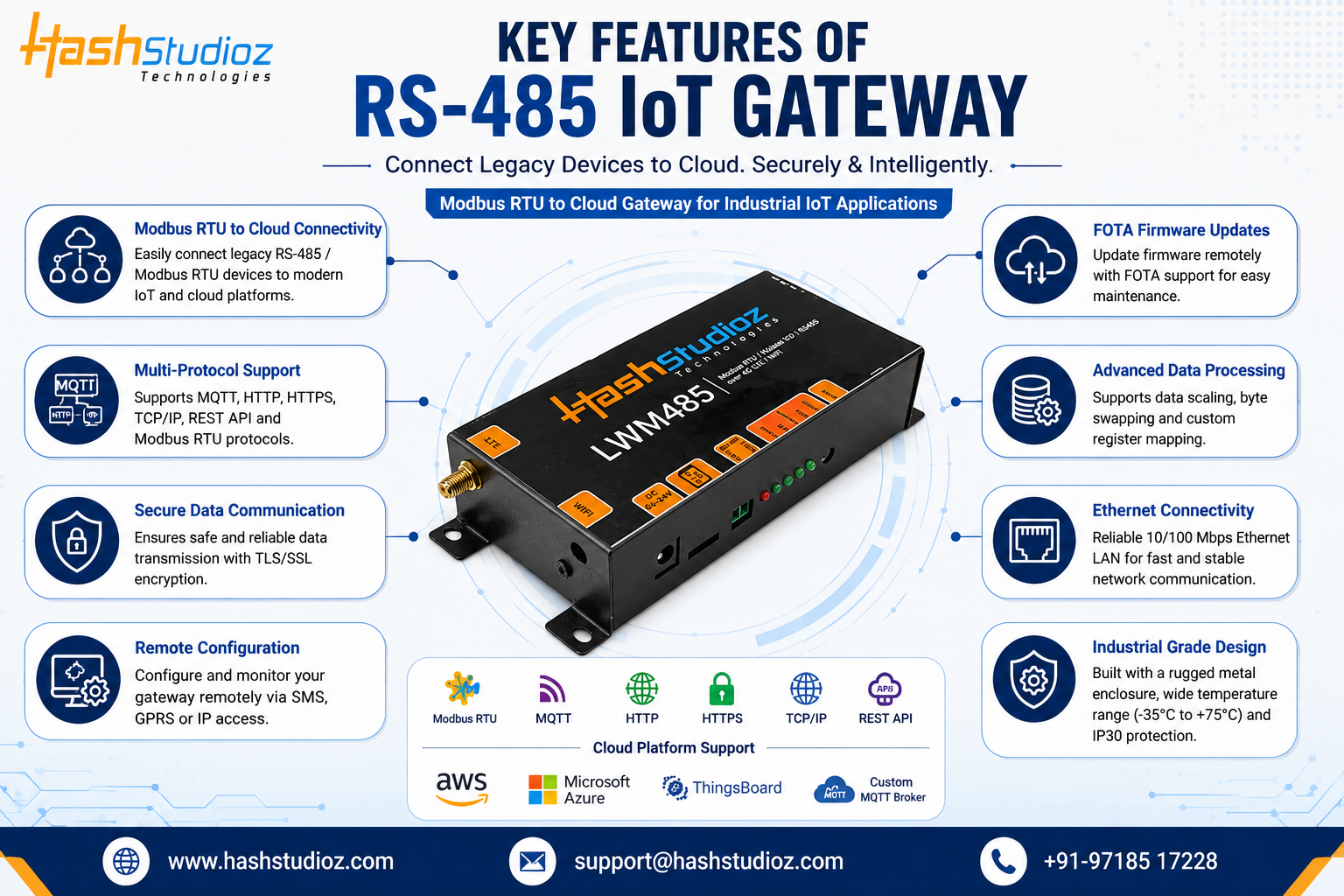
The RS-485 IoT Gateway from HashStudioz is designed to connect Modbus RTU-based industrial devices with modern communication protocols and cloud platforms. It supports protocols such as MQTT, TCP/IP, HTTP, HTTPS, and REST API, making it suitable for industrial automation, energy monitoring, remote equipment monitoring, and smart infrastructure applications.
What Is an RS-485 IoT Gateway?
An RS-485 IoT Gateway is a communication device that acts as a bridge between RS-485 equipment and modern network or cloud systems.
Many industrial devices generate useful data, but that data may remain inside the local machine or control network because the equipment communicates using Modbus RTU over RS-485. An IoT gateway receives this data, processes it when required, and transfers it through network protocols that can be used by IoT platforms and applications.
For example, a Modbus energy meter can send voltage, current, power, and energy readings through RS-485. The gateway can collect this information and send it to an IoT platform using MQTT or another supported protocol. This allows users to monitor equipment remotely without replacing the original meter.
Why Is RS-485 Still Important in Industrial IoT?
RS-485 remains widely used in industrial automation because it is designed for reliable communication in electrically noisy environments and can support communication over relatively long cable distances.
It is commonly found in:
- Energy meters
- Temperature and humidity controllers
- PLC systems
- HVAC equipment
- Industrial sensors
- Motor controllers
- Solar equipment
- Pump controllers
- Building automation systems
- Industrial machines
The main advantage is that businesses can continue using their existing equipment while adding modern connectivity around it.
This makes an RS-485 IoT Gateway a practical option for industrial IoT modernization.
How Does an RS-485 IoT Gateway Work?
The basic operation is straightforward.
An RS-485 device sends data using the Modbus RTU protocol. The gateway receives the serial data through its RS-485 interface and converts or forwards the information according to the configured communication method.
The data can then be transmitted to an application, server, or cloud platform using supported protocols such as MQTT, HTTP/HTTPS, TCP/IP, or REST API.
A typical setup looks like this:
RS-485 Device → RS-485 IoT Gateway → Ethernet/Network → IoT Platform → Dashboard/Application
This architecture allows companies to collect information from existing machines and make that information available for monitoring and analysis.
Key Features of RS-485 IoT Gateway
1. Modbus RTU to Cloud Connectivity
One of the main purposes of the gateway is to connect traditional Modbus RTU devices with modern IoT platforms.
It can work with cloud environments such as AWS IoT, Azure IoT, ThingsBoard, and custom MQTT brokers. This makes it easier to integrate existing industrial equipment into a larger IoT infrastructure.
2. Multi-Protocol Support
Industrial systems do not always use a single communication protocol. The gateway supports multiple protocols, including:
- Modbus RTU
- MQTT
- TCP/IP
- HTTP
- HTTPS
- REST API
This flexibility makes it easier to connect the gateway with different software applications, servers, and IoT platforms.
3. Secure Data Communication
Industrial data can contain important operational information, so secure communication is an important consideration.
The gateway supports TLS/SSL encryption for secure data transmission. This helps protect information while it moves between industrial devices, networks, and cloud systems.
4. Remote Configuration
Industrial equipment is often installed in locations where regular physical access is difficult.
The RS-485 IoT Gateway supports remote configuration and monitoring through SMS, GPRS, or IP-based access, depending on the deployment. This can reduce the need for technicians to travel to the installation site for every configuration change.
5. FOTA Firmware Updates
Firmware updates are an important part of maintaining connected industrial equipment.
The gateway supports FOTA, or Firmware Over-The-Air updates. This allows firmware to be updated remotely without requiring technicians to physically access every installed gateway.
For large deployments, this can make device maintenance much easier.
6. Advanced Data Processing
Different industrial devices may store data in different formats. The gateway includes data-processing capabilities such as byte swapping, scaling, and custom register mapping.
These features can help prepare Modbus data before it is transferred to an IoT application or cloud platform.
7. Ethernet Connectivity
The gateway provides a 10/100 Mbps Ethernet LAN interface for network communication.
This allows RS-485 devices to become part of an Ethernet-based industrial network without requiring the original equipment to have a built-in Ethernet port.
Benefits of Using an RS-485 IoT Gateway
Extend the Life of Existing Equipment
One of the biggest advantages is that companies do not necessarily need to replace older RS-485 devices.
The gateway provides a modern connectivity layer around existing equipment, helping businesses move toward IoT without completely rebuilding their infrastructure.
Enable Remote Monitoring
Once industrial data is available through a network or cloud platform, operators can monitor equipment remotely.
This can be useful for checking machine parameters, energy consumption, environmental conditions, alarms, and other operational information.
Reduce Maintenance Effort
Remote configuration and FOTA support can reduce the number of physical visits required for device management.
This is particularly useful when gateways are installed across multiple factories, buildings, solar sites, water systems, or remote industrial locations.
Improve Operational Visibility
Connecting machines to an IoT platform makes it easier to collect and analyze operational data.
Instead of checking individual machines manually, organizations can create centralized dashboards and monitor information from multiple devices.
Support Industrial Digital Transformation
Many companies want to implement Industrial IoT but already have large amounts of legacy equipment.
An RS-485 IoT Gateway provides a practical bridge between traditional industrial communication and modern IoT infrastructure.
Applications of RS-485 IoT Gateway
Industrial Automation
Factories can use the gateway to connect PLCs, meters, controllers, and other Modbus devices with monitoring systems.
Collected data can be used for equipment monitoring, production analysis, and operational management.
Energy Monitoring
Energy meters commonly use Modbus RTU over RS-485. An IoT gateway can collect meter readings and transfer them to a centralized monitoring platform.
Businesses can use this information to track energy consumption and identify unusual usage patterns.
Solar and Renewable Energy
Solar plants and other renewable-energy installations often include multiple monitoring devices.
An RS-485 gateway can help connect compatible field devices with a remote monitoring system, allowing operators to access important operating information without being physically present at the site.
Smart Infrastructure
Buildings and infrastructure systems can use RS-485 devices for monitoring HVAC equipment, meters, controllers, and sensors.
Connecting these devices to an IoT platform can provide centralized visibility and support smarter facility management.
Remote Equipment Monitoring
Industrial equipment located at remote sites can be monitored through network-connected gateways.
This can be useful for water systems, pumps, generators, energy equipment, and other assets where regular physical inspection may be inconvenient.
RS-485 IoT Gateway vs. Replacing Legacy Equipment
Replacing an entire fleet of industrial devices simply to add IoT connectivity can be expensive.
An RS-485 IoT Gateway provides another approach.
Instead of removing existing equipment, organizations can:
Keep existing RS-485 equipment → Add IoT Gateway → Connect to network/cloud → Start collecting data
This approach can reduce infrastructure changes and make IoT adoption more practical for businesses with large numbers of legacy devices.
Why Choose an Industrial RS-485 IoT Gateway?
An industrial IoT deployment needs more than simple serial-to-network conversion. The gateway should be able to communicate with existing devices, work with modern protocols, provide secure data transmission, and support remote device management.
The HashStudioz RS-485 IoT Gateway combines these capabilities in one device. Its support for Modbus RTU, multiple network protocols, cloud platforms, secure communication, remote configuration, FOTA, and data processing makes it suitable for organizations looking to modernize existing industrial systems.
Conclusion
An RS-485 IoT Gateway provides that connection between traditional Modbus RTU devices and today’s IoT networks and cloud platforms. It can help businesses collect real-time equipment data, enable remote monitoring, improve visibility, and simplify the transition toward connected industrial operations.
For applications involving industrial automation, energy monitoring, remote assets, smart infrastructure, and legacy device integration, an RS-485 IoT Gateway can be an important part of a practical IoT architecture.
If you are planning to connect existing RS-485 or Modbus RTU equipment to a cloud or IoT platform, the HashStudioz RS-485 IoT Gateway is designed to provide a reliable and flexible connectivity solution.