Europe Medical Ceramics Market: 2025–2034 Growth Projections
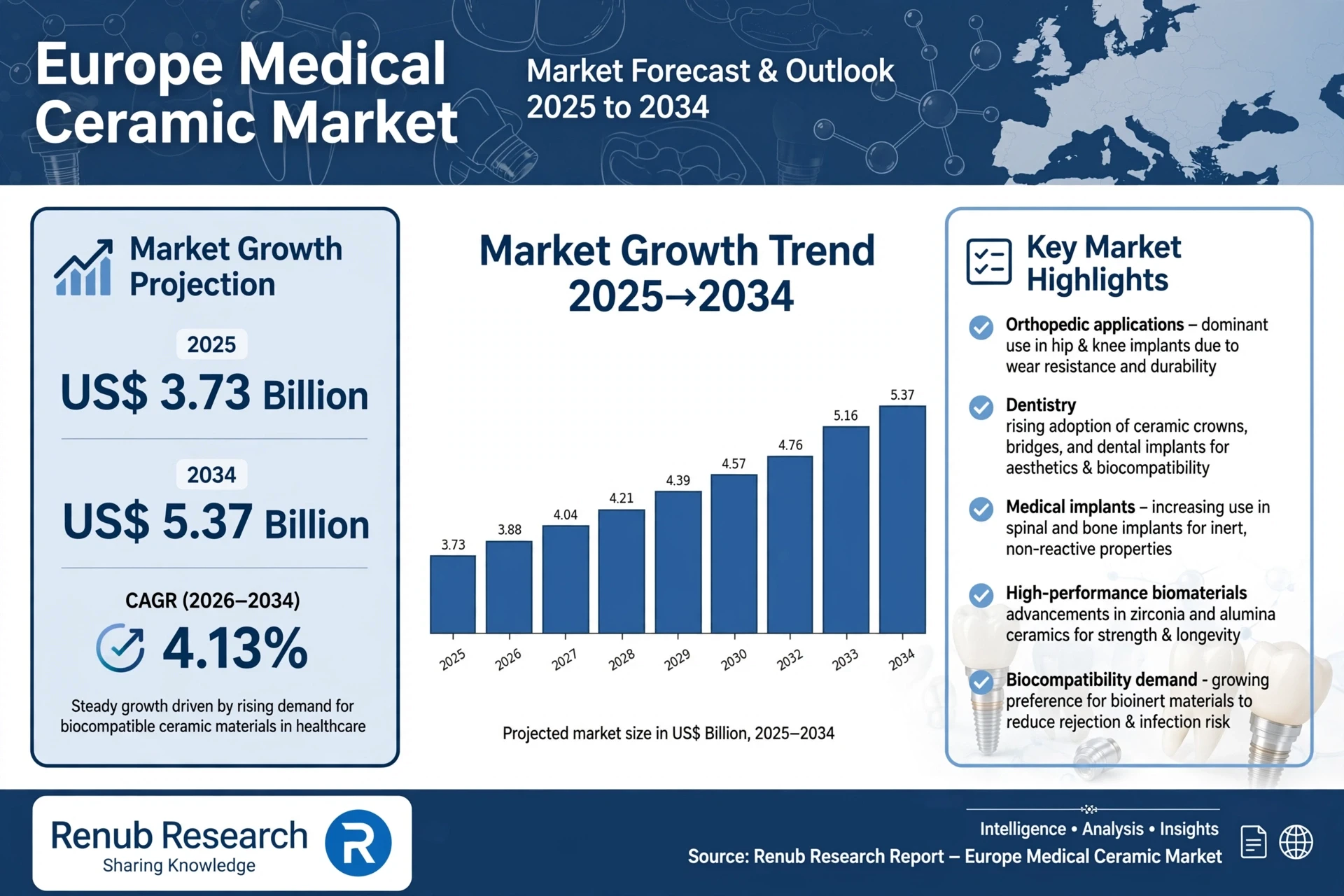
The European medical ceramics market is entering a phase of sustained evolution, driven by an aging population, the rising prevalence of musculoskeletal disorders, and breakthroughs in bio-printing and material science. Valued at US$ 3.73 billion in 2025, the sector is projected to reach US$ 5.37 billion by 2034, expanding at a CAGR of 4,13%.
This growth is underpinned by the clinical shift toward high-performance biomaterials—specifically zirconia, alumina, hydroxyapatite, and bioactive glasses—which offer superior wear resistance and biological inertness compared to traditional metal alloys.
Request Sample Report: https://www.renub.com/request-sample-page.php?gturl=europe-medical-ceramics-market-p.php
Sector Analysis: Why Ceramics are Redefining Implants
Medical ceramics are non-metallic, inorganic materials engineered for long-term integration within the human body. Unlike metallic implants, which can release ions over time—potentially causing inflammation or tissue rejection—ceramics are bio-inert.
Key Clinical Advantages
- Wear Resistance: Ceramics exhibit minimal surface friction, making them ideal for articulating surfaces in hip and knee joint replacements.
- Chemical Stability: They resist corrosion in the body’s saline environment, drastically extending the functional lifespan of implants.
- Osseointegration: Bioactive and bioresorbable variants actively promote bone growth, creating a mechanical bond between the implant and host tissue.
Market Drivers and Technological Catalysts
The European market is uniquely positioned due to rigorous regulatory standards (MDR) that favor durable, failure-resistant materials.
1. Escalating Demand for Orthopedics & Dentistry
With approximately one-third of the UK population suffering from musculoskeletal conditions, the demand for joint revisions is constant. Furthermore, the European dental market is transitioning toward "metal-free" restorations. Zirconia and porcelain crowns are now the clinical standard due to their ability to mimic the translucency and hardness of natural tooth enamel.
2. Evolution of Processing (CAD/CAM & Bio-printing)
Advancements in Computer-Aided Design and Manufacturing (CAD/CAM) have enabled patient-specific customization. A landmark development occurred in May 2025, when Auxilium initiated clinical trials for the NeuroSpan Bridge—the world’s first nerve regeneration implant space-bioprinted on the International Space Station (ISS). This milestone signals the beginning of an era where complex, micro-structured ceramics can guide biological tissue repair.
3. Shift Toward "Active" Bioceramics
Healthcare providers are moving away from passive implants toward bioresorbable ceramics. These materials provide temporary mechanical support and are gradually replaced by natural bone, eliminating the need for secondary "removal" surgeries.
Regional Landscape
- Germany: The largest market in Europe. It benefits from a mature medical manufacturing base and high reimbursement rates for robotic-assisted surgeries (e.g., Johnson & Johnson’s VELYS system).
- France: Currently focusing on the integration of Artificial Intelligence in dental diagnostics (e.g., Allisone Technologies’ acquisition of Spotimplant) to optimize the selection and placement of ceramic implants.
- United Kingdom: Driven by evidence-based healthcare, the UK is prioritizing "revision-free" longevity, favoring premium ceramic-on-ceramic hip bearing surfaces.
- Russia: While adoption lags behind Western Europe, infrastructure modernization efforts are steadily increasing the demand for robust joint replacement solutions.
Key Challenges
- Production Costs: The refinement of high-purity medical ceramics requires energy-intensive sintering and specialized technical oversight, keeping entry-level prices higher than traditional stainless steel or titanium options.
- Structural Brittleness: Ceramics are inherently prone to fracture under high-impact, point-load conditions. Engineers are currently addressing this by developing Zirconia-Toughened Alumina (ZTA) composites, which combine the hardness of alumina with the fracture toughness of zirconia.
Recent Strategic Rollouts (2023–2025)
Innovation in the European market has been aggressive, with manufacturers focusing on "smart" and "antibiotic-eluting" materials:
DateCompanyInnovationDec 2025ZentivaLaunched EMA-approved monoclonal bone biosimilar for concurrent use with ceramic grafts.Sept 2025Enovis & MathysInitiated ZTA ceramic project for low-friction hip joint heads.May 2025AuxiliumClinical trials for space-bioprinted NeuroSpan nerve bridge.2024–25CeramTecScaled distribution of CeramType monolithic metal-free zirconia implants.June 2023BONESUPPORTOptimized CERAMENT G, an injectable ceramic that elutes antibiotics to prevent infection.
Market Segmentation Summary
- By Material: Bioinert (dominant in orthopedics), Bioactive (rising in bone grafts), and Bioresorbable (growing in regenerative medicine).
- By Application:
- Orthopedic: Hip/Knee replacements, spinal fusion cages.
- Dental: Crowns, veneers, and implant abutments.
- Plastic Surgery: Facial reconstruction and bone shaping.
- Surgical Instruments: High-precision, non-magnetic ceramic scalpel blades and components.
Frequently Asked Questions (FAQs)
1. Why are ceramics preferred over titanium for orthopedic implants? Ceramics are preferred because they are bio-inert and produce negligible wear debris. Unlike titanium, which can release metal ions into the bloodstream causing potential sensitivity, high-purity ceramics are hypoallergenic and provide superior friction reduction in joint movement.
2. What is the difference between bioactive and bioresorbable ceramics? Bioactive ceramics (like bioactive glass) bond directly to bone tissue to stimulate regeneration. Bioresorbable ceramics (like calcium phosphates) are designed to slowly dissolve as the body replaces them with natural bone tissue, eliminating the need for permanent foreign implants.
3. Why is the "brittleness" of ceramics a concern? Ceramics are hard but prone to "catastrophic failure" (cracking) under sudden, extreme mechanical shock. Manufacturers mitigate this by creating composite materials like Zirconia-Toughened Alumina (ZTA), which significantly improve fracture toughness.
4. How is AI impacting the medical ceramics market? AI is being used to identify optimal implant sizing and positioning (e.g., in digital dentistry) and to assist in robotic-assisted surgeries, ensuring that ceramic implants are placed with sub-millimeter precision to prevent long-term loosening.
5. Which European country leads the market? Germany is the market leader due to its advanced engineering sector, high adoption of robotic surgical systems, and robust insurance/reimbursement frameworks for orthopedic procedures.
6. What role does 3D printing play in this sector? 3D printing (additive manufacturing) allows for the creation of patient-specific, porous ceramic scaffolds that mimic the internal architecture of human bone, drastically improving the success rate of bone grafts.
7. Are ceramic dental implants better than metal ones? For patients with metal sensitivities or those concerned about aesthetics (as metal implants can show through thin gum tissue), ceramic implants are considered superior. They also exhibit lower plaque accumulation, promoting better long-term gum health.
