India Video Surveillance Market: Growth, Trends, and Outlook 2034
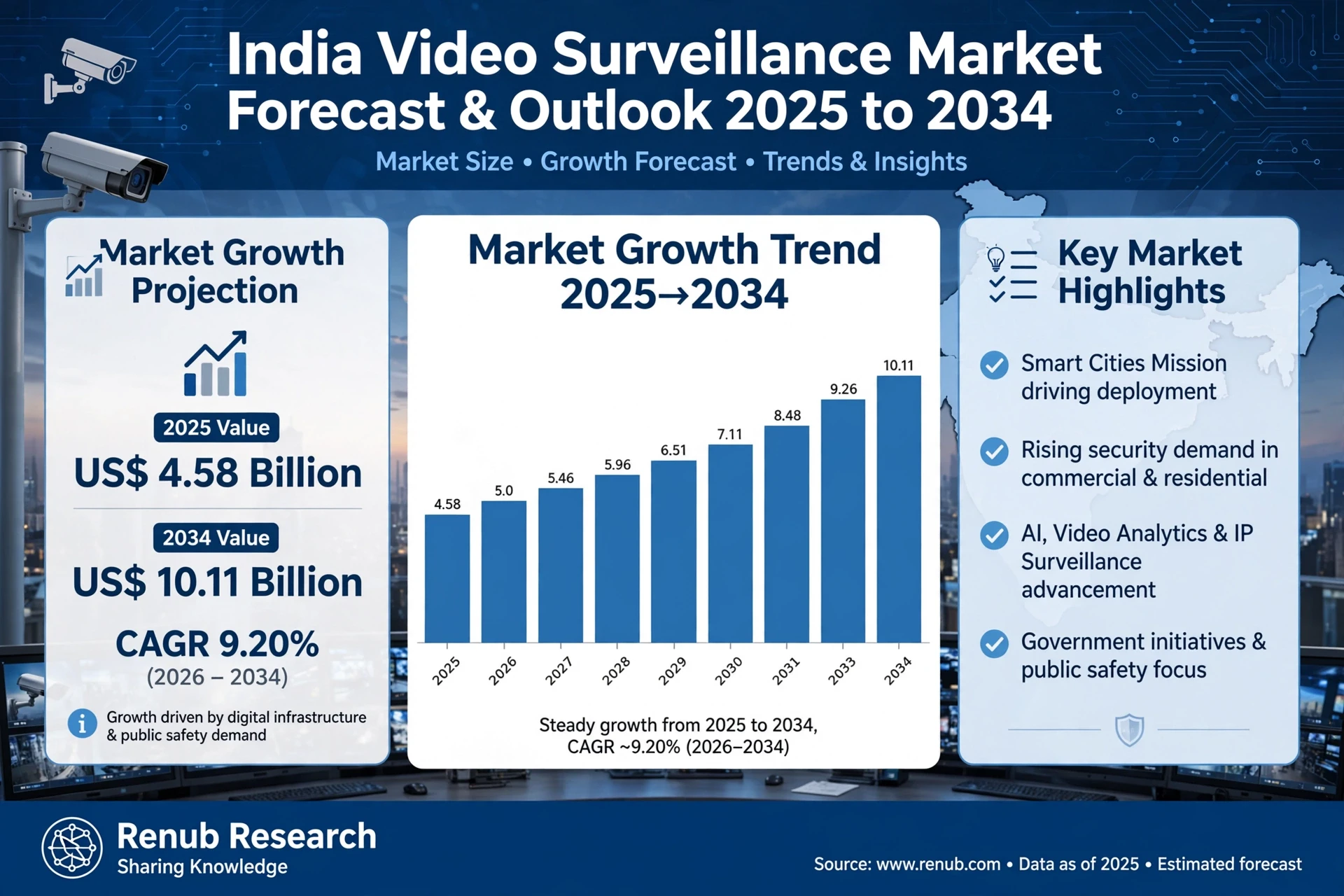
India is experiencing a massive digital and physical security transformation, with the country’s video surveillance landscape expanding at an unprecedented rate. According to Renub Research, the India video surveillance market is projected to grow from US$ 4.58 Billion in 2025 to approximately US$ 10.11 Billion by 2034, registering a robust Compound Annual Growth Rate (CAGR) of 9,20% during the 2026–2034 forecast period.
Driven by smart city initiatives, rising urbanization, and advancements in artificial intelligence (AI), video surveillance has evolved from a passive recording tool into an intelligent, proactive security and management ecosystem.
Understanding Video Surveillance and Its Evolution in India
Video surveillance involves capturing, recording, and analyzing activities across public and private domains using cameras, network hardware, and sophisticated monitoring software. While traditional setups relied on basic analog Closed-Circuit Television (CCTV) setups, modern deployments leverage Internet Protocol (IP) cameras, network video recorders (NVRs), cloud storage, and AI-enabled video analytics.
Request Sample Report: https://www.renub.com/request-sample-page.php?gturl=india-video-surveillance-market-p.php
From Passive Monitoring to Proactive Intelligence
Today’s systems do much more than record footage. Equipped with features such as facial recognition, Automatic Number Plate Recognition (ANPR), behavioral anomaly detection, and real-time crowd management, surveillance platforms empower law enforcement and commercial enterprises to intercept security threats before they escalate.
The Scale of Adoption: The Delhi CCTV Project Example
Urban centers across India are setting global benchmarks for public monitoring density. For instance, the Delhi CCTV Project—an initiative by the state government—installed over 2.5 lakh cameras by early 2024, with totals continuing to scale alongside thousands of additional ANPR and facial recognition lenses deployed by the Delhi Police. Alongside cities like Hyderabad, Chennai, and Mumbai, India’s major urban hubs rank among the most intensely monitored metropolitan areas in the world outside of China.
Key Growth Pillars
1. Government-Led Smart Cities and Public Safety
Public sector investments form the bedrock of the Indian surveillance market. Through flagship initiatives like the Smart Cities Mission and various digital policing frameworks, federal and state agencies are deploying integrated command-and-control centers. Central police organizations, state police forces, and specialized agencies (such as the National Security Guard and the Special Protection Group) increasingly rely on high-definition, AI-driven surveillance to protect critical infrastructure, highways, transport networks, and public squares.
2. Commercial and Residential Security Awareness
Growing concerns regarding theft, asset protection, and workplace safety are driving widespread adoption across the private sector. Retail chains, banking institutions, corporate offices, healthcare facilities, and manufacturing plants are upgrading their security infrastructures. Concurrently, residential demand is surging; gated communities, apartment complexes, and independent homeowners are adopting cloud-connected smart cameras for round-the-clock remote monitoring via smartphones.
3. Technological Leaps: AI, IoT, and IP Migration
The market is benefiting from a rapid technological migration from legacy analog setups to advanced IP-based and hybrid systems. Strategic industry partnerships—such as CP PLUS collaborating with Qualcomm Technologies in late 2025 to introduce edge-AI processors and intelligent platforms—are embedding high-end computing right into the camera hardware. Simultaneously, major exhibitions like IFSEC India continue to showcase hundreds of global and domestic brands pushing the envelope in IoT security integration.
Market Challenges and Impediments
Privacy Concerns and Regulatory Scrutiny
The rapid expansion of public monitoring and biometric data collection (such as facial recognition) has sparked intense conversations regarding civil liberties and data protection. Navigating evolving data privacy regulations while maintaining effective law enforcement remains a delicate balancing act for policymakers and industry stakeholders.
High Implementation and Infrastructure Costs
Despite falling hardware costs, comprehensive enterprise-grade and municipal deployments require significant capital expenditure. Maintenance expenses, cloud storage fees, cybersecurity measures, and the need for high-speed internet connectivity and reliable power supplies continue to pose challenges, particularly for small and medium-sized enterprises (SMEs) and budget-constrained public entities.
Regional Market Dynamics: Top State Hubs
- Maharashtra: Anchored by Mumbai, Pune, and Nagpur, Maharashtra is a commercial powerhouse leading the country in integrated command-and-control infrastructure, smart transit surveillance, and industrial security deployments.
- Karnataka: Driven by Bengaluru’s massive technology ecosystem, Karnataka sees massive demand for AI-enabled surveillance across corporate tech parks, data centers, and urban traffic management initiatives.
- Tamil Nadu: A major hub for automotive, electronics, and textile manufacturing, Tamil Nadu utilizes advanced video analytics to secure sprawling production facilities and enhance municipal safety in Chennai and Coimbatore.
- Uttar Pradesh: Large-scale infrastructure development across Noida, Lucknow, Ghaziabad, and Varanasi has accelerated the deployment of extensive CCTV grids and public safety monitoring frameworks.
Conclusion and Future Outlook (2026–2034)
The Indian video surveillance market’s journey toward a US$ 10.11 Billion valuation by 2034 highlights the country’s resolute focus on digital transformation and national security. As hardware becomes more affordable, 5G and fiber-optic networks expand deeper into semi-urban areas, and AI analytics become standard, video surveillance will remain an indispensable pillar of modern Indian infrastructure, urban planning, and enterprise management.
Frequently Asked Questions (FAQs)
1. What is the projected market size of the India video surveillance market by 2034? The market is projected to reach approximately US$ 10.11 Billion by 2034, growing from US$ 4.58 Billion in 2025.
2. What CAGR is the market expected to register during 2026–2034? The market is anticipated to record a compound annual growth rate (CAGR) of 9,20% over the forecast period.
3. What are the primary drivers of the video surveillance market in India? Key drivers include government-led smart city initiatives, rapid urbanization, rising security awareness across residential and commercial sectors, and technological advancements in AI and IP-based surveillance.
4. Why is IP surveillance gaining preference over analog systems? IP surveillance offers superior video resolution, enhanced scalability, seamless network integration, and advanced remote-monitoring capabilities compared to traditional analog setups.
5. How are AI and video analytics transforming modern security cameras? AI enables cameras to move beyond passive recording into proactive intelligence, providing automated features like facial recognition, Automatic Number Plate Recognition (ANPR), behavioral anomaly detection, and real-time alerts.
6. Which Indian states are leading the adoption of video surveillance solutions? States with high levels of industrialization and urbanization—such as Maharashtra, Karnataka, Tamil Nadu, and Uttar Pradesh—are leading the market in deployment scale.
7. What are the main challenges facing the Indian video surveillance market? Primary challenges include data privacy and regulatory compliance concerns regarding public monitoring, alongside high initial capital implementation costs and infrastructure hurdles in semi-urban areas.
