What is the Assisted Reproductive Technology Market Size and Forecast?
As modern lifestyles evolve, an increasing number of individuals and couples face challenges when starting a family. This reality has fueled rapid expansion across the global healthcare sector, specifically within advanced reproductive care.
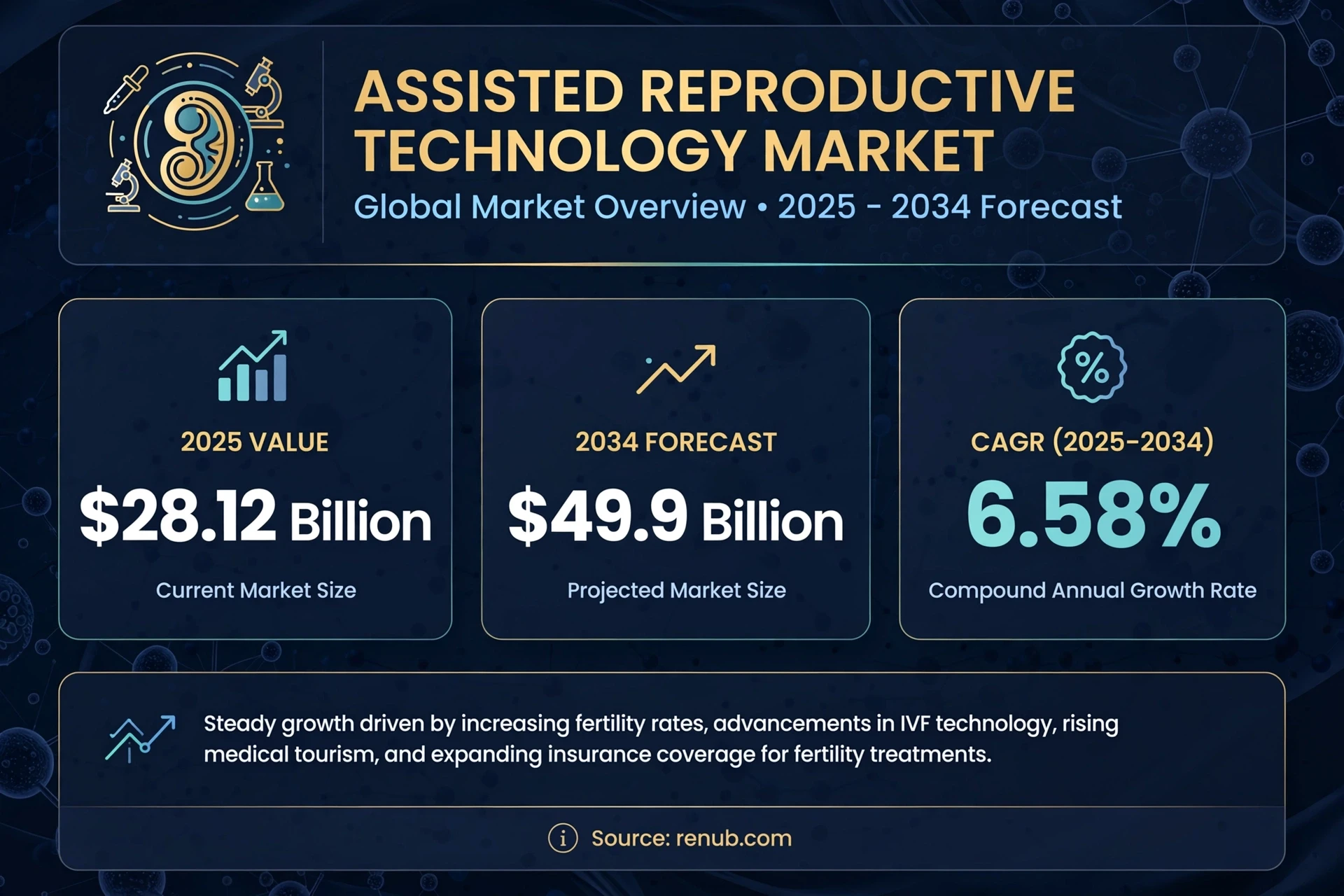
According to market research by Renub Research, the Assisted Reproductive Technology Market Size is projected to grow substantially from US$ 28.12 Billion in 2025 to US$ 49.9 Billion by 2034, expanding at a Compound Annual Growth Rate (CAGR) of 6.58% from 2026 to 2034.
This steady market surge is heavily supported by rising global infertility rates, technological innovations in reproductive medicine, and growing social acceptance of fertility treatments worldwide.
Download Free Sample Report: https://www.renub.com/request-sample-page.php?gturl=assisted-reproductive-technology-market-p.php
What are the Primary Drivers and Challenges in the ART Market?
The global adoption of assisted reproductive technologies is shaped by several key catalysts alongside complex operational and ethical hurdles.
Growth Drivers
- Rising Global Infertility Rates: According to World Health Organization (WHO) reports, roughly 17,5% of the adult population globally (about 1 in 6 people) experience infertility. Factors like high stress, environmental changes, and hormonal disorders contribute significantly.
- Delayed Parenthood: Many individuals now postpone having children to focus on education, career, or financial stability. Because natural fertility declines with age, older prospective parents frequently turn to clinical fertility interventions.
- Technological Innovations: Breakthroughs such as Preimplantation Genetic Testing (PGT), improved embryo culture media, and advanced cryopreservation have drastically raised success rates and patient confidence.
- Expanded Awareness and Specialized Clinics: Public health campaigns are successfully breaking down historical social taboos, encouraging patients to seek timely interventions at specialized fertility centers and hospital departments.
Market Challenges
- High Financial Costs: Sophisticated procedures like In Vitro Fertilization (IVF) require advanced laboratory equipment, specialized medical professionals, and multiple cycles, making treatments expensive. In many regions, insurance coverage remains limited, posing a barrier in low- and middle-income settings.
- Ethical, Legal, and Social Concerns: Decision-making regarding embryo creation, storage, and selection brings complex ethical considerations. Furthermore, differing national legal frameworks and lingering social stigmas can restrict access in certain communities.
Key Market Segments and Regional Landscape
The global market is categorized by procedure type, end user, and geographic reach to address diverse clinical needs.
Market Segmentation Overview
- By Type: The market includes In-Vitro Fertilization (IVF) and Artificial Insemination (such as Intrauterine Insemination), alongside specialized diagnostic and preservation procedures.
- By End User: Services are heavily concentrated across dedicated Fertility Clinics and specialized hospital reproductive medicine departments, alongside other outpatient surgical centers.
- By Geography: Key regions spanning North America, Europe, Asia Pacific, Latin America, and the Middle East & Africa drive distinct market adoption rates. The United States features advanced technological ecosystems, while the United Kingdom benefits from a robust legal framework. Meanwhile, nations like India have emerged as prominent hubs due to lower treatment costs, and Saudi Arabia is scaling up state-of-the-art infrastructure.
Frequently Asked Questions
What is the projected market size of the Assisted Reproductive Technology market by 2034?
The market is forecasted to reach US$ 49.9 Billion by 2034, scaling up from US$ 28.12 Billion in 2025.
What is the expected CAGR of the ART market from 2026 to 2034?
The global market is expected to expand at a compound annual growth rate (CAGR) of 6,58% over the forecast period.
What are the primary factors driving the growth of assisted reproductive technologies?
Key growth drivers include rising global infertility rates, trends toward delayed parenthood, continuous technological upgrades in reproductive medicine, and growing public awareness.
Which procedure types dominate the assisted reproductive technology landscape?
In-Vitro Fertilization (IVF) and Artificial Insemination represent the core types of interventions driving clinical demand globally.
Why are fertility clinics and hospitals seeing an increase in patient volume?
Increased social openness, active reduction of historical taboos, and expanded access to specialized reproductive health centers have made patients much more willing to seek early medical assistance.
What are the main challenges faced by patients undergoing ART treatments?
High out-of-pocket treatment costs, lack of comprehensive insurance coverage in many countries, and complex ethical or legal regulations surrounding embryo handling are notable challenges.
Which key corporate entities operate within the competitive landscape?
Prominent market players offering technology, equipment, and clinical support include Thermo Fisher Scientific Inc., CooperSurgical, Inc., Fujifilm Holdings Corporation, Merck KGaA, and Progyny Inc., among others.
