Why Is Next Generation Sequencing Transforming Healthcare Globally?
The Rising Trajectory of the Next Generation Sequencing Market
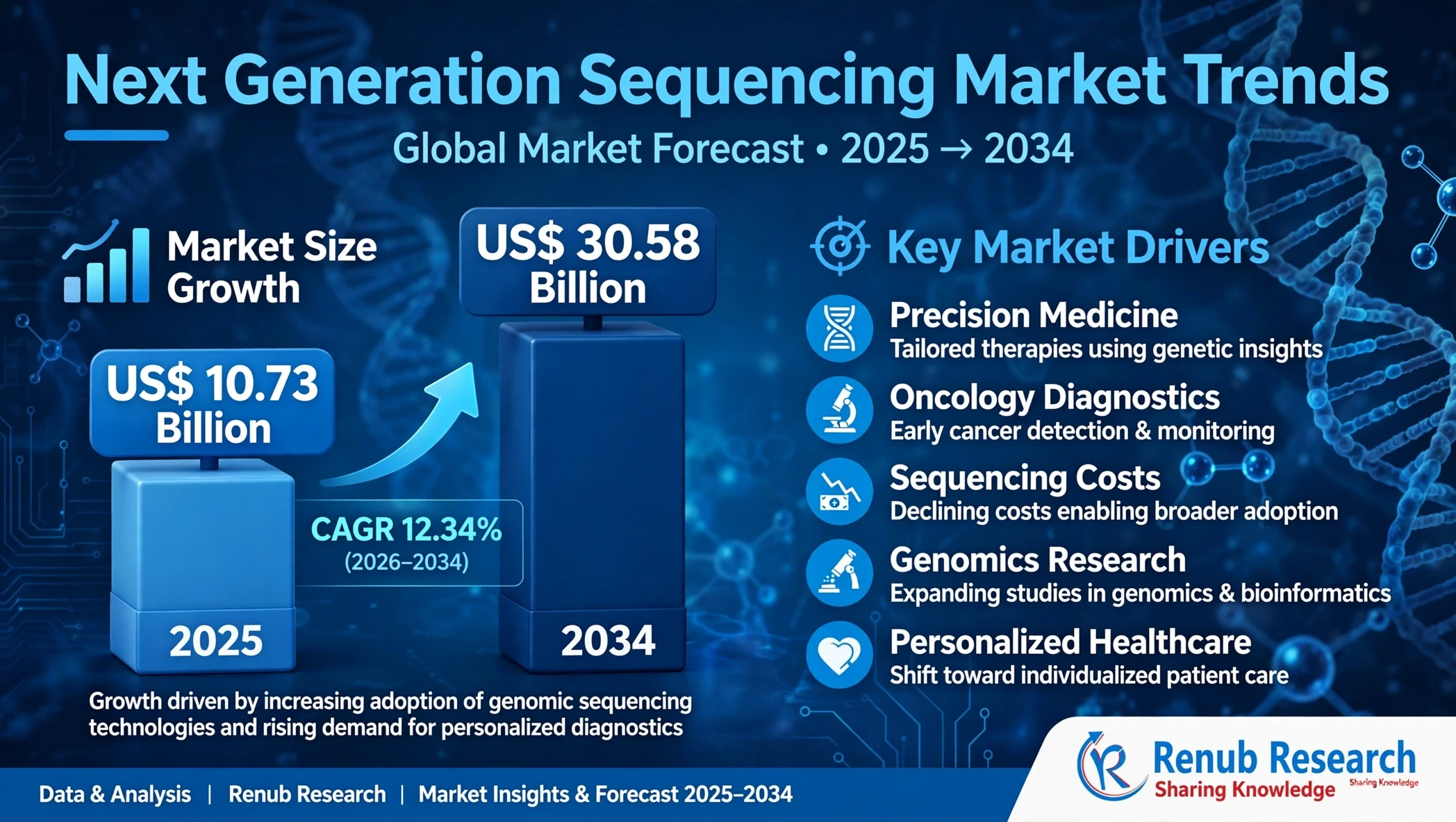
According to Renub Research, the Next Generation Sequencing (NGS) Market is projected to grow from US$ 10.73 Billion in 2025 to US$ 30.58 Billion by 2034, registering a Compound Annual Growth Rate (CAGR) of 12,34% during the forecast period 2026–2034.
The biotechnology landscape is undergoing a massive transformation powered by high-throughput genomics. Next-generation sequencing has evolved from an experimental academic tool into an indispensable clinical standard. As healthcare paradigms shift toward early disease interception and customized therapeutic interventions, high-density genomic profiling delivers unprecedented insights into the human genome.
Traditional Sanger sequencing established the foundation of modern genetics, but its low-throughput, labor-intensive workflows cannot match modern molecular diagnostic demands. NGS bypasses these bottlenecks through massive parallel processing, analyzing millions to billions of DNA fragments simultaneously. This fundamental breakthrough allows researchers and clinicians to decode entire human genomes, capture exomes, and analyze focused multi-gene panels within days.
Global growth is propelled by expanding applications in precision oncology, rare inherited disorder diagnostics, agricultural biotechnology, and pathogen surveillance. Simultaneously, steep cost reductions per megabase sequenced, combined with artificial intelligence algorithms and automated sample preparation workflows, have democratized genomic tools. Research institutions, commercial diagnostic labs, biopharma developers, and tertiary hospital networks worldwide are actively embedding sequencing platforms into daily clinical workflows.
Download Free Sample Report: https://www.renub.com/request-sample-page.php?gturl=next-generation-sequencing-market-p.php
Core Growth Drivers Accelerating Global Adoption
Precision Oncology and Biomarker Discovery
Personalized cancer therapy represents the largest clinical catalyst for NGS. Conventional broad-spectrum chemotherapy is rapidly being replaced by targeted therapies tailored to unique molecular signatures. By analyzing tumor biopsies and cell-free circulating tumor DNA (liquid biopsies), NGS identifies actionable somatic mutations, copy number variations, and structural rearrangements. These findings guide oncologists in selecting biomarker-matched therapies and tracking minimal residual disease (MRD) with extreme precision.
Declining Sequencing Costs and Workflow Automation
Over the last two decades, per-genome sequencing costs dropped from roughly US$ 100 million in 2001 to well below US$ 1,000 today. The development of high-density flow cells, automated library preparation systems, and isothermal amplification chemistries has lowered consumable and labor overhead. Modern platforms streamline complex protocols, enabling routine molecular testing without requiring dedicated specialized bioinformatics departments for everyday runs.
Population Genomics and Public Health Initiatives
Governments worldwide recognize genomics as a cornerstone of preventive healthcare. Large-scale national sequencing projects catalog genetic diversity, pinpoint rare disease mechanisms, and improve population-level health risk stratification. These programs generate vast longitudinal datasets that fuel novel drug target discovery and accelerate personalized medicine deployment across health systems.
Key Highlights: European Union Genomic Initiatives
Genomic policy and research funding across Europe highlight the growing institutional commitment to precision medicine. Public investments from EU Cohesion Fund beneficiaries and Non-EU Cohesion Fund beneficiaries demonstrate marked growth over recent decades:
- 2000–2010: Foundational growth period recording 3 genomic initiatives funded by EU Cohesion Fund beneficiaries and 5 initiatives funded by Non-EU Cohesion Fund beneficiaries.
- 2010–2020: Peak expansion decade capturing 18 initiatives from EU Cohesion Fund beneficiaries alongside 19 initiatives from Non-EU Cohesion Fund beneficiaries.
- 2020–2024: Sustained momentum with 9 EU Cohesion Fund initiatives and 5 Non-EU Cohesion Fund initiatives launched, with the vast majority remaining actively operational.
Overall, European genomic activity experienced a massive acceleration after 2010, transitioning genomics from exploratory academic research into institutionalized healthcare and life sciences infrastructure.
Industry Challenges: Cost and Data Complexity
Despite impressive commercial progress, the sequencing ecosystem faces several operational hurdles:
High Capital Expenditure and Analytical Complexity
While per-sample consumable costs have declined, modern high-throughput sequencing instruments still require substantial upfront capital investments running into hundreds of thousands of dollars. In addition to hardware, laboratories must invest in auxiliary compute infrastructure, automated liquid handlers, and petabyte-scale secure cloud storage. A single whole-genome run generates massive raw FASTQ datasets requiring complex secondary and tertiary bioinformatics pipelines. The global shortage of trained bioinformaticians frequently creates diagnostic bottlenecks, especially across emerging healthcare markets.
Regulatory Compliance and Data Privacy
Genomic data constitutes uniquely identifiable, permanent personal information. Compliance with strict data protection frameworks such as GDPR in Europe and HIPAA in the United States requires advanced encryption, secure access controls, and transparent patient consent protocols. Furthermore, cross-border data transfer restrictions and differing regulatory approval pathways for in-vitro diagnostic (IVD) sequencing assays complicate multi-center international clinical trials.
Key Market Segments and Technological Advancements
Next Generation Sequencing LAMP Technologies
Loop-Mediated Isothermal Amplification (LAMP) has emerged as an efficient sample preparation and amplification method. By amplifying target nucleic acids at a constant temperature without thermocycling, LAMP compresses preparation times to under an hour. When coupled upstream of NGS pipelines, LAMP-based methods accelerate pathogen identification, environmental testing, and point-of-care infectious disease diagnostics.
Clinical Diagnostics
Clinical diagnostics represents the most lucrative application segment. NGS panels now routinely serve as first-line tests for neonatal screening, hereditary cancer risks, cardiovascular risk profiling, and complex pediatric neurodevelopmental syndromes. With over 7,000 known rare diseases—most having a distinct genetic origin—NGS shortens diagnostic odysseys from years to days.
±----------------------------------------------------------------------------+
| NGS ECOSYSTEM BREAKDOWN |
±-----------------------------------±---------------------------------------+
| Technology Pathways | Clinical Applications |
| * Sequencing by Synthesis (SBS) | * Precision Oncology & Liquid Biopsy |
| * Nanopore & Long-Read Systems | * Rare & Inherited Disease Panels |
| * Ion Semiconductor Sequencing | * Non-Invasive Prenatal Testing (NIPT)|
| * Single-Molecule Real-Time (SMRT)| * Pathogen & Antimicrobial Tracking |
±-----------------------------------±---------------------------------------+
Sequencing-by-Synthesis (SBS)
Sequencing-by-Synthesis remains the dominant technological workhorse. By sequentially imaging fluorescently tagged reversible terminator nucleotides during strand extension, SBS platforms deliver superior data accuracy (>99.9%) and immense throughput. This technological dependability makes SBS the standard for large-scale clinical trials and whole-exome sequencing.
Real-Time Nanopore Long-Read Sequencing
Nanopore sequencing provides complementary capabilities by directly passing native DNA or RNA molecules through biological protein pores. By measuring changes in electrical current, platforms generate continuous reads exceeding 100,000 base pairs in real time. This capability enables precise structural variant resolution, repetitive element mapping, and direct epigenetic base modification detection without chemical bisulfite conversion.
Hospitals and Molecular Clinics
Tertiary hospitals and specialized clinics represent the fastest-growing end-user base. Medical centers are increasingly establishing in-house molecular diagnostic suites. Direct integration of sequencers with electronic health records (EHR) empowers multidisciplinary tumor boards to coordinate personalized therapies rapidly without relying on third-party referral laboratories.
Regional Market Dynamics
United States
The United States holds the leading market share, driven by strong clinical adoption, robust public research funding, and favorable private reimbursement pathways. High national cancer incidence and extensive precision oncology programs accelerate adoption across university health networks and commercial reference labs. Continuous innovation in AI-assisted variant classification and liquid biopsy assays cements US market dominance.
United Kingdom
The United Kingdom serves as a benchmark for public clinical genomics integration. Driven by large-scale population sequencing programs, the National Health Service (NHS) routinely offers whole-genome sequencing within routine care pathways for specific rare diseases and pediatric malignancies. Robust academic-industry partnerships make the UK a primary European genomic research hub.
India
India is experiencing rapid double-digit market growth, fueled by modernized diagnostic infrastructure, increased chronic disease awareness, and strong biotechnology investment. Given its demographic scale and high burden of inherited rare disorders, private pathology networks are deploying cost-effective targeted NGS panels, bringing advanced molecular diagnostics to broader patient populations.
Saudi Arabia
Under the strategic framework of Vision 2030, Saudi Arabia is allocating substantial investments toward modernizing its life sciences infrastructure. High rates of familial consanguinity have historically contributed to elevated rare disease incidences, prompting government investments in national premarital screening, neonatal genomic profiling, and dedicated molecular pathology laboratories.
Comprehensive Market Segmentation
By Product
- Instruments
- Reagents & Consumables
- Sequencing & Analytical Services
By Application
- Diagnostics (Oncology, Inherited Conditions, Infectious Pathogens)
- Agriculture and Animal Biotechnology
- Drug Discovery & Target Validation
- Personalized Medicine and Population Genetic Screening
- Other Life Science Applications
By Technology
- Sequencing by Synthesis (SBS)
- Ion Semiconductor Sequencing
- Single-Molecule Real-Time (SMRT) Sequencing
- Nanopore Sequencing
- Other Emerging Sequencing Modalities
By End-User
- Academic and Clinical Research Centers
- Pharmaceutical and Biotechnology Companies
- Hospitals, Diagnostic Clinics, and Pathology Laboratories
- Other Commercial Entities
By Geographic Region
- North America: United States, Canada
- Europe: France, Germany, Italy, Spain, United Kingdom, Belgium, Netherlands, Turkey
- Asia Pacific: China, Japan, India, South Korea, Thailand, Malaysia, Indonesia, Australia, New Zealand
- Latin America: Brazil, Mexico, Argentina
- Middle East & Africa: Saudi Arabia, United Arab Emirates, South Africa
Competitive Ecosystem and Leading Innovators
The global Next Generation Sequencing sector features established instrumentation manufacturers, assay chemistry innovators, and specialized bioinformatics providers:
- Illumina: Global market leader recognized for extensive SBS platforms, broad library preparation ecosystems, and high-throughput clinical instrumentation.
- Thermo Fisher Scientific: Developer of integrated semiconductor-based sequencing instruments, targeted AmpliSeq panels, and automated sample preparation solutions.
- Pacific Biosciences: Pioneer in long-read Single-Molecule Real-Time (SMRT) sequencing systems delivering high-fidelity genomic and structural variant resolution.
- QIAGEN N.V.: Provider of sample-to-insight solutions, specialized extraction chemistries, targeted gene panels, and comprehensive bioinformatics platforms.
- Roche: Diagnostic innovator offering molecular assay kits, targeted enrichment solutions, and personalized healthcare integration.
- Bio-Rad Laboratories, Inc.: Provider of droplet digital PCR systems, single-cell genomic preparation tools, and quality control standards.
- Takara Bio Inc.: Developer of specialized cDNA synthesis, low-input library preparation reagents, and RNA-seq molecular tools.
- Hamilton Company: Automated liquid handling workstation provider optimizing automated, high-throughput NGS library preparation workflows.
- Geneious: Bioinformatics software provider delivering graphical genomic analysis, sequence alignment, and molecular visualization suites.
- BioMérieux SA: Global in-vitro diagnostics leader utilizing advanced genomic and molecular typing solutions for clinical microbiology and pathogen surveillance.
Frequently Asked Questions
What is the projected market size of the NGS market by 2034?
According to Renub Research, the Next Generation Sequencing market is projected to reach US$ 30.58 Billion by 2034, up from US$ 10.73 Billion in 2025.
What is the expected CAGR for the Next Generation Sequencing industry?
The global NGS market is projected to expand at a Compound Annual Growth Rate (CAGR) of 12,34% between 2026 and 2034.
What makes NGS different from traditional Sanger sequencing?
Sanger sequencing processes a single DNA fragment per reaction, while NGS performs massively parallel sequencing of millions of fragments at once. This delivers dramatically higher throughput, faster turnaround times, and a significantly lower cost per base.
Why is precision oncology the primary driver of sequencing adoption?
Precision oncology relies on NGS to detect specific targetable genetic mutations, structural rearrangements, and tumor mutational burdens. This enables oncologists to match patients with targeted therapies and monitor treatment responses in real time.
What are the main differences between short-read and long-read sequencing?
Short-read sequencing (50–300 base pairs) offers high throughput, low per-base cost, and deep base accuracy. Long-read sequencing (>10,000 base pairs) spans complex structural variations, repetitive elements, and resolves full-length RNA isoforms directly.
Which product segment accounts for the largest recurring revenue in NGS?
Reagents and consumables account for the largest recurring revenue share. Every sequencing run requires fresh flow cells, amplification reagents, fluorescent labels, and library preparation chemistries.
What are the biggest operational challenges for laboratories adopting NGS?
Key challenges include high upfront capital costs for hardware, the need for scalable data storage, complex bioinformatics pipelines, stringent data privacy compliance, and a shortage of experienced genomic data analysts.
