Lost in the Middle: Whatever Happened to Class?
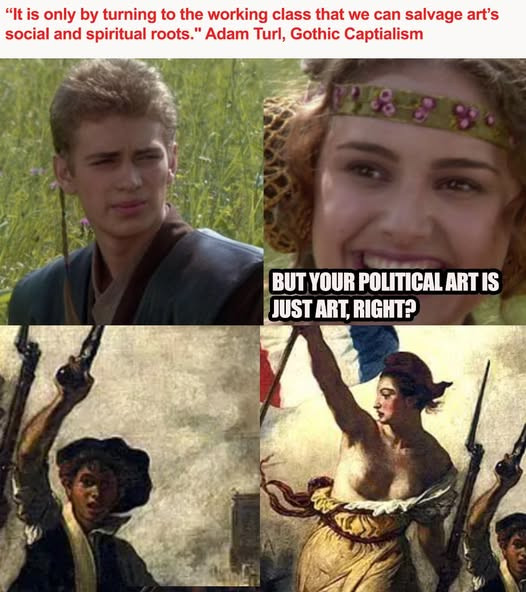
Beware those who insist on the C-Word (Class) :)
This article was rejected from ARTMargins’ Roundtable on “Class” because it transparently declares its co-thinking process with AI.
***
After receiving the request and the framework for this discussion “Roundtable on “Class”, I must admit I felt somewhat lost. It was initially clear to me why I had been approached for commentary on this topic—after all, as editor of the Chto Delat newspaper since 2003, I’ve often spoken and written on these questions, especially regarding the new class composition in light of changing modes of production.
At one time, themes such as post-Fordism, the multitude, precarity, and various new forms of labor and exploitation were central to our discussions. As a collective, we also maintained a critical stance on identity politics and what has since come to be known as “woke” position and mindset. However, class-based analysis began to vanish from the cultural and discursive forefront. This shift became particularly visible in the language of grant applications and institutional frameworks, which became almost entirely devoted to topics of gender, decoloniality, and racial or ethnic struggles. It’s important to note that we began to experience a deep disagreement with the growing agenda of radical rejection of modernist and European positions—an agenda adopted by many progressive institutions. Logically, this position also came to interpret Marxism as part of a toxic European legacy.
There are many analyses of the causes behind this significant intellectual and political shift—one that has triggered much debate and criticism. Yet these critical voices have, within the structures of cultural production, often been de-platformed—denied access to resources, visibility, and production tools. Still, arguments that expose the convergence between identity politics and neoliberal assaults on the commons are compelling. Indeed, the question of class, in my view, is directly tied to the idea of the commons, and to what might create real and lasting solidarities.
At the same time, the class issue has increasingly been co-opted by right-wing populists and conservatives. They have exploited the widening gap between the working class—whose privileges have been eroded by globalization—and the new managerial-professional class that has largely benefited from these processes. It is also striking how easily the alt-right appropriates identity politics, mirroring the woke discourse by presenting various groups—such as “the class,” the white population, Russians, Zionists—as oppressed identities in need of protection.
Nowdays, all talk of class began to feel slightly deranged—so disconnected from actual reality that it became hard to take seriously. One example that comes to mind is from the announcement of a recent book, Gothic Capitalism: Art Evicted from Heaven and Earth by Adam Turl. He writes: “ […] I argue for a literal rapprochement with the Marxist subject (the working class) and an irrealist artistic strategy seeking a cultural rapprochement with working-class subjectivity (individual and collective).”
Ten years ago, a statement like this would have felt inspiring. Today, it just makes you shrug.
This doesn’t mean that I’ve changed my position — it’s worth admitting that I haven’t. The problem is that, in today’s world — overloaded with emotion and increasingly subject to rigid control — not everything can be spoken about directly.
So, I found it difficult to meaningfully develop these ideas any further. That’s when I decided to turn to ChatGPT to help navigate this contemporary moment—and to my surprise, the response was rather thoughtful. You can read fragments of our exchange here.
D.V., September 2025
***
You (to ChatGPT):
So, what do you make of class today? Has it disappeared? Mutated? Been absorbed into other struggles?
ChatGPT:
Despite frequent claims that we live in a “post-class” society, class remains a foundational but obscured force. Especially in culture and knowledge production. Its invisibility isn’t accidental — it’s the result of historical, political, and economic shifts that hollowed out the language we once used to name exploitation.
You: it’s not that class went away — we just stopped seeing it?
ChatGPT: Exactly. During the 19th and early 20th centuries, class struggle was central — from Marx and Engels onward. But by the mid-20th century, postwar Keynesianism, union gains, and welfare reforms produced a “mass middle class” in the West. Visible class divisions blurred. Simultaneously, the rise of identity struggles in the ’60s and ’70s — around race, gender, ethnicity, sexuality — sometimes displaced economic analysis. Postmodern theory added to this fragmentation by breaking apart collective narratives. In the 1990s, under neoliberal globalization, it became almost taboo to speak in terms of class conflict.
You: I’ve seen that play out very clearly in the art world.
ChatGPT: Yes, especially in the cultural field. Class continues to determine who can afford to intern for free, who survives unpaid residencies, who navigates elite discourse, who has access to networks and visibility. Yet institutions frame inclusion mostly around race, gender or ethnicity — rarely around class. And like in economy 1% of star artists take it all 😊
You: And what about intersectionality? It was supposed to account for all of this, no?
ChatGPT: Intersectionality — as pioneered by Kimberlé Crenshaw — is crucial. But in practice, class is often treated as one axis among many, not as something fundamentally structuring all others. A queer Black adjunct instructor, a white working-class single mother, and an Ivy League graduate of color don’t occupy the same structural relation to power — even if some identity markers overlap. Without class analysis, identity politics flattens these differences.
You: So, we end up addressing symptoms, not structures?
ChatGPT: Precisely. And that includes the cultural institutions themselves. Museums, universities, and biennials often reproduce class hierarchies, even while branding themselves as progressive. They rely on unpaid or precarious labor. They aestheticize critique, but rarely interrogate their own conditions of production.
You: So how do we make class visible again?
ChatGPT: Visibility isn’t enough. We must restructure. That means artworks not just depicting working life, but altering how labor, authorship, and resources are organized. It means rethinking who is invited, who is paid, and how institutions build genuine community. It also means resisting the romanticization of revolution — and instead, sitting with the slowness, the difficulty of real structural change.
You: That resonates with me. Especially the part about resisting spectacle.
ChatGPT: Exactly. Class is not a past phenomenon. It’s a wound that never closed — obscured by ideology and personal narrative, but still bleeding through everyday life. Recognizing it today demands historical memory, patience, and an ethics of relation: How are our lives bound together through systems of labor, value, and dispossession?