Alla prima meditations on Aziza Kadyri’s "Play Nice" (London, January 2026)
If anyone asks me again about time travel and parallel universes, I will say: YES. For I have recently been to Aziza Kadyri’s Play Nice.
Kadyri, a London-based multidisciplinary Uzbek artist, presented Play Nice in November 2025 at Somerset House as an exhibition of newly commissioned work. She developed it during a twelve-month Creative Technologies Fellowship, in partnership with the UAL Creative Computing Institute. Stunned, to say the least, by the clarity of execution and the amount of thought and preparation behind the project, I listened in awe as Aziza generously showed me the backbone of Play Nice: the system programmed meticulously in Touchdesigner, running on a computer hidden behind a wooden box in the far right corner of the installation.
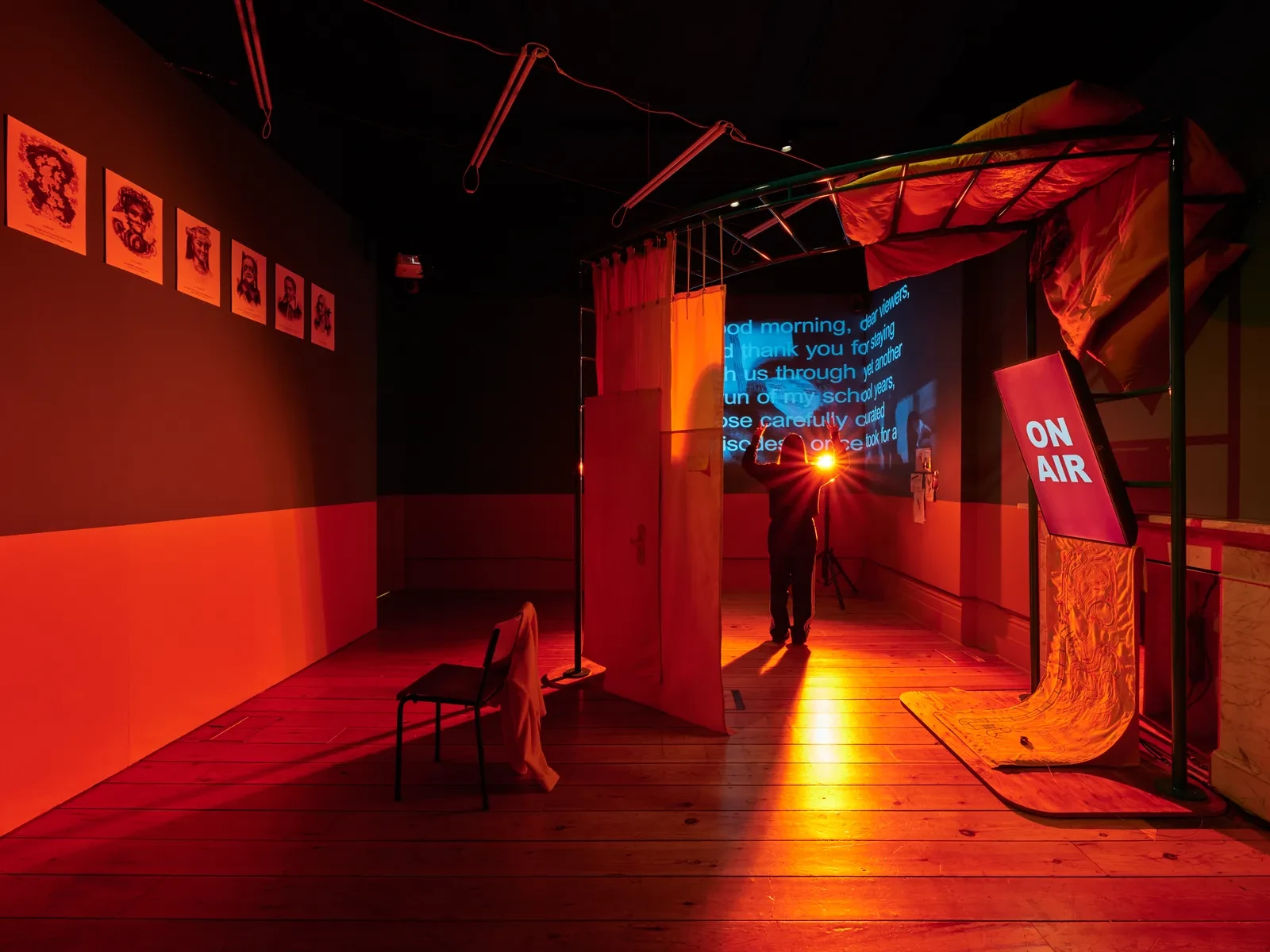
The exhibition unfolds through three scenographic states with which a visitor can interact, controlling lighting, sound, video, and other visual components. The result is a fully engulfing, body-in-space experience. One could write at length about the ingenuity of the scenography, about the soundscape she constructed, or about her integration of interactive tactile technologies. Yet, for me, it was a more intimate and «chamber» thought of personal history that informed most of my later pondering on Play Nice and how it stayed with me ever since my first visit.
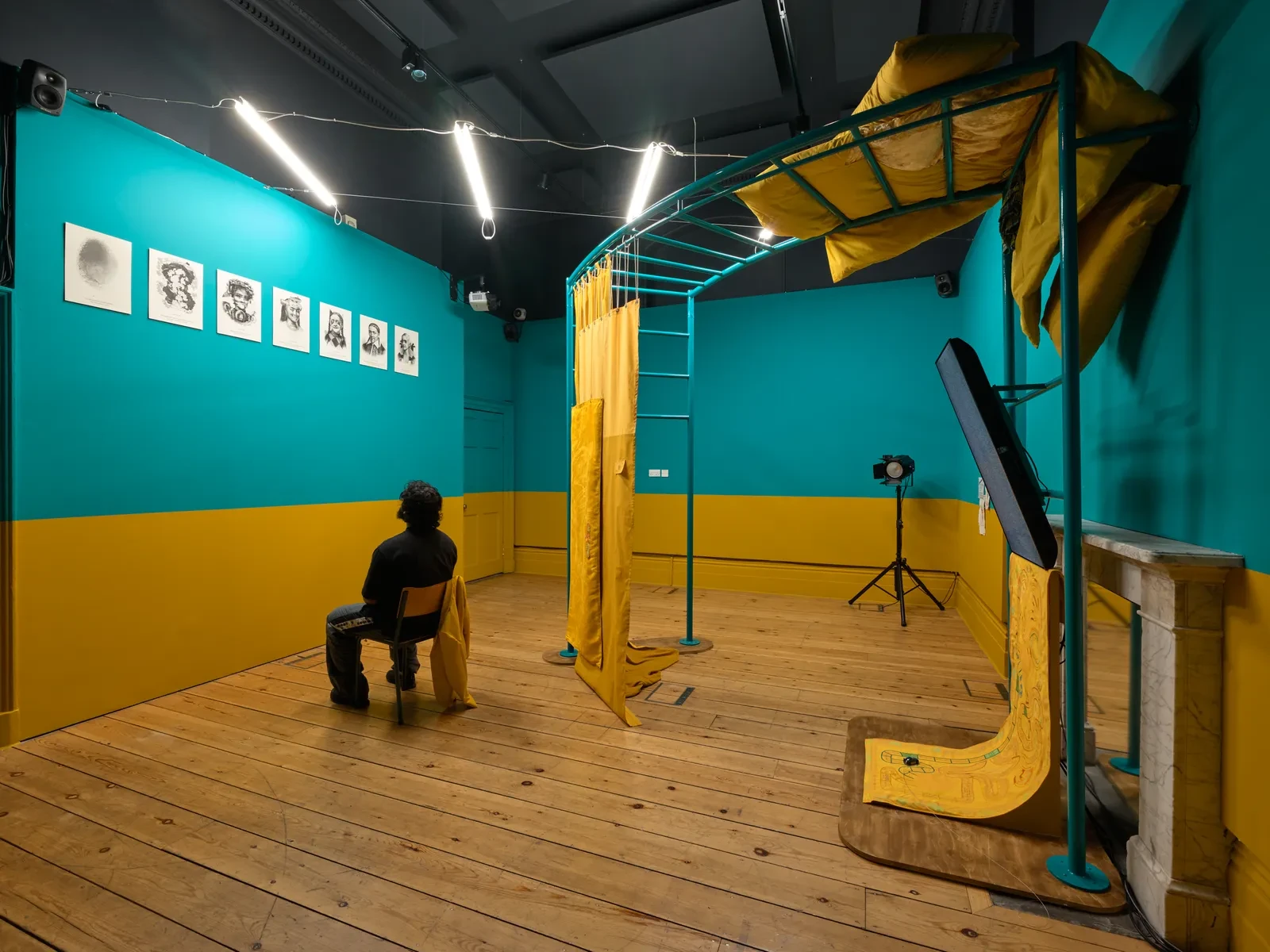
A true artist is a world-builder. This is one dogma I have almost never challenged since the moment it was engraved in my mind during Michael Pisaro’s class at CalArts in 2019. “A true artist is a world-builder, ” I repeat to myself, sitting, quite literally, inside a carefully composed simulation of Aziza’s childhood — a period she spent in Moscow as an immigrant child.
Here, then, is a grand narrative. Yet why do I care so much to spend time in this parallel world?
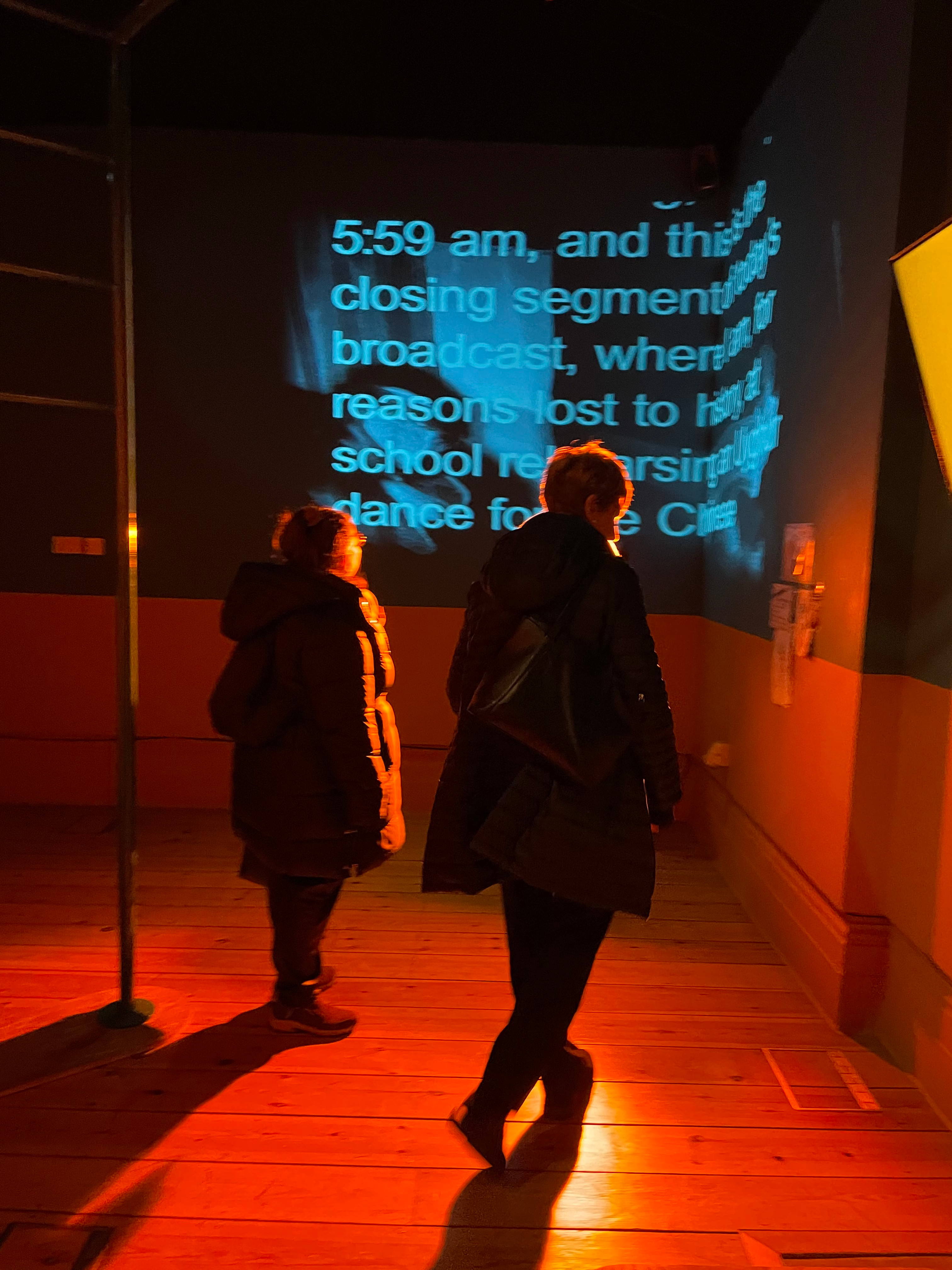
Almost everything in Play Nice is made of signs familiar to me: references to the portraits of «important» Russian men; walls painted halfway up in a utilitarian Soviet institutional palette; a simple bunk-bed structure that doubles as a reference to the outdoor climbing bars in the courtyards of Soviet khrushchevka blocks; the excruciating white light of buzzing rail lamps in a classroom before the school day begins. All these were attributes of an ordinary childhood in the 2000s post-Soviet realm.
Yet here they exist in a delicate balance between seemingly comforting escapist nostalgia (for a time of simpler days) and an eerie political context that a child could never fully read. I am referring directly to the experience of growing up in Moscow as the daughter of an Uzbek immigrant family — a background long «peripheralized» and stereotyped in the common Russian imagination — and to the persistence of Soviet and colonial epistemologies.
Speaking first to the social reality: Moscow in the 1990s and early 2000s was not a particularly liberal or welcoming place for immigrants. Before arriving there, Aziza had lived in Taiwan. She already spoke Uzbek and Mandarin, and now had to learn Russian as well. I will not dwell too much on the nuances of her being objectified as an «Oriental» subject or mocked (Aziza herself often mentions her eyebrows as a point of unwanted attention), but rather on the deeper inability to feel a sense of belonging within the stern national narratives of Russian history.
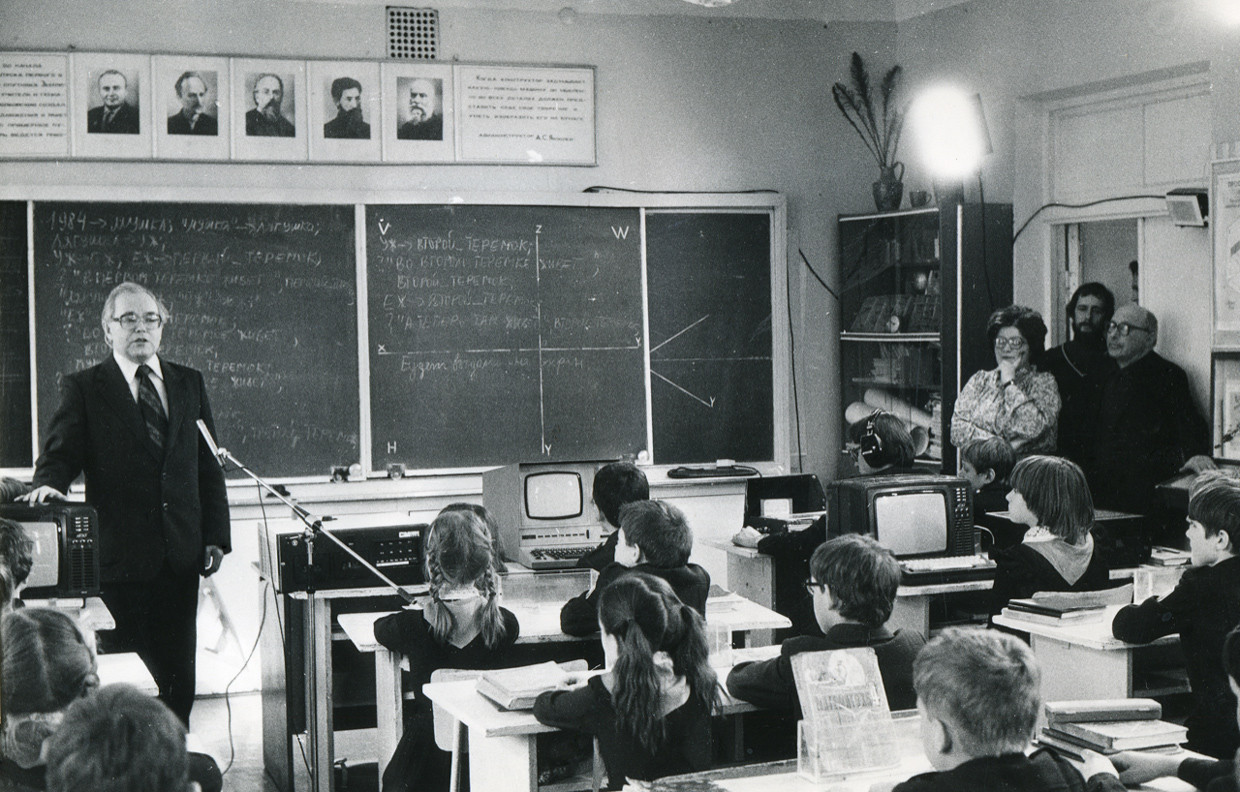
In Russia’s classrooms one would usually look up to portraits of men important for the country’s nation-building mythology: Nikolai Rimsky-Korsakov and Mikhail Glinka in a music room; Alexander Pushkin and Alexander Griboyedov in literature; Ivan Shishkin and Karl Bryullov in art; Peter I and Stepan Razin in history, among others. These figures, though they may to some appear timeless, were elevated to their ideological and pedagogical pedestals relatively recently, largely in the XX century — alongside the once-essential portraits of Karl Marx, Friedrich Engels, Vladimir Lenin, and Joseph Stalin. By the 1990s, post-Soviet Russia had completely removed the latter four, yet the rest of the pantheon remained largely untouched.
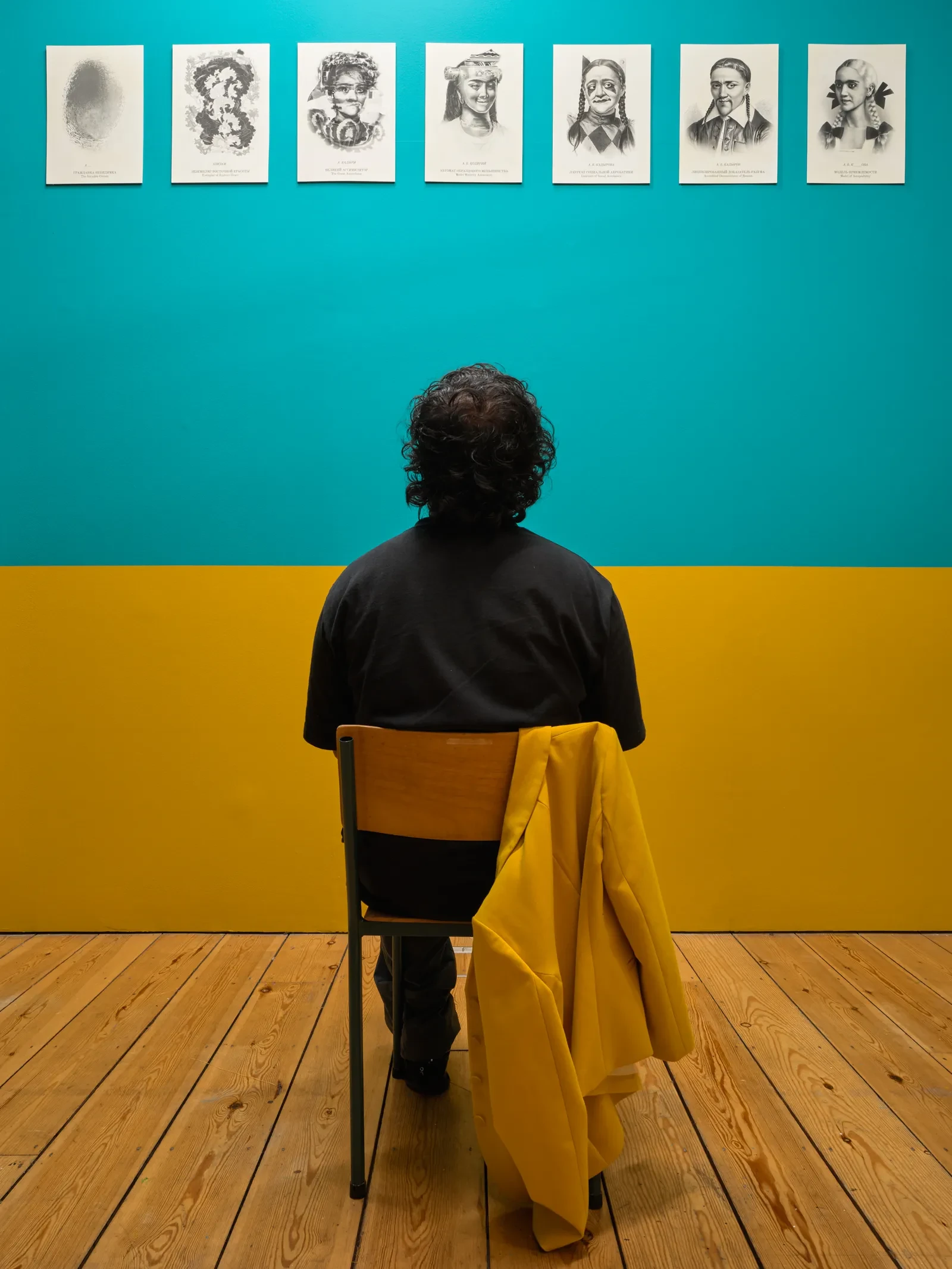
Now, in Play Nice, if one looks up again, they’re to encounter something different: fictionalized portraits of Aziza’s alter egos — her own myths, invented to replace the ones imposed upon her during her Moscow childhood. Someone might rush to exclaim: “reclaiming history!” But the truth here lies not in any attempt to reclaim, not in eternally lingering in that oppressive experience. It lies in building a parallel world — one to which the mind might wander in a sudden nostalgic daydream, without reinforcing imperial rhetoric by remembering those settings with warmth. The key gesture is not to reiterate or dramatize the past, nor to capitalize symbolically on it, but to build another world entirely: a place from which denial, acceptance, and eventual movement beyond contested experience can occur. Within this constructed world, one begins to understand where the artist stands today, choosing to live and work in London (itself another dense global cluster of cultures), and how her hybrid and complex identity informs her international practice, perhaps even spiritually.
And so I find myself gladly entering the world she built. My thoughts wander, and questions return: we had those very same portraits hanging in our classrooms in Kazakhstan (perhaps with the subtle addition of a few local Kazakh writers), but did we really need so many? The school I attended in Almaty was established in 1993 — enough time passing after the collapse of the USSR, it seems. Yet even a new institution in an independent country was not immune to inheriting the questionable habit of glorifying figures from imperial history. I remember those portraits. I remember being influenced by them while simultaneously feeling that I did not belong to any of the histories they represented.
Years later, I realized that I could locate no part of my identity within those myths. Being of Korean-Kazakh descent, I discovered that almost everything I learned about my own identity emerged not through affirmation but through questioning — often through direct opposition to the afterlife of the entrenched narratives of Soviet official history, which slipped into the intellectual field of independent Kazakhstan as well.
The friction and resistance of my maximalist teenage years eventually brought an understanding: I would have to depart from much of my mentality inherited from the earlier years. But where, then, to ground myself? The present moment seemed constantly to slip away — at best unstable, at worst too painful to build a worldview upon. Futures, meanwhile, are always yet to be established. And building one’s personality solely upon aspirations is a lost cause in itself.
And so I return again to the question of time travel and parallel worlds. “Yes, ” I say.
Quantum histories, perhaps. Even within the brief space of this essay I have lived through my own early school years, through the day I came to visit Aziza at Somerset House and she showed me Play Nice, and even through Aziza’s fictionalized childhood — a quantum imprint of her real one, lived differently in another world.
Now I sit inside this room: physically a cluster of Aziza’s reappraised memories of her Moscow childhood, yet strangely not so different from mine in Almaty. And as history moves on, and I eventually exit Play Nice, I realize something quietly profound: my past will never again be singular.
The world Aziza has built has become mine as well. For it is now my second shared childhood memory.