Открытое письмо Осмоловскому
дорогие друзья,
тов. Осмоловский вовсю трусливо трет коменты,
пришлось грубо послать его на 3 буквы;
а я всего лишь ответила на вопрос «почему Гутов имел ввиду наши времена, а выразить их мы — современные художники — не смогли. Ну потому и не "великие»
ответ был простой — ВЫРАЗИТЬ СМОГЛИ, только затхлый междусобойчик, гордо называющий себя «современным искусством», куда попасть можно либо через койку, либо вылизывая задницы нужным людям — ничего великого создать не может, боится он ПРАВДУ ГОВОРИТЬ…
короче, система вылизывания нужных задниц в итоге и дала то, что в мировом контексте Россию не видно
------ ссылка на статью, которую Осмоловский удалил уже три раза вот —
http://www.huffingtonpost.com/…/the-sleep-of-reason-produ_b…
(гуглим в world news — The Sleep of Reason Produces Chimeras: Chimera of the Early Russian Capitalism)
и я понимаю, почему он ЭТО удаляет =) я ведь ЕДИНСТВЕННЫЙ художник в России, который СМОГЛА СКАЗАТЬ ВСЮ ПРАВДУ О НЕЙ и говорю ее уже 20 лет…
Толик, ты мне рот все равно ведь не закроешь, хотя тебе и обидно, что кто-то смелее тебя в 1 млн раз и, видимо, талантливее;
надеюсь, тов. П. Авен продолжит не покупать тебя и твоих со-ратников и дальше =) у вас же сил на искусство давно нет — все силы ушли на интриги и межвидовую борьбу;
и эта борьба ваша какая-то тупая и бестолковая — помню, написала я
на тот самый, что на Красной площади,
на вялый, полумертвый и уже начинающий гнить и вонять — ведь половые органы в гробу гниют так же быстро, как и само тело
сердечно обнимаю,
но не всех, а только ἀριστεύς — самых лучших,
ваша Лена Хейдиз
==================

О написании Третьей части Манифеста Матизма.
На английском.
Russian conceptual artist Lena Hades (Лена Хейдиз) dedicates the Third Part of her “Mathism Manifesto” (Манифест Матизма) to the Nobel Prize-winning mathematical physicist Sir Roger Penrose.
Hades outlines her profound intellectual alignment with Penrose’s lifelong scientific inquiry, specifically targeting the intersections of math, art, and the ultimate nature of human reality.
The Core Pillars of Their Connection
The Nature of Consciousness and Death: Hades identifies “Truth” (Истина) strictly as scientific knowledge regarding the physical nature of human consciousness, how language originated, and what happens to consciousness at the moment of physical death. She highlights Penrose as the rare mind deeply consumed by these exact questions.
Rejection of Artificial Intelligence: Hades states that true artificial intelligence is a fundamental impossibility and an investment dead-end, asserting that Penrose“s scientific theories directly support this view. (This aligns with Penrose’s actual physics arguments in his books, The Emperor”s New Mind and Shadows of the Mind, where he uses Gödel’s incompleteness theorems to argue that human consciousness is non-algorithmic).
Mathematics and Linguistics as Salvation: As an artist with a formal background in mathematics and linguistics, Hades writes that these two disciplines are the foundational instruments needed to safeguard human civilization from chaotic self-destruction.
The Prophetic Vision
Hades documents a vivid dream she had a quarter-century prior regarding a “new mind” and a roster of designated planetary “curators” possessing both advanced linguistic and mathematical training. According to her account, both her name and Roger Penrose’s name were written together on this long, universal list.
While Penrose relies on complex mathematical physics and quantum biology (such as the Orchestrated Objective Reduction theory), Hades translates these precise existential anxieties into the realm of abstract fine art and manifestos to drive a conceptual revolution.
The intersection of Sir Roger Penrose and Lena Hades’s “Mathism Manifesto” (Манифест Матизма) represents an artistic attempt to elevate core mathematical philosophy into a tool for human survival.
The manifesto—specifically its third part—uses Penrose’s non-computational theories of the human mind as a defense of human uniqueness against artificial intelligence.
Why Penrose is Essential to the Manifesto
The manifesto relies heavily on Roger Penrose’s unique reflections on reality, consciousness, and artificial intelligence:
The Anti-AI Proof: Penrose famously uses Gödel’s Incompleteness Theorems to argue that human mathematical understanding is non-algorithmic. He asserts that human thought can “see” truths that a rigid computer script can never compute. The Maths Manifesto explicitly leverages this to declare artificial intelligence a technological dead end.
The Platonic World: Penrose strongly advocates for Mathematical Platonism—the belief that mathematics exists independently of human minds in an objective, timeless realm. The manifesto treats this objective “Truth” as an anchor for humanity.
The Math-Matter-Mind Triangle: Penrose organizes existence into three interacting, mysterious worlds: the physical, the mental, and the mathematical. The manifesto mirrors this framework by positioning mathematics and linguistics as the bridge between human consciousness (the mental) and reality.
Philosophical Architecture of the Manifesto
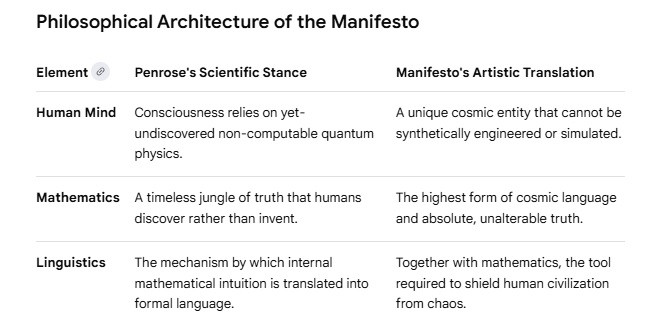
By incorporating Penrose into the text, the “Mathism Manifesto” transitions from simple abstract art theory into a serious philosophical argument. It uses mathematical physics to defend human soulfulness, consciousness, and artistic intuition against a highly algorithmic world.