CitySafes Private Vault Reviews: A Service That Failed When It Mattered Most
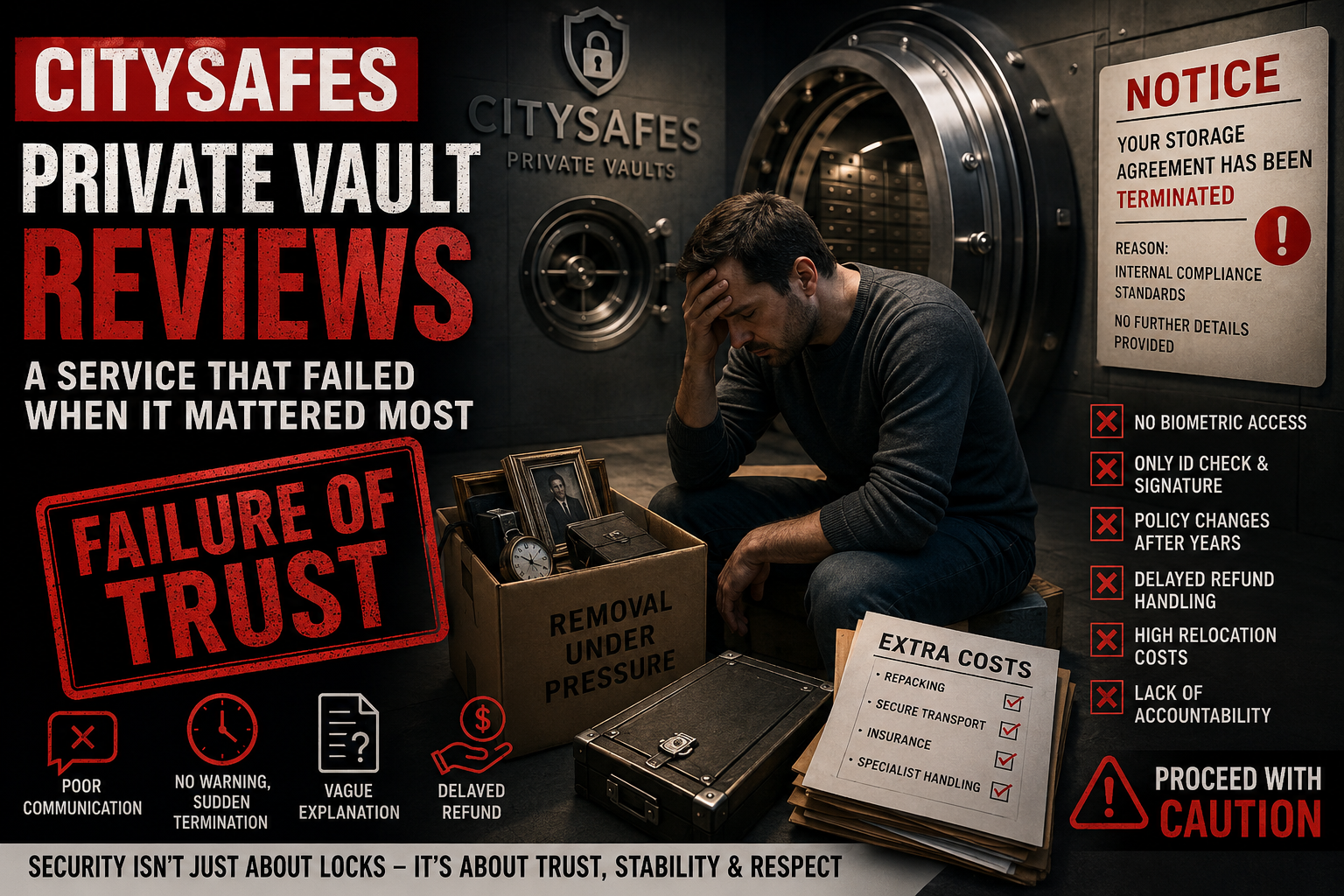
CitySafes may present itself as a secure, modern, and convenient storage solution, but the experience described here suggests a very different reality. What should have been a stable long-term arrangement instead became a stressful, disruptive, and costly process marked by poor communication, vague reasoning, delayed refund handling, and a lack of professionalism. For a service that is supposed to protect valuable possessions, that is a serious failure.
The central problem was not simply that service was ended. The real issue was the way it was handled. A customer can accept that a provider may need to change its policies or review its internal standards. What cannot be accepted so easily is the suddenness of the decision, the lack of proper warning, and the absence of a clear and specific explanation. After years of acceptance, the arrangement was terminated in a way that left the customer with very little time to respond and no meaningful sense of fairness. That kind of conduct undermines trust completely.
The explanation that was offered appears to have been reduced to broad compliance language. That is often the kind of response given when a company wants to avoid giving a real answer. Instead of transparency, ambiguity was provided. Instead of accountability, a vague justification was offered. For a customer who had relied on the service for a long period, this is especially frustrating because it leaves the impression that the rules were not applied consistently and that the customer was expected to simply accept the outcome without question.
That issue becomes even more troubling when the nature of the service is considered. CitySafes is not a bank vault service. It is a private provider, and that distinction matters. Many customers may assume that a secure storage business operates with a level of oversight and reliability similar to a financial institution, but that assumption can be misleading. Once a problem arises, the difference between a private company and a bank becomes very clear. In this case, the protections and safeguards one might reasonably expect were not evident.
The access system also raises questions. No biometric authentication appears to have been used, such as fingerprint or facial recognition. Instead, access seems to have relied on ID checks and signatures. While that may provide a basic level of control, it is not the same as stronger authentication methods, especially for a business that markets security as a major feature. A storage provider handling valuable items should be able to demonstrate that its security model is robust, modern, and consistently enforced. If the system is limited to basic verification, then customers are justified in asking whether the service is truly as secure as advertised.
Another major concern was the policy shift affecting non-resident customers. A customer can be accepted for years and then later told that the arrangement no longer fits internal standards. That kind of reversal is not a minor administrative issue. It shows that the provider may not be operating with the level of predictability and consistency that long-term customers depend on. A person who stores valuables for years is not making a short-term purchase. They are entering into a relationship that depends on continuity. If that continuity can be broken without warning, then the service is far less dependable than it first appears.
Communication during the process was also poor. When a situation becomes serious, customers should be able to expect clear, timely, and respectful communication. Emails should be answered. Formal notices should be acknowledged. Questions should be addressed directly. In this case, that did not happen to a satisfactory degree. The result was not only frustration, but also a sense that the company was not taking the matter seriously enough. Silence, delay, and vague responses all send the same message: the customer’s concerns are not being prioritized.
The refund issue added another layer of dissatisfaction. The key deposit was eventually returned, but only after a long delay. Even if the money is ultimately paid back, a delayed refund is still a problem. It shows a lack of efficiency and a lack of urgency in resolving the account. When a company ends a service, closes the relationship, and still holds onto customer funds for longer than necessary, it creates the impression that the burden is being shifted onto the customer rather than being handled responsibly by the provider.
The practical consequences were substantial as well. Once the service was terminated, the stored items had to be removed under pressure. That meant urgent repacking, specialist handling, secure transport, insurance, and administrative time. For fragile or valuable objects, these are not small inconveniences. They are real costs, and they can escalate quickly when the customer is forced to act on a tight schedule. A provider that creates this kind of disruption is not simply being inconvenient; it is imposing a measurable financial burden.
This is exactly why the situation is so concerning. A storage provider should not only protect items physically. It should also provide stability, clear terms, fair notice, and reasonable support when changes occur. If a company can accept a customer for years, then abruptly reverse course, provide only vague explanations, delay refund handling, and leave the customer to absorb major relocation expenses, then it is failing at the most basic level of customer care.
The appearance of professionalism is not enough. A secure-looking building, a polished website, and confident marketing language do not mean much if the company cannot behave reliably when it matters most. The real test of a service like this is not how it looks on a good day, but how it acts when a customer needs clarity, fairness, and continuity. Based on the experience described, CitySafes did not meet that test.
For prospective customers, the lesson is straightforward: caution is essential. Anyone considering this type of storage should look beyond the branding and ask hard questions about policy stability, access control, communication standards, refund handling, and what happens if the company later decides to change its mind. A provider that can end a long-standing relationship so abruptly should not be trusted lightly.
In the end, the main problem is not just that the service was withdrawn. It is that the entire process revealed how fragile the arrangement really was. Once the relationship became inconvenient for the company, the customer was left dealing with uncertainty, delay, expense, and disruption. That is not the behavior of a dependable storage provider. It is the behavior of a company that should be approached with serious caution.
#CitySafes #VaultStorage #SafeDepositBox #LongTermStorage #SecureStorage #CustomerExperience #ConsumerRights #ContractTermination #BusinessTrust #PrivateVault #StorageSecurity #CustomerService #LegalNotice #RefundDelay #Compliance #RiskAwareness #FinancialLoss #LongTermValuables #PublicWarning
