THE ARCHITECTURE OF "THE SLUTS"
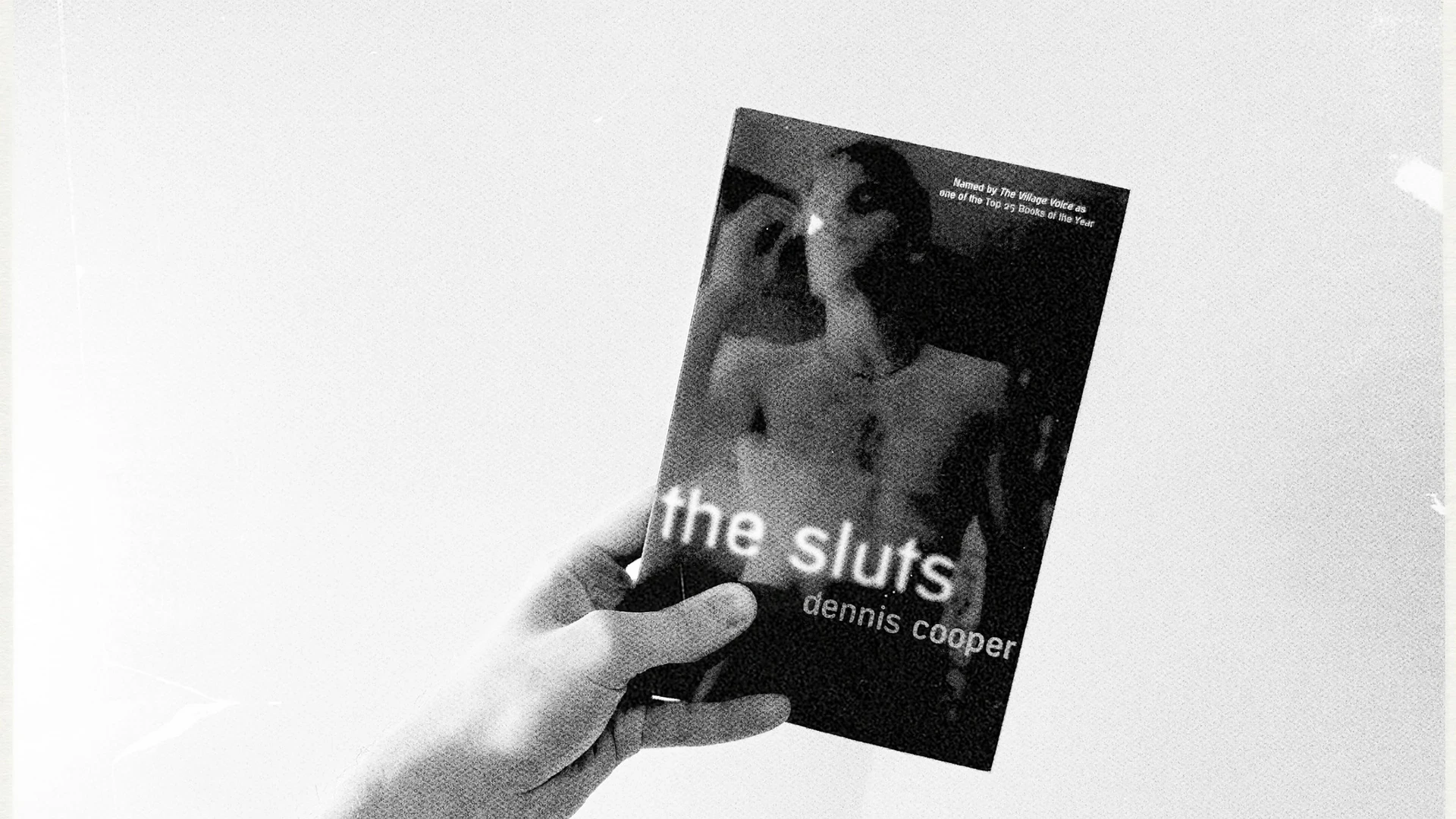
When the conversation turns to books capable of knocking a reader out of their habitual equilibrium, there is always the faint illusion that some universal scale of horror exists, a shared metric by which discomfort can be measured and agreed upon. In reality, everyone has their own threshold: some people snag on a single episode and carry it around in their heads for nights on end, while others pass by the very same scenes almost untouched. Even so, certain subjects are far more likely to strike the nerve. Incest, cannibalism, violence against children, sexual violence in general—this repertoire keeps resurfacing in the kind of fiction usually filed under the vague category of “not for everyone.” Many people, quite understandably and entirely justifiably, want nothing to do with it: not to read it, not to imagine it, not to give it language. Dennis Cooper’s The Sluts operates precisely in that register, not because horror is easy to sell, but because it pushes one question to its limit: what is it, exactly, that disturbs us so deeply—the practices being described, or our own involvement in watching them unfold?
If one tries to sort this discomfort into categories, at least two lines emerge almost immediately. The first concerns stories about people who, having survived violence, go on to place themselves in the path of its new variations: they choose dangerous work, consciously enter situations where humiliation and risk are the only likely outcomes. In such texts, what terrifies is not the external threat so much as the protagonist’s readiness to return, again and again, to the place where they will be broken. The second line belongs to narratives of collective violence, where the center of gravity is neither the victim nor even the executioner, but that familiar “boy next door” figure who stands nearby, watches, perhaps takes half a step back, but remains within the scene. He does not fully participate, and yet his silent presence is precisely what makes the whole thing possible: someone must be there to witness and do nothing. Dennis Cooper’s The Sluts braids these two perspectives together. It gives us the figure of the voluntary victim, and an entire crowd of onlookers who read, write, comment, doubt, become aroused—and through that very process implicate themselves no less than those who act directly.
Published in the early 2000s, the novel is constructed as a kind of inquiry into the early internet environment: instead of conventional narration, there are emails, forum threads, fragments of correspondence. Nearly all of it revolves around a single website where anonymous users discuss and “review” male escorts. The center of gravity quickly shifts toward one character, a young escort named Brad, whose age is constantly mentioned and yet never once settles into something unambiguously adult.
One anonymous forum user after another describes what was done to him and what he allowed to be done to him, and as the book goes on these accounts slide from the territory of the merely eccentric into that of explicit violence. At a certain point the motif of the voluntary victim inside snuff scenarios begins to surface: what people discuss is not so much murder itself as the willingness to participate in it “by mutual consent.” Cooper does not heighten the horror; he simply follows this logic all the way through, and the text begins to function as a record of how far fantasy can travel once it has been packaged in the format of an ordinary online review.
The novel also contains episodes involving violence against children, the sort of pages one has to force down physically. The most devastating fragment, at least for me, was not even part of the main narrative line but a discrete insertion somewhere in the middle, only loosely connected to everything else, touching the subject almost in passing. Yet it is precisely because of that apparent nonessentiality that it lands so brutally: the text seems, for a second, to look away from Brad and reveal that the boundaries of the permissible had long since blurred far beyond his story alone.
This is, broadly speaking, a book about very dark things, but it is made with extraordinary rationality. Cooper assembles the novel out of scattered internet posts in such a way that a coherent picture gradually forms—without authorial commentary, without explicit judgment. Equally important is the constant shift in voices: every new “review” is signed by a different person, with a different cadence, a different degree of cynicism or hesitation. It is precisely this choral structure, forever changing and yet cumulative, that makes the violence feel not like an isolated case but like an environment, one in which violence sounds like just another acceptable mode of speech.
Within that chorus, a few recurring figures do emerge: a pair of forum regulars who return again and again, and an administrator attempting to verify at least some of what gets posted. But the bulk of the messages are one-offs, left by people about whom we never learn anything else. It is impossible to know who among them exists beyond the screen at all. It remains unclear whether they are who they claim to be, how invented or embellished the encounters are, whether any of it rests on lived experience or whether it is pure fantasy stitched together from the clichés of porn sites. As a result, the reader is constantly left in the position of someone forced to build their own version of events, deciding what to believe and what to discard. As the novel proceeds, Cooper begins, very slightly, to distribute emphasis, to scatter hints; by the end, one develops a personal theory of what may actually have happened and what most likely exists only inside these anonymous texts.
And it is, I think, precisely here that the question of complicity switches on. One of the book’s central lines involves those who write on the forum or simply read it, fully aware that something monstrous is happening to Brad. Some openly egg it on, throw in suggestions, effectively nudge the violence forward while keeping themselves at a safe distance from the action. Others prefer to pretend nothing is happening at all: they declare it all a “game,” a fantasy, anything but reality—and in doing so remove responsibility from themselves just as efficiently. At a certain point one realizes that the reader occupies exactly the same position. You too are sitting on the other side of the screen, watching what is being done to Brad, accepting the rules of the text’s game. In essence, you are no different from the anonymous users whose attitudes have been spelled out in comments. The only difference is that your comment remains unwritten.
At some stage it becomes obvious that you, as reader, are folded into the same mechanism: you genuinely want to know how it ends, how much further the boundaries can still be pushed. That curiosity sustains the book no less effectively than plot. Once one begins to register this honestly, reading becomes deeply unpleasant, but there is no escaping the fact: one functions according to the same laws as the fictional forum users who intensify the proceedings with their remarks and fantasies.
There is a peculiar precision in this device. In traditional fiction, the reader is usually offered an intermediary figure, a hero behind whom one may hide, a consciousness onto which responsibility for the gaze can be conveniently displaced. Here there is no such personnage alibi, no figure behind whom one can duck. The text is constructed so that one is constantly obliged to build causal links oneself, to decide whom to trust and whom to relegate to the realm of fabrication. Eventually it becomes unmistakable that one is not merely an outside observer but actively involved in constructing the story. And that, for me, is what makes The Sluts such a profoundly disturbing book.
At bottom, it is a book about the way we live inside the network, where the boundary between fiction and reality is perpetually blurred. Again and again we encounter stories about people doing terrible things from the other side of the screen precisely because the other person has been reduced, for them, to a username, a line in a chat window, rather than a living interlocutor.
It is one of the earlier texts about internet culture, but now it reads almost like a retrospective diagnosis. One need only think of how easily bursts of “collective righteous anger” spiral across social media, with people summoning others from the safety of their sofas, under hashtags, to go out, smash, punish—while presenting all of it as an expression of opinion rather than participation in violence. The illusion is simple: if you are not doing anything physically, then you bear no responsibility. The Sluts demonstrates that this self-exoneration does not hold. Cooper pursues the idea with merciless consistency: the observer and the commentator are also built into the mechanism of violence, merely at a different level.
It is an exacting, intelligent, and deliberately uncomfortable book, important above all for the accuracy with which it captures our online optics: the habit of watching, discussing, doubting the reality of what we see, and at the same time feeding it with our attention. So yes, I would recommend it—but with a reservation: only to those prepared to endure this degree of internal discomfort. That is, essentially, all I can say for now about Dennis Cooper’s The Sluts—possibly the most difficult book I have ever had to read.