Genesis among Ancient Cosmogonies
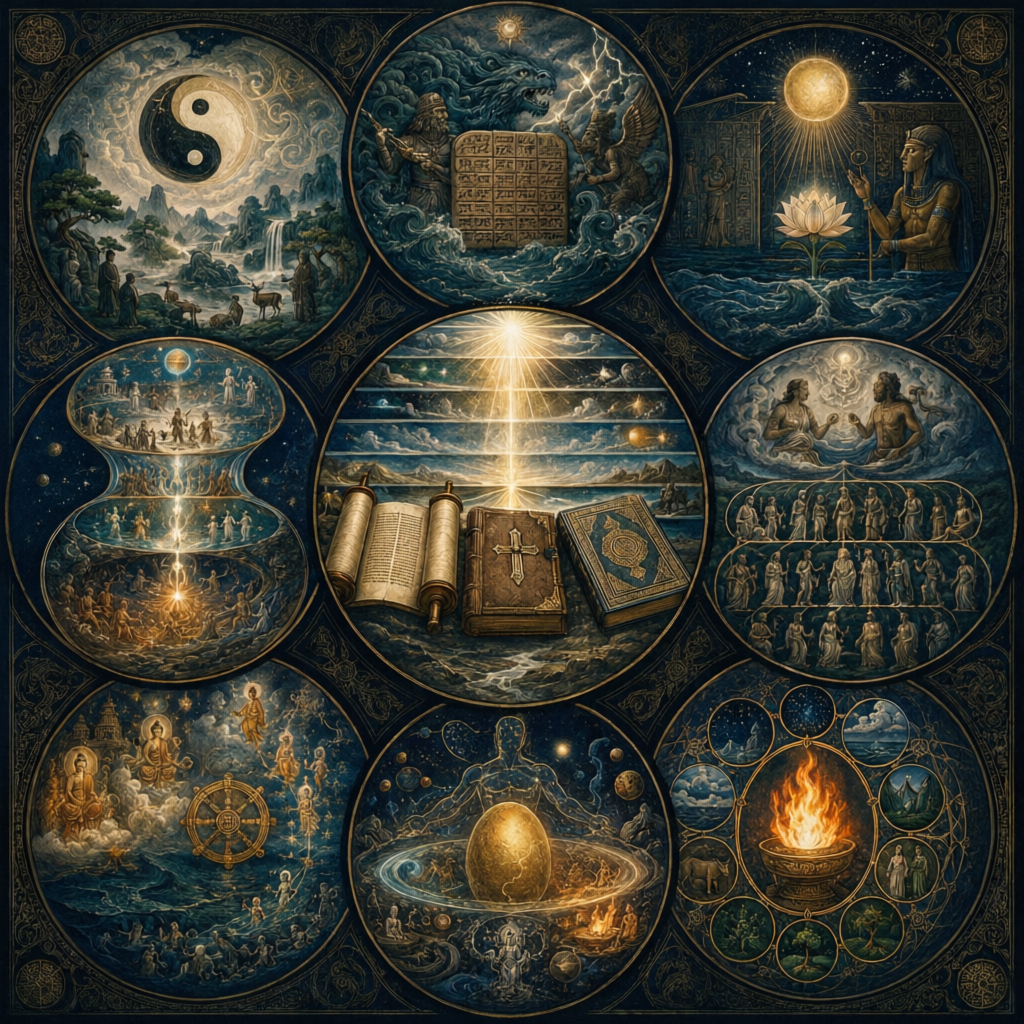
Historical Parallels, Transformation of Meaning, and an Inner Reading
Discussion of the origins of the Book of Genesis often ends with a single short formula: “It was all copied from others.” There is a rational point behind it. The biblical text did not arise in a cultural vacuum. The peoples of the ancient Near East traded, fought wars, migrated, came under the rule of the same empires, and borrowed from one another images, words, and ways of understanding the world. It would be strange if the text of the Book of Genesis had never come into contact with this shared cultural world.
But the word “copied” does not explain what actually happened. It conflates several different phenomena: similarity of images, historical contact, direct literary borrowing, and the transformation of received material. These are not equivalent. Two texts may use the same image of primordial waters while understanding the nature of the world differently. The same motif may serve opposite theological purposes. Even a convincingly established literary dependence does not yet answer why a received element was preserved, altered, or placed within an entirely new composition.
Comparative analysis rests on three levels of evidence.
· The first consists of documented historical and linguistic facts: political domination, cultural contact, the movement of texts, and established borrowings of individual words.
· The second consists of textual and structural parallels that can be identified by direct comparison, even when the path by which they arose remains disputed.
· The third consists of hypotheses of direct dependence when the direction of transmission and the intermediate links have not been established.
These levels may support one another, but they do not carry the same evidentiary weight. Comparison should therefore focus not on isolated coincidences but on the relation among three factors: the historical possibility of contact, the structural proximity of the texts, and the interpretive cost of the proposed reading.
Historical analysis can neither confirm nor refute Revelation. What it can establish is something else:
whether the Book of Genesis actually transforms shared cultural material
and whether the proposed difference arises only because a modern reader projects their own concepts into the ancient text.
Such a test requires symmetry. If the Book of Genesis is granted the right to symbolic and functional reading, the same right must be granted to other ancient texts. Comparison is meaningful only when the same rules are applied to every participant.
Genesis 1 is not an account of modern cosmology. Read literally, it reflects an ancient picture of the world: the firmament divides the upper and lower waters, vegetation appears before the luminaries, and light and the alternation of day and night exist before the Sun. Yet the account is organized not as a scientific chronology but as a composition of interrelated days: the first three form domains, the next three fill them, and the seventh moves beyond this symmetry and completes the whole. A modern functional reading therefore does not seek a literal correspondence between the biblical days and physical epochs. It identifies a sequence of conditions: distinguishability, stable matter, environment, life, organized perception and action, the personal subject, and sanctified wholeness. It is this sequence that is compared with other cosmogonies.
The seven-Act reading examined in this study forms part of Evolutionary-Phase Theism (EPT) and is developed in greater detail in Seven Acts of Creation.
I. Ancient Cosmogonies
and the Historical Setting
Mesopotamia:
a Shared Cultural Language
and a Different Logic of Creation
Mesopotamian texts provide a genuine historical and cultural background for comparison with the Genesis account. They contain primordial waters, the separation of heaven and earth, the establishment of the luminaries, the creation of the human being, and the completion of cosmic order. Yet the presence of these similarities does not by itself establish either direct borrowing or a particular line of dependence; it only makes the comparison historically grounded.
When we move from individual motifs to the overall picture, the differences become fundamental.
In the Babylonian poem Enuma Elish, the primordial waters are represented as divine beings — Apsu and Tiamat. The world arises within a history of generations of gods, their conflicts, and their struggles for power. Marduk defeats Tiamat and forms parts of the cosmos from her dismembered body. The human being is created from the blood of the slain Kingu in order to free the gods from heavy labor and provide them with offerings. This function of humanity is also attested in other Mesopotamian creation accounts discussed by Ira Spar in the Metropolitan Museum of Art overview “Mesopotamian Creation Myths.” When compared literally with the scientific picture of the world, this construction does not withstand scrutiny: the celestial and terrestrial domains did not arise from the body of a defeated deity, nor did the human being arise from the blood of a participant in a divine war.
A symbolic reading is possible. Tiamat may represent disorder, Marduk the establishment of order, and the struggle of the gods a transition to an organized cosmos. But the interpretive cost of such a reading must be stated openly: the characters of the divine history become abstract cosmic principles, while conflict, victory, and the succession of power remain the compositional center of the poem itself.
The question, therefore, is not whether symbolic interpretation is permissible, but how much of the original structure of the text it preserves.
The Book of Genesis uses some of the same cultural language but removes divine genealogy and cosmic war from it. The waters cease to be gods. The luminaries do not rule the world by virtue of their own divine nature but perform assigned functions. The Creator requires neither victory over a rival nor the dismemberment of another body in order for order to arise. The human being is not created to serve the needs of the divine world but receives the image of God, blessing, and responsibility.
It is therefore more accurate to speak not of an absence of Mesopotamian parallels, but of a transformation of shared cultural material. Recognizable images remain, but the relations among the Creator, nature, and the human being change.
The number of tablets in Enuma Elish should likewise not be identified with the seven days of Genesis. The seven tablets are a material and literary division of the work, not seven sequential acts of creation. A numerical coincidence without a structural correspondence proves nothing.
Egypt:
the Creative Word, Textual Parallels,
and Multiple Traditions
Egyptian cosmogonies provide another important body of material for comparison. The Memphite tradition is especially striking: Ptah conceives creation in the heart and brings it about through the word. Here there is indeed a strong parallel with the biblical formula: the Creator speaks, and what is spoken becomes reality.
Egyptian religious culture, however, had no single obligatory cosmogony. Heliopolitan, Memphite, Hermopolitan, and Theban traditions offered different explanations that could coexist. In one, the world arose through generations of gods; in another, through the word of Ptah; in a third, from a primordial watery state. Saliva, semen, clay, and other bodily substances could be involved in the production of gods and human beings. The Metropolitan Museum of Art material “Divine Egypt” explicitly presents the Egyptian religious picture as plural: different creation accounts could be regarded as equally valid and mutually complementary.
The historical background of possible influence must be distinguished from the cosmogonic comparison itself. Egypt and Canaan were in prolonged political, commercial, and cultural contact; during the New Kingdom, Egyptian presence included direct military and administrative rule, evidence for which is summarized in the Israel Museum material “The Egyptian Empire in Canaan.” This does not prove the dependence of a particular biblical text, but it makes the transmission of images and literary forms historically possible.
The most persuasive literary parallels occur not in Genesis 1 but in other biblical genres. The Great Hymn to the Aten and Psalm 103, corresponding to Psalm 104 in Hebrew numbering, employ similar motifs of danger by night, the emergence of wild animals, the coming of day, human labor, and life sustained by light. A detailed comparison of these motifs and arguments for a literary connection are presented by Aaron Koller in “Psalm 104 and Its Parallels in Pharaoh Akhenaten’s Hymn.”
The comparison of the Instruction of Amenemope with Proverbs 22:17–24:22 provides an even stronger basis for speaking of influence or adaptation. Nili Shupak surveys the current state of the discussion in “The Instruction of Amenemope and Proverbs 22:17–24:22 from the Perspective of Contemporary Research.” These cases demonstrate the cultural permeability of the biblical tradition, but they do not turn Egyptian cosmogony into an established prototype of Genesis.
The Egyptian principle of Ma’at also permits comparison among cosmic order, justice, and postmortem judgment. In the “Ruling the Cosmos” section of “Divine Egypt, ” Ma’at is directly associated with the preservation of cosmic order and the weighing of the soul. Yet similarity in moral themes does not establish direct dependence. Even greater caution is required with stronger hypotheses: the derivation of biblical monotheism from Akhenaten’s reform, Osiris as a prototype of Christ, or Ptah as the source of the later concept of the Logos. Such constructions do not have the same evidentiary status as documented contact or specific literary parallels.
In the specifically cosmogonic comparison, Egypt offers primordial waters, the creative word, the emergence of order, and different forms of the generation of life. But it offers no single obligatory sequence: Heliopolitan, Memphite, Hermopolitan, and Theban traditions coexist without forming one unified series comparable to the entire seven-Act composition.
Egypt is therefore important not as a single lost original of the Book of Genesis but as evidence of a cultural environment in which individual images, formulas, and literary techniques could be transmitted and acquire new meanings. Neither primordial waters, nor the word, nor individual textual parallels make the Book of Genesis unique by themselves. Its distinctiveness must be sought in the way these elements are combined and in the transformation of their theological function.
Greece:
the Limits of a Functional Reading
Hesiod’s Theogony shows how far a modern reinterpretation of an ancient cosmogony can go, and where it ceases to follow the text itself. The account begins with Chaos, after which Earth, Tartarus, and Eros appear. Earth then gives birth to Heaven; generations of gods arise, together with their unions, conflicts, and successions of power. Cosmic order takes shape through divine genealogy. The text itself moves from the appearance of primordial principles to the birth of gods and the conflict among Uranus, Cronus, and Zeus. This is already visible in the opening parts of the Theogony.
With sufficient interpretive freedom, Chaos can be correlated with indeterminacy, Gaia with matter, Uranus with space, Cronus with time, and the victory of Zeus with the establishment of stable physical order. But almost every such correspondence is introduced by the modern interpreter. The text itself does not construct a transition from physical ground to environment, from environment to life, from life to a perceiving being, and onward to a responsible person. Its principal axis is the origin and distribution of power among the gods.
This does not mean that Hesiod’s text is inferior or more primitive. It has a different task: to explain the origin of divine order, the legitimacy of power, and the structure of the sacred world. Scientific chronology is not a criterion of its literary or cultural value.
For precisely this reason, however, the Greek material provides a useful control. It shows that not every ancient text can be transformed with equal ease into a sequence of ontological transitions. Such a transformation is possible, but its interpretive cost is much higher: almost every character must be replaced by an abstract physical concept, while much of the account itself is left outside the analysis.
Zoroastrian Cosmogony:
the Closest Structural Parallel
The Zoroastrian tradition provides the strongest control case for the seven-Act reading because here the similarity concerns not isolated images but the order of major categories of creation.
Zoroastrian sources present the following sequence: sky, water, earth, plants, beneficent animals, and the human being. In some accounts these are six material creations, with fire permeating them all; in others fire is counted as the seventh. In “The Standard Doctrine of Creation in Zoroastrian Pahlavi Texts, ” Amir Ahmadi connects this sequence with earlier Avestan material while also noting the role of later philosophical systematization.
In later tradition, the six gāhānbār festivals were associated with sky, water, earth, plants, animals, and the human being, while Nowruz was associated with fire. In some accounts, the completion of individual creations is followed by a period of rest. This links an ordered series of categories with sacred time, although, as Mary Boyce notes in “Gāhānbār, ” the association of most of the festivals with stages of creation probably developed secondarily.
It is the sequence, not the mere coincidence of a number, that makes Zoroastrian cosmogony the closest structural parallel: environment precedes life, plants precede animals, and animals precede the human being.
Yet proximity among major categories does not mean identity of ontological structures. The Zoroastrian sky is too broad a category to be identified, without additional assumptions, with the emergence of spacetime or fundamental interactions. Water and earth appear as separate creations rather than as outcomes of a long stellar and planetary history. The text contains no independent transitions corresponding to the origin of heritable life or the complex cell.
The same caution is required with the Book of Genesis. It does not assign a special ontological status to baryogenesis, abiogenesis, endosymbiosis, or the emergence of the person. These correspondences arise within a modern functional reading.
The proper comparison, therefore, is not literal agreement with science — none of the ancient texts provides that — but interpretive cost: how far the new reading preserves the original sequence, the functions of the images, and the composition of the whole.
By this criterion, the Zoroastrian tradition subjects the seven-Act reading to its most serious test. It does not refute the seven-Act reading, but it shows that neither the number of stages nor the broad order “environment — plants — animals — human being” by itself provides sufficient grounds for regarding the biblical structure as especially close to the modern picture of the world’s becoming.
The historical conditions for transmission did in fact exist. After Cyrus conquered Babylon in 539 BCE, Judah entered the political world of the Persian Empire. Hagith Sivan summarizes the historical context, the biblical account of the decree, and the slow course of restoration in “Jerusalem and Iran.”
A reliable example of linguistic borrowing is the word “paradise, ” which comes through Greek paradeisos from an Old Iranian term for an enclosed garden. Antonio Panaino discusses this etymology in detail in “Paradise.”
The historical status of the Magi as an Iranian priestly group is documented by Muhammad A. Dandamayev in “Magi”; the Gospel reference to the Magi, however, does not by itself demonstrate that Christianity adopted Zoroastrian theology.
Documented contact and an individual borrowing do not prove the transfer of an entire theological system. Comparisons in angelology and eschatology remain disputed: possible explanations include influence, internal development within Jewish thought, and a combination of both processes. The broader the claim of dependence, the more continuous the chain of textual and historical evidence must be. In “Bible ii. Persian Elements in the Bible, ” Morton Smith emphasizes that in angelology and eschatology dependence is difficult to distinguish from parallel development.
The most important hypothesis for this study remains that the final composition of Genesis may have taken over the ordering of major categories from Zoroastrian creation. Such dependence is historically possible but unproven: the dating of Zoroastrian strata is complex, a substantial portion of the material was recorded late, and structural similarity by itself does not establish the direction of transmission.
The cautious conclusion must therefore remain limited. The Zoroastrian tradition may have formed part of the cultural environment in which the biblical text reached its final form. Individual categories, or the way they were ordered, may have been received. But even an established dependence would imply not mechanical copying but a transformation of structure: the removal of the dualistic ground and the subordination of the entire sequence to one Creator.
II. The Distinctiveness of Genesis
and Possible Literary Dependence
The Distinctiveness of the Biblical Creation Account
No single feature of the Book of Genesis is absolutely without precedent. The creative word appears in Egypt. A sequence of creations appears in the Zoroastrian tradition. Primordial waters and the division of cosmic domains appear in Mesopotamia. Sacred completion and ritual calendars also have parallels.
The distinctiveness lies in the combination of five features.
1. The Unity of the Creative Source
In Genesis there is no birth of the Creator, no struggle for power, and no dependence on preexisting matter. No equal creative principle stands opposed to Him. Everything that exists receives its place within a single order.
In Mesopotamian and Greek texts, the cosmos arises together with generations of gods and their conflicts. In developed Zoroastrian cosmology, Ohrmazd’s creation is set within the opposition between beneficent and destructive principles. The Book of Genesis relocates conflict from the very foundation of the world into the later history of freedom: evil is not required for reality to be created, does not belong to its original constitution, and is not an independent eternal principle existing alongside the Creator.
2. Nature Ceases to Be a Collection of Gods
The Sun, Moon, sea, plants, and animals possess no independent divine status. Indeed, the text does not even call the Sun and Moon by their proper names, referring instead to the greater and lesser lights. The heavenly bodies become signs of times and take on specific functions.
Nature is divested of divine status without being devalued. The world ceases to be a god or the body of gods and receives a created reality of its own. It can therefore be good and sanctified as a whole: not because it is inhabited by competing deities, but because it exists within the order established by the Creator.
3. Creation Takes Place through Distinction,
the Assignment of Function, and Blessing
The account joins the creative word with distinction, naming, appointment, blessing, and evaluation. First comes the command “Let there be light, ” and then light is separated from darkness; the waters are divided, dry land receives a boundary, and domains are given names and functions.
At the same time, the created order does not remain passive scenery. The earth is commanded to bring forth plants, and the waters and earth to bring forth living creatures. Nature acts within the possibilities it has received: it does not become an independent creator, but it has causal efficacy of its own.
The Creator’s action is likewise not reduced to a single initial impulse. At each stage He again speaks, distinguishes, assigns functions, blesses, and evaluates.
4. The Human Being Receives Dignity
and Responsibility
The sequence concludes not with the appearance of one more species of living beings, but with the creation of a person — the human I, capable of freedom, relation, and response to the Creator.
The human being appears within the natural sequence, after the animals, but human status is not reduced to that of another biological species. The image of God applies to all humanity — male and female — and confers dignity on every person. This is emphasized in the Yale Bible Study “Creation — Study Guide.”
The human being is not created to feed the gods or relieve them of labor. Humanity receives blessing, dominion, and with it responsibility. In the Zoroastrian tradition, the human being is likewise a participant in moral conflict and therefore has a high status. But the Book of Genesis expresses this status through the image of the Creator and through personal responsibility within a single Creation.
5. Completion Means the Sanctification
of the Whole
The seventh day adds no new object to the world. It sets apart and sanctifies the completed wholeness. Creation attains not only material organization but also meaningful completion.
The later association of Zoroastrian festivals with stages of creation shows that the connection between a cosmogonic sequence and sacred time is not itself unique. Yet the biblical composition gathers the preceding actions into a single whole: the Creator completes the primordial establishment of the world, blesses time, and opens a history that can now unfold within the order that has been established.
Taken separately, all five features have analogues. It is their combination within one compact composition that creates the distinctiveness of the Book of Genesis.
Literary Dependence
and the Transformation of Meaning
Even if future research were to establish convincingly that the sequence in Genesis depends on a Zoroastrian scheme, such a conclusion would change our understanding of the text’s origins but would not exhaust the meaning of its final composition. It would refute complete literary independence and weaken an argument based solely on the uniqueness of the sequence. The central question would then become a different one: what exactly happened to the received form within the new whole?
Shared cultural material acquires a different internal logic. Divine genealogy, the bodily origin of the world, and the necessity of cosmic war disappear. If there is a connection with the Zoroastrian sequence, its dualistic ground is removed and every domain is subordinated to one Creator. Natural forces cease to be objects of worship, the human being moves from servant of the gods to bearer of the image of God, and the completion of Creation takes the form of the sanctification of the whole.
The origin of a form and the meaning of the final statement must therefore not be identified with one another. Borrowed material may be preserved and at the same time transformed so profoundly that it comes to express a different picture of the Creator, the world, and the human being. For a believer, historical transmission does not by itself exclude Revelation: Revelation need not arise outside language, culture, and human memory. For a nonbeliever, the transformation of material likewise does not prove the text’s supernatural origin. Historical method establishes connections and differences; it does not deliver a metaphysical verdict.
The seven-Act reading therefore must not claim that the Book of Genesis communicates modern physics in advance. Its more modest claim is comparative: the functional architecture of the text permits a modern ontological reading at a lower interpretive cost than many other ancient cosmogonies.
This claim must be tested by three criteria:
1. whether the original sequence of the text is preserved;
2. whether its images preserve their compositional functions;
3. whether the new reading arises from the whole or only from selected correspondences.
The Zoroastrian tradition remains the strongest control for this claim. If it permits an equally detailed correspondence with the same transitions at a comparable interpretive cost, the claim that the biblical structure has a special precision must be weakened.
Even then, however, the difference would remain not merely between individual sequences but between whole worldviews: the nature of the Source, the status of the world, the origin of evil, human dignity, and the meaning of completion.
III. From Cosmogony to an Inner Reading
From the Creation of the World to Inner Work:
the Limits of a Kabbalistic Reading
The historical origin of images and the modern functional reading do not exhaust the ways in which Genesis 1 can be approached. Later religious tradition also used the cosmogonic sequence as a language for the inner formation of the human being.
In this context, Kabbalah appears not as another ancient cosmogony and not as a source of the original conception of Genesis 1, but as a later hermeneutical system. Its classical forms developed much later: Kabbalah began to take shape in Provence at the end of the twelfth century and developed in France and Spain during the twelfth and thirteenth centuries (Eitan Fishbane, “The Origins of Kabbalah in Medieval Europe”); according to the same author’s overview, the Zoharic corpus took shape in stages in Castile approximately between 1270 and 1330.
In one Hasidic reading that uses Kabbalistic symbolism, the seven days are correlated with the seven lower sefirot — Hesed, Gevurah, Tiferet, Netzah, Hod, Yesod, and Malkhut — which in turn are correlated with qualities of the human soul and with inner work. This correspondence is stated explicitly in “Ascending Higher and Higher, ” but it is not a single obligatory scheme for Kabbalah as a whole. This twofold direction makes it possible to use Kabbalistic hermeneutics as one language for moving from cosmology to anthropology; Michael Fishbane provides a historical overview of mystical readings of Scripture in “The Bible in the Jewish Mystical Tradition.”
Within the Christian perspective adopted here, the appeal to Kabbalah has hermeneutical, not doctrinal status. The point is not to incorporate Kabbalistic metaphysics into Christian doctrine, but to use a movement characteristic of the Jewish mystical tradition — from the structure of the world to the inner life of the human being.
Such an appeal requires us both to remember Christianity’s Jewish foundation and to preserve the real differences between the two traditions. Recognition of a shared textual and spiritual inheritance does not imply identity between their later theological constructions.
This continuity is also emphasized by the International Theological Commission’s document marking the 1700th anniversary of the Council of Nicaea, which connects the confession of the God of Jesus Christ with the Revelation of the God of Israel.
The Seven Acts as an Imagistic Map of Personal Formation and Inner Work
The proposed correspondence between the seven Acts and stages of personal formation is not a generally accepted Kabbalistic teaching. It is an independent hermeneutical exercise that uses the movement, characteristic of Kabbalah, from the structure of the world to the structure of the human soul.
This reading does not reconstruct the original meaning of Genesis and does not claim the status of a psychological theory. It asks a more limited question: can the sequence of functional conditions of Creation become an imagistic map of human formation without turning cosmology into psychology?
The First Act — distinction. Human formation begins with the emergence of differences: light and dark, near and alien, one’s own body and the surrounding world. This is not yet moral choice, but it is already a condition of every later experience. Until something is distinguished, neither perception, memory, nor action is possible.
The Second Act — stability. Differences must persist. The world ceases to arise anew at every moment: objects acquire permanence, the body acquires continuity, and one’s own existence begins to be experienced as the same through time. In this way a ground appears on which a personal history can take shape.
The Third Act — inhabiting an environment. Stable existence is not enough: a human being needs a habitable world of relations, boundaries, language, and trust. Just as a physical environment must become fit for life, human surroundings must become a space within which development, not merely survival, is possible.
The Fourth Act — living memory. What has been experienced begins to leave a trace. Experience is preserved, combines with new experience, and influences later actions. Through memory, learning, and habit, life acquires continuity: yesterday does not disappear but becomes material for today.
The Fifth Act — organized perception and action. A human being no longer merely reacts to individual stimuli. They compare, anticipate, choose means, correct errors, and change behavior in light of the result. The world becomes not merely something perceived but a space of directed action.
The Sixth Act — the person. What arises is not one more capacity but a new register of existence: a human being experiences life as their own biography, acknowledges authorship of a deed, can answer for what has been done, and can enter a free relation with another person and with the Creator. Here an action can for the first time be not only effective but morally mine.
The Seventh Act — sanctified wholeness. This stage does not arrive automatically with age. A person may possess reason and freedom while remaining internally fragmented. Completion means neither inactivity nor self-satisfied finishedness, but the gathering of capacities, desires, and deeds around a meaning freely accepted. From a religious perspective, turning to the Creator becomes that center.
This correspondence does not mean that the universe develops like a child or that psychology explains the physical history of the world. What are compared are not mechanisms but functional conditions: distinguishability, stability, environment, memory, organized action, personal authorship, and wholeness of meaning.
The first five stages of this sequence may arise predominantly through natural development. Yet the emergence of responsibility does not guarantee moral correction, and freedom by itself does not lead to turning toward the Creator. The Seventh Act in the inner reading is therefore not a stage attained once and for all, but a task that must continually be renewed.
Such a reading proves nothing historically or scientifically. It shows something else: why a text about the creation of the world can become, for the person who reads it, a mirror of their own formation and inner work.
IV. Non-Abrahamic Models:
Contrasting Answers about the World, Karma, and Liberation
Comparison with Vedic and Hindu models, Buddhism, Jainism, and Daoism has a different status. These traditions are not treated as proposed literary sources of Genesis: there are no reliable grounds for such dependence.
Here the comparison concerns not paths of textual transmission but answers to shared questions:
· does the world have a beginning;
· does it require a personal Creator;
· does an enduring human subject exist;
· how are action and suffering related;
· what does inner work consist in;
· toward what completion is it directed.
Such a comparison must not lead to the formula that all religions say the same thing and differ only in words. The differences concern the foundations themselves: whether the world is a gift or a beginningless cycle, and whether evil is understood as a rupture of relation, ignorance, karmic bondage, or the loss of natural proportion.
Vedic and Hindu Models:
Several Accounts of Beginnings
It would be inaccurate to speak of a single “Hindu cosmogony.” Vedic and later Hindu thought contains many models that cannot be reduced to one coherent system. Shyam Ranganathan’s “Hindu Philosophy” in the Internet Encyclopedia of Philosophy explicitly warns that Hindu philosophy is a family of different schools rather than a single doctrine of the cosmos, God, the soul, and liberation.
In the Nāsadīya Sūkta — Rigveda 10.129 — the question of the world’s beginning remains open. The first stanza refuses a simple opposition between existence and nonexistence; the sixth notes that the gods themselves appeared later than creation; the conclusion leaves open the possibility that even the highest overseer may not know its origin. What appears here is not a sequence of creative actions but an acknowledgment of the limit of human and even divine knowledge concerning the beginning.
By contrast, the Puruṣa Sūkta — Rigveda 10.90 — offers a definite image: Puruṣa becomes a sacrificial offering, social groups are derived from parts of his body, and elements of the cosmos from his head, feet, navel, and hearing. This is a powerful cosmogonic construction, but its logic differs fundamentally from Genesis. The world is formed from the body of a primordial being, and social hierarchy receives a cosmic foundation. In Genesis the Creator does not become the material of the world, and the image of God belongs not to one estate, king, or priest but to the human being as such — male and female.
Another line appears in the Upanishads. Chandogya Upanishad 6.2.1, for example, speaks of a single Being that existed before the manifested world. The relation among this Being, Brahman, the individual Atman, and the visible cosmos was later interpreted differently by different schools, ranging from nonduality to the preservation of a real distinction among God, soul, and world. The popular formula that Hinduism as a whole declares the world an illusion therefore does not describe the diversity of the tradition. Some schools do indeed weaken the independent ontological status of the world; others understand it as a real manifestation, a creation, or a reality dependent on God.
Later texts often place the existence of the world within recurring cycles of manifestation and dissolution. In Bhagavad-Gita 9.7–8, all beings return to the divine nature at the end of each cosmic cycle and are manifested again through it at the beginning of the next; the recurrence of the cosmos is thus explicitly connected with divine governance. Karma, dharma, knowledge, action, devotion to God, and liberation enter into different combinations depending on the school.
The proximity of individual motifs therefore does not erase the fundamental difference. In Genesis the world is not another turn of an eternal cosmic cycle and does not arise from the Creator’s body. The sequence moves toward the seventh day — not toward the dissolution of what has been created, but toward the sanctification of completed wholeness. The human being receives the image of God, blessing, and responsibility, and enters into relation with the Creator.
Buddhism:
a Cosmos without a First Act
Classical Buddhism does not place a single Creator at the beginning of the world. This does not mean a simple denial of all gods: gods may exist, but they themselves remain conditioned beings within samsara. They are not the absolute Source of being. The cycle of rebirth itself is regarded as having no discoverable beginning, while worlds pass through long periods of contraction and renewed expansion.
Of particular importance is the cosmogonic passage in the Aggañña Sutta — DN 27 — which exhibits not only a broad similarity in worldview but also a striking series of substantive parallels. The similarity is considerable: primordial waters, darkness, the appearance of luminaries and time, the differentiation of the sexes, the emergence of terrestrial order, and the transition to moral and social history are all present.
At the beginning of another unfolding, the world is a mass of water immersed in darkness. There is not yet a Sun or Moon; day and night, seasons, male and female are not distinguished. Beings who have come from another world initially possess their own radiance and exist in a subtle state. They then begin to taste the earth that has appeared on the surface of the waters. Craving arises, their own radiance disappears, the Sun and Moon appear, bodies become coarser, and differences of appearance and sex emerge. Then come the storing of food, the division of land, property, theft, falsehood, punishment, and finally political authority. This entire sequence is directly presented in the Aggañña Sutta.
The similarity is great enough that the direction of the whole sequence, rather than isolated motifs, can be compared. Here the fundamental divergence becomes clear: the Aggañña Sutta does not describe the first establishment of the world. It describes another unfolding of an already existing samsara. Beings appear before the terrestrial order and bring their own prior history with them. The transitions occur not through the word of the Creator but through a combination of natural processes, craving, attachment, pride, and appropriation. Differentiation is accompanied not by blessing but by gradual coarsening and the loss of the original state.
The immediate purpose of the sutta is also connected with a critique of hereditary caste exclusivity. Social groups arise from people’s behavior and chosen occupations, not from different parts of the body of a cosmic being. The Buddhist text therefore not only presents a different picture of the cosmos but also argues against the Brahmanical justification of social hierarchy.
If the seven-Act structure moves from distinction toward life, the person, and sanctified wholeness, the Aggañña Sutta in many respects presents the opposite moral trajectory: from a subtle and radiant state toward bodily coarseness, appropriation, conflict, and the need for external coercion. Similarity between individual stages therefore does not turn the two texts into versions of the same teaching. It makes the difference in their directions especially visible.
Jainism:
an Eternal World and Material Karma
Jainism offers an even more radical alternative to the idea of creation. The universe was not created and has no first beginning. Matter, space, the conditions of motion, time, and a multitude of individual souls exist without beginning. The world passes through immense cycles of ascent and decline, but the question of its creation does not arise.
Unlike Buddhism, which denies an unchanging independent self, Jainism affirms the existence of many eternal individual souls. Each soul is capable of perfect knowledge but becomes bound by karma. Here karma is understood not only as a moral regularity but also as a special subtle matter that, as a consequence of actions and passions, attaches to the soul and obscures its capacities. Marie-Hélène Gorisse gives a detailed account of this model in “Jaina Philosophy.”
Inner work therefore acquires an almost material ontological meaning: the influx of new karmic matter must be stopped and what has already accumulated must be removed. Hence the extreme demands of Jain asceticism and the principle of ahimsa — the commitment not to harm any living being.
Jainism thus combines an extremely strict personal responsibility with the absence of a Creator. No external agent brings about the soul’s condition or liberates the soul on its behalf. This construction differs markedly both from Buddhism, which has no eternal soul, and from the biblical understanding of the person, in which responsibility exists within relation with the Creator.
In Jainism the world is not a gift that has received blessing, and the soul is not called to sanctify Creation. Its goal is to free itself from the matter that binds it and fully disclose its own nature. Moral order here exists without a personal Lawgiver, without forgiveness granted by a personal Creator, and without restoration of relation with Him.
Dao:
Becoming without Command
Daoism reveals another model that cannot be reduced either to Indian karma or to biblical Creation. In the Dao De Jing, the Dao gives rise to One, One to Two, Two to Three, and from Three arise all things. This formula from chapter 42 of the Dao De Jing may recall a movement from unity to distinction and multiplicity.
The Dao, however, is not presented as a personal Creator who addresses the world, names its parts, blesses living beings, and enters into relation with the human being. Multiplicity arises not through command and not as a single initial event, but as a natural and continuous unfolding. One key concept is ziran — naturalness or spontaneity, the self-so character of things. Chad Hansen’s “Daoism” surveys different philosophical readings of this category.
In classical Daoist texts, karma and samsara are not central categories, and there is no model of a single cosmic judgment. Later Daoist traditions develop ideas of a celestial bureaucracy, ritual merit, and postmortem destiny. At the same time, Fabrizio Pregadio’s “Religious Daoism” cautions that the familiar division between “philosophical” and “religious” Daoism is a modern scholarly scheme and does not fully correspond to the tradition’s own self-understanding.
Human disorder arises from the attempt to impose one’s own order on the world by force, from excess desire, rigidity, artificiality, and the loss of proportion. Inner work consists in returning to simplicity, reducing coercion, and acting without forceful interference — wu wei.
Here there can be a genuine practical convergence with the idea of renouncing self-will. But the soul’s turning to the Creator and the Daoist return to naturalness are not the same movement under different names. In the first case, the person, freedom, responsibility, repentance, and relation are preserved. In the second, the central task becomes bringing life into accord with the impersonal way in which things become.
Karma, Sin, and Suffering:
a Similarity Easy to Overstate
The word “karma” is often used as though in all Indian traditions it denoted a single law of automatic moral retribution. This is an oversimplification.
In Hindu schools, karma may be connected with the performance of dharma, the cycle of rebirth, knowledge, selfless action, devotion to God, or divine grace. In Jainism it becomes subtle matter that attaches to an eternal soul. In Buddhism, karma is primarily connected with intention: one performs it through body, speech, and mind. This is how it is defined in AN 6.63.
Karma is therefore not the same as fate and does not necessarily presuppose a cosmic Judge who distributes rewards and punishments. It is especially important that an early Buddhist text does not allow every instance of experienced suffering to be explained as the result of past actions. The Sīvaka Sutta lists different causes of pain — bodily conditions, climatic influences, injuries, and the consequences of actions — and explicitly rejects the view that everything experienced is wholly caused by past karma. This is clear in SN 36.21.
The Buddhist understanding of karma therefore cannot honestly be reduced to the formula “a person suffers because they deserved it.” Such a formula is not only philosophically crude but morally dangerous: it turns another person’s pain into a convenient explanation and allows the observer to withhold compassion.
The biblical concept of sin is structured differently. Sin is not a material substance and cannot be reduced to an impersonal balance of consequences. It presupposes freedom, turning, trust, rupture of relation, and responsibility before a personal Creator. Overcoming it therefore requires not only the consequences of actions but repentance, forgiveness, mercy, and restoration of relation.
This does not mean that the biblical tradition denies causation: actions change the person, relationships, and the world. But experienced suffering does not become an exact measure of personal guilt. Another person’s pain gives no right to pass moral judgment on the one who bears it.
In nontheistic karmic models, one form of the problem of theodicy is removed: where there is no personal Creator, there is no need to explain why He permits suffering. But the problem itself does not disappear. It shifts to other questions: why samsara and ignorance have no discoverable beginning, how moral causation is preserved in the absence of a permanent self, why an eternal soul becomes bound by karmic matter, and how explanations in terms of past births should relate to compassion for the person suffering now.
Karma therefore does not solve the problem of evil once and for all. It offers a different language of responsibility and a different picture of the human condition. Comparison becomes substantive only when the differences are not erased among the cessation of craving, the liberation of the soul from karmic matter, knowledge of Brahman, following the Dao, and the free turning of a person toward the Creator.
V. The Biblical Perspective:
Creation, Freedom, and Inner Work
Comparison with Vedic, Hindu, Buddhist, Jain, and Daoist models reveals the distinctiveness of Genesis not through an absence of parallels but through the way they are combined.
Here the world is not formed from the body of a primordial being, is not another turn of a beginningless cycle, and does not arise as the spontaneous unfolding of an impersonal way. It receives being, distinctions, functions, life, blessing, and evaluation. The human being receives the image of God, freedom, and responsibility. Completion takes the form of sanctified wholeness.
Evil does not enter the ground of the world as a necessary principle and does not take part in its creation. It arises in the later history of freedom. Inner work is therefore directed not toward rejecting the created world or dissolving the person, but toward acknowledging the distortion introduced by the human being, turning to the Creator, and restoring the broken relation.
Comparative analysis does not prove the truth of this picture. It performs a more limited but necessary task: it prevents us either from reducing Genesis to the formula “it was all copied” or from defending it by claiming that the text has no historical parallels.
The Book of Genesis stands among ancient cosmogonies without dissolving into them. It speaks a recognizable cultural language and changes its inner grammar: instead of divine war, one Source; instead of nature as a community of gods, a created world; instead of humanity as a labor force, image, dignity, and responsibility; instead of a beginningless cycle, a history that can move toward completion and sanctification.
The final question, therefore, is not only where individual images came from. Something else matters more:
what picture of the world
and the human being
emerges from their final composition?
Sources and Materials
Studies, Encyclopedias, and Museum Materials
- Ahmadi, Amir. “The Standard Doctrine of Creation in Zoroastrian Pahlavi Texts.” Journal of the Royal Asiatic Society 32, no. 2 (2022): 387–409.
- Boyce, Mary. “Gāhānbār.” Encyclopaedia Iranica.
- Dandamayev, Muhammad A. “Magi.” Encyclopaedia Iranica.
- Fishbane, Eitan. “The Origins of Kabbalah in Medieval Europe.” Jewish Theological Seminary, 2024.
- Fishbane, Eitan. “The Zohar.” Jewish Theological Seminary, 2024.
- Fishbane, Michael. “The Bible in the Jewish Mystical Tradition.” In Michael Fishbane: Jewish Hermeneutical Theology, 115–143. Brill, 2015.
- Gorisse, Marie-Hélène. “Jaina Philosophy.” Stanford Encyclopedia of Philosophy.
- Hansen, Chad. “Daoism.” Stanford Encyclopedia of Philosophy.
- Israel Museum. “The Egyptian Empire in Canaan.” Curator: Fawzi Ibrahim.
- Koller, Aaron. “Psalm 104 and Its Parallels in Pharaoh Akhenaten’s Hymn.” TheTorah.com, 2022.
- Metropolitan Museum of Art. “Divine Egypt.”
- Panaino, Antonio. “Paradise.” Encyclopaedia Iranica, 2022.
- Pregadio, Fabrizio. “Religious Daoism.” Stanford Encyclopedia of Philosophy.
- Ranganathan, Shyam. “Hindu Philosophy.” Internet Encyclopedia of Philosophy.
- Shupak, Nili. “The Instruction of Amenemope and Proverbs 22:17–24:22 from the Perspective of Contemporary Research.” In Seeking Out the Wisdom of the Ancients, 203–220. Eisenbrauns, 2005.
- Sivan, Hagith. “Jerusalem and Iran.” Encyclopaedia Iranica.
- Smith, Morton. “Bible ii. Persian Elements in the Bible.” Encyclopaedia Iranica.
- Spar, Ira. “Mesopotamian Creation Myths.” Metropolitan Museum of Art, 2009.
- Yale Bible Study. “Creation — Study Guide.”
Primary Texts and Available Translations
- DN 27 Aggañña Sutta. Russian translation: “Instruction on the Knowledge of the Beginning.”
- Bhagavad-Gita, chapter 9.7–8.
- Chandogya Upanishad 6.2.1. Translation by Swami Lokeswarananda.
- Dao De Jing, chapter 42. Chinese Text Project.
- Hesiod. Theogony. Translation by H. G. Evelyn-White.
- Rigveda 10.90, “Puruṣa.” Translation by R. T. H. Griffith.
- Rigveda 10.129, “Nāsadīya Sūkta.” Translation by R. T. H. Griffith.
- AN 6.63, “Nibbedhika Sutta.” Translation by Thanissaro Bhikkhu.
- SN 36.21, “Sīvaka Sutta.” Translation by Thanissaro Bhikkhu.
Traditional and Confessional Materials
- International Theological Commission. “Jesus Christ, Son of God, Savior: 1700th Anniversary of the Ecumenical Council of Nicaea (325–2025).” Vatican, 2025.
- Yaakov Yosef of Polonoye. “Ascending Higher and Higher.” Translation and commentary by Eliezer Shore.