Seven Acts of Creation (a hypothesis)
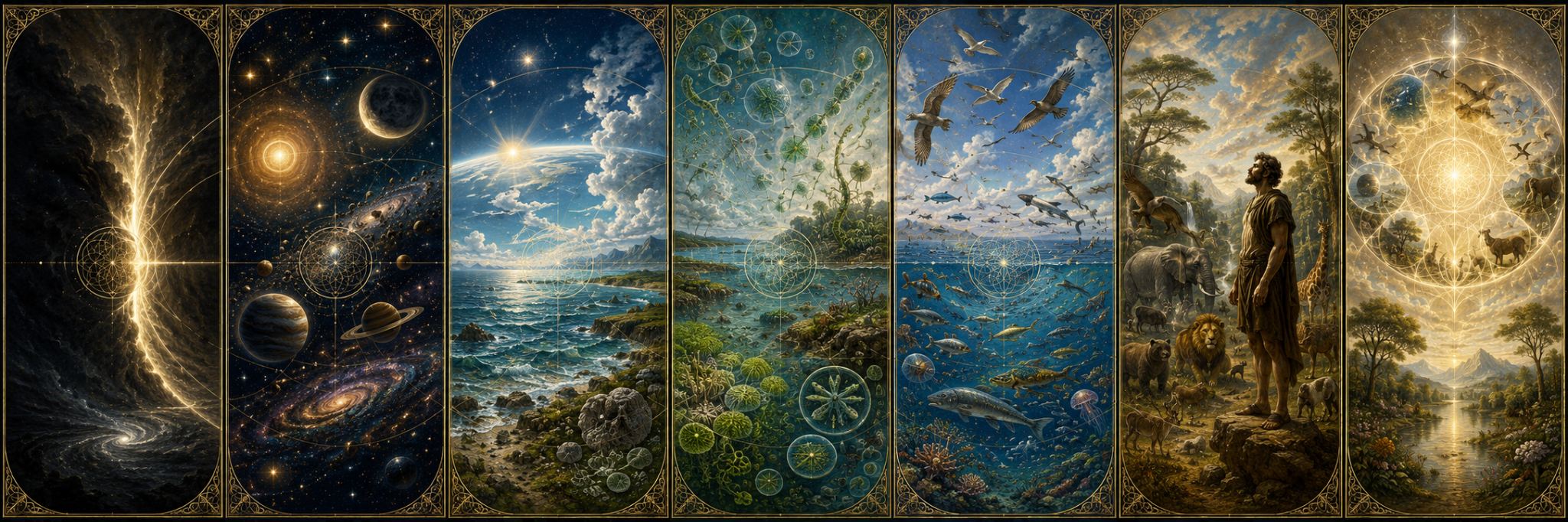
Status and Boundaries
No document in the Evolutionary-Phase Theism (EPT) project aims to prove the existence of the Creator scientifically. Such a task lies beyond the scope of natural science, since the scientific method investigates objects, states, and causal relations within the observable world, whereas the Creator is understood not as another object within that world but as the Source of being itself, of its laws, and of the possibility of existence.
This boundary can be clarified by analogy. A microscope can investigate the composition of ink, the arrangement of marks, and the structure of paper, but it will not discover the author of a book as another element among the printed letters. Authorship belongs to a different level of inquiry and is recognized not within an isolated part of the text but through reflection on the work as a whole. This analogy does not by itself prove the existence of the Creator. It merely shows why the demand to discover Him as a physical object or derive Him from a scientific formula involves a category error.
The EPT project does not replace the scientific history of the world with a theological scheme, nor does it select Acts from a list of unresolved scientific problems. The architecture of the hypothesis is determined by the text of Genesis, while scientific knowledge tests how well the proposed correspondences accord with the actual history of the world. Baryogenesis, a long-term terrestrial aqueous regime, the emergence of heritable life, eukaryotic integration, and the transition to a personal subject are treated not as proofs of the Creator but as working points of comparison. Each point must connect the function of a biblical image, a positively specified novelty, and a definite place in the sequence of becoming.
An Act opens a new phase but does not replace its natural history. Natural processes preserve the conditions that have been established, unfold the possibilities available to them, and produce results not prescribed in advance in every detail. A new Act does not abolish grounds opened earlier: material stability is preserved in the aqueous world, the aqueous environment in the biosphere, heritable life in the complex organism, and biological embodiment in the embodied person. The phases are therefore sequential at their root-level thresholds and nested in terms of the possibilities they preserve.
If it is sufficiently shown that the proposed transition is attainable within the possibilities of the preceding level, the corresponding comparison loses force on its own defined terms. It may not be moved to another unresolved transition while retaining the previous Act under a new scientific name. The natural-emergent status of a novelty does not eliminate its reality, but it does mean that the novelty does not constitute an independent root-level boundary of this map. The openness of a scientific question is not by itself evidence of a special action of the Creator. The seven-Act map is a specialized part of EPT and does not exhaust the entire philosophical-theological hypothesis.
The project’s physical module, including the specific formalization of the proposed prephysical ground of the First Act (F), has a secondary and revisable status. Its success confirms only the corresponding technical claims. Its failure requires those claims to be abandoned, but does not automatically amount to the failure of the constitutive core of the First Act, the seven-Act map, EPT as a whole, or belief in the Creator. At the same time, a specific physical correspondence cannot be retained after it has failed merely because the metaphysical question of the ground of being remains open.
If the coherent system of key correspondences between the seven Acts and the history of the world collapses, the seven-Act hypothesis may lose its force as an integral interpretation. What is then subject to testing and revision is the proposed human reading, not the Creator and not Revelation.
A Perspective for Reading Genesis
The days of Creation are understood here not as identical calendar days but as completed cycles of meaning. The hypothesis correlates their structure with the Acts—actions of the Creator by which what is genuinely attainable is established or expanded. When the text of Genesis is compared with the history of the universe, a question arises about the order of the Acts. The biblical fourth day is devoted to the luminaries, whereas in the proposed framework its central function is correlated with the Second Act, baryogenesis, and the stabilization of the observable material line. A believing reader naturally wonders whether such a rearrangement amounts to an attempt to correct Revelation in light of modern science.
The hypothesis proceeds from a distinction between the order of biblical images and the order of ontological grounds. The days retain their place in the text, but their semantic functions unfold on several levels.
The first internal key to such a reading lies in the text itself. The formula vayehi erev vayehi boker (“and there was evening and there was morning”) closes the first, second, and third days before the appearance of the Sun, Moon, and stars, which on the fourth day are charged with governing day and night and serving as signs for seasons, days, and years. If the first three days are understood exclusively as ordinary solar days, a question arises: what determines their evening and morning before the heavenly luminaries are established as regulators of time?
The structure of the text thus itself separates the rhythm of creation from the familiar astronomical calendar. The formula “and there was evening and there was morning” retains its direct meaning but ceases to be tied only to the movement of the Sun across the sky. In the composition of the text, evening marks the completion of one act of creation, while morning marks the appearance of a new state of the world arising from that act. The words erev and boker therefore become not only designations of times of day but also signs of the transition from a completed action to a new order.
The Hebrew word yom, “day,” has a broad semantic range. It can denote the daylight portion of a day, a calendar day, the time of an event, or a more extended period. In Genesis itself, the expression “in the day that the Lord God made the earth and the heavens” encompasses the entire sequence of creative actions described earlier rather than a single calendar day.
A nonliteral understanding of the days existed long before the rise of modern geology and cosmology. Already in the period of Hellenistic Judaism, when there was no concept of billions of years of cosmic history, Philo of Alexandria interpreted the days of creation as an expression of the order and structure of the world rather than as the time the Creator needed for sequential physical labor. The internal composition of the text and the ancient tradition of its interpretation converge on one point: the days of creation carry not only a temporal but also a dimension of meaning. Each day gives form to a completed act in the unfolding of Design. This allows the days to be understood not as equal physical intervals but as completed cycles of meaning. Their sequence establishes the order in which Design unfolds, but need not measure it in earthly hours.
The Functional Meaning of the Fourth Day
The language used to describe the appearance of the luminaries is especially significant. In the Hebrew text of the fourth day, the verb bara, associated with God’s distinctive creative action, is absent. Instead, the verbs asah, “made” or “fashioned,” and natan, “gave,” “placed,” or “set,” are used. The meanings of these verbs cannot be reduced to a rigid formula. Bara does not always mean creation from absolute nothingness, and asah does not mean only the working of already existing material. Their semantic ranges overlap. Yet the choice of words on the fourth day accords well with the overall character of the passage: the emphasis falls not on the physical mechanism by which stellar matter came into being, but on assigning the luminaries a particular function. They are to divide day from night; illuminate the Earth; serve as signs; determine seasons, days, and years; and set the visible rhythm of the terrestrial world. The fourth day is therefore read in this hypothesis as a transition from the physical existence of cosmic objects to their terrestrial manifestation and function. The luminaries enter the human world as points of orientation, measures of time, and visible signs of an ordered cosmos.
Two Perspectives on Creation
The proposed hypothesis distinguishes two interconnected perspectives for reading Genesis.
The phenomenological perspective preserves the order of the biblical days and presents the world as it enters the human horizon: light is separated from darkness, the waters are divided, dry land appears, and the luminaries become signs of seasons. This is an order of manifestation, not a technical chronology of physical processes.
The ontological perspective asks what earliest condition made the function of each image possible. The fourth day therefore retains its place in the biblical composition, while its function may be correlated with an earlier material ground: the luminaries become the visible maturity of cosmic order, and baryogenesis one of the conditions of its history. By the same principle, the division of the waters is correlated with a stable environment, and the earth’s bringing forth with the emergence of a living order.
These perspectives do not form two competing versions of Revelation. The biblical text unfolds Creation in the order of images and functions, whereas the ontological map is a modern human attempt to reconstruct the sequence of conditions that made this manifestation possible. A difference in sequence does not imply an error by the Creator or the falsity of Revelation.
The rearrangement occurs only within the proposed map of correspondences, and the hypothesis bears responsibility for it. If the hypothesis lacks sufficient justification or comes into conflict with the text and the history of the world, it is the human reading that must be revised, not the Book of Genesis.
One possible physical background for the appearance of the luminaries to a terrestrial observer is a change in the early atmosphere, in which diffuse light reaches the surface before the Sun, Moon, and stars become clearly distinguishable. The hypothesis, however, does not depend on a single atmospheric scenario. Its central claim is not a reconstruction of a particular cloud cover, but a distinction between the physical existence of the luminaries and their entry into terrestrial experience as points of orientation, signs, and measures of time.
The correspondence is drawn not between an ancient word and a modern formula, but between functions in two languages of description. The text of Genesis speaks in the language of separations, images, and transitions of meaning. Modern science speaks in the language of physical, chemical, and biological mechanisms. In the proposed perspective, these languages do not replace one another: the biblical order retains its own inner truth, while the scientific history of the world helps reveal the order of fundamental conditions.
In selecting correspondences, the hypothesis looks not to the external resemblance of a biblical image to a later scientific event, but to the earliest fundamental condition that makes the function of that image possible. The central function of each day is therefore correlated not with the latest visible form, but with the transition without which that form and its role could not have arisen.
At the same time, imagistic language does not perform exactly the same function in every part of the text. As long as the subject is the cosmos, environment, and life, the images are correlated primarily with the external history of the world, accessible to third-person description. With the transition to the Edenic block, the center of attention changes: the subject is no longer the first emergence of inner experience as such, but a distinctively personal form of self-relation—the capacity to relate lived experience to one’s own biography, acknowledge a deed as one’s own, regard an obligation as binding on oneself, and respond freely to the Creator. In the anthropological block, a personal-ontological register is therefore added to external description. The ground of this transition is considered in the Sixth Act.
The General Logic of the Seven Acts
Each Act is correlated first with the function of a biblical image and then with the qualitative transition or condition in the history of the world without which that function could not have been realized. The incompleteness of a scientific mechanism affects the assessment of a correspondence but is not the basis for choosing the Act itself.
An Act of Creation is an action of the Creator by which what is genuinely attainable is established or expanded, thereby setting the root-level boundary of a new phase. The action itself is not a directly observable event within scientific description. What is available to investigation are the states of the world, processes, transitions, and consequences with which the hypothesis correlates the Act.
New attainability does not mean merely the appearance of an unfamiliar or complex result. Within the defined scope of the relevant correspondence, the hypothesis claims that the preceding level had no sufficient path to the proposed novelty. That scope links in advance the function of the biblical image, the positively specified type of novelty, and the limit at which the specific correspondence loses its force. Once such a correspondence fails, the Act may not be moved to the next unresolved problem.
An Act and a phase are not two names for the same event. The Act denotes the root-level establishment of a new regime, while the phase is its natural historical unfolding up to the next root-level threshold. The beginning of a biblical day, the preparatory history, the root-level transition, and the mature result therefore need not coincide at a single point in time. Possibilities opened earlier do not disappear but continue to operate within subsequent phases.
A physical phase transition is a natural change between regimes of an already existing system within the physical possibilities available to it. Emergence is qualitative novelty arising from the organization and interaction of already existing elements within the range available to the world. Neither a physical phase transition nor emergent novelty is by itself an Act. Emergence does not compete with Creation: it describes the natural unfolding of possibilities within an already established order.
A miracle is likewise not identical with an Act. A miracle is a special action of the Creator within an already established order. It may alter the ordinary course of causes, become a sign or a mode of Revelation, and have exceptional historical or personal significance, but it does not establish a new foundational ground or a new phase of Creation. The fact that an event remains unexplained is not by itself evidence either of a miracle or of an Act.
The distinction between an Act and its preparatory history is especially clear in the Fourth and Sixth Acts. The Fourth includes the completion of the formation of dry land and seas, but its root-level novelty is heritable life. The Sixth includes the development of animals and the preparation of the biological bearer, but its root-level novelty is the personal subject. Preparatory movement may enter the internal composition of an Act without constituting its root-level boundary.
The common mark of an Act is not a necessary increase in complexity, but what becomes newly attainable. The First Act concerns the gift of being and distinguishable order. The Second concerns the stable continuation of the material line. The Third concerns a long-term terrestrial aqueous regime. The Fourth concerns heritable life. The Fifth concerns integrated eukaryotic organization, within whose natural history multicellularity, perception, action, nervous systems, and subjective experience unfold. The Sixth concerns the personal subject, normative authorship, and free response. The Seventh concerns the completion of the initial establishment of foundations and sanctified wholeness, within which personal relation with the Creator continues.
This sequence is not a physical formula and does not describe a ready-made future implanted in the world in every detail in advance. It is a map of meaning that traces conditions and root-level thresholds within which the created world acquires the possibility of having a history of its own.
Scopes of Uniqueness
and Domain of Application
The biblical text has a universal theological horizon: it speaks of the Creator of all reality. The seven-Act reconstruction has a more specific task. It traces the line of our created order and terrestrial history leading to the human being, freedom, and relation with the Creator. The seven Acts are therefore not presented as an exhaustive list of all possible creative actions of the Creator.
The First Act occupies a special place in this line. It is constitutively unique with respect to our created order: what is at issue is not the first event within an already existing universe, but the gift of being itself, distinguishability, and the possibility of the history of this order. Subsequent Acts occur within the reality already established. The First Act establishes the order of their possibility but does not contain the physical, biological, or personal forms of subsequent history in ready-made form.
For the subsequent correspondences, three scopes of uniqueness must be distinguished.
Historical uniqueness means that an event occupies a single place in the terrestrial line being traced.
Typological uniqueness would mean that the very type of such a transition occurs only once.
Cosmic uniqueness would mean the absence of anything similar throughout our created order.
The historical uniqueness of a particular terrestrial threshold does not automatically entail either typological or cosmic uniqueness.
Similar local histories therefore do not by themselves refute the seven-Act map. Long-term liquid water on another planet is compatible with the terrestrial meaning of the Third Act. An independent biosphere is compatible with the terrestrial correspondence of the Fourth, although it would become exceptionally important evidence for testing the attainability of life. A nonhuman subject of experience belongs within the natural-emergent history of subjectivity accepted by the hypothesis. A convincing nonhuman person would raise a separate question about that person’s personal ground and relation with the Creator, but could not be excluded in advance merely because the person does not belong to the earthly human personal lineage.
A similar physical or biological realization does not yet repeat an Act in the fullness of its theological meaning. In the seven-Act map, an Act occupies a particular place in the history of Creation being traced. The discovery of an analogue therefore requires us first to determine whether it is a realization of a possibility already opened or points to an independent history of creative relation.
The scope of the claims of this reconstruction is limited to our created order. The question of whether other orders or universes exist, how many there may be, and what their mode of being might be lies beyond its scope. Even the expression “before the First Act” is conditional because it presupposes time, whereas the metric order of time itself already belongs to created reality.
The First Act — the First Day of Genesis: the Gift of Being, Light,
and Distinguishability
“In the beginning God created the heavens and the earth. The earth was formless and empty, and darkness was over the deep, and the Spirit of God was hovering over the waters.”
This is how the Book of Genesis opens in the Russian Synodal translation. But the Hebrew text permits a broader semantic rhythm in its opening lines. It begins: “Bereshit bara Elohim et hashamayim ve’et ha’aretz.” In the NRSVUE, the opening is rendered: “When God began to create the heavens and the earth…” Bereshit can therefore be understood as pointing not only to an absolute beginning but also to the beginning of an unfolding creative action.
The proposed hypothesis, however, does not depend on choosing between these two translations. What is decisive for it is the formula “the heavens and the earth” itself. Here it is read as a merism, that is, as naming a whole through two extreme poles. “The heavens and the earth” denote not two already completed objects but the fullness of the world being created—what modern language calls the universe.
The “earth” of the following verse should therefore not, within the hypothesis, be prematurely identified with the already formed planet Earth. The text continues to unfold the state of the universe just named. “Earth” expresses its material pole, not yet formed into a stable cosmos. In the modern physical picture, this material line will later unfold into observable matter, stars, planets, and other stable structures, but at the beginning it has not yet been gathered into distinguishable forms.
In modern Hebrew, the term ha-yekum is used for the universe in the physical and astronomical sense. In biblical usage, yekum did not yet have this cosmological meaning: in the account of the Flood, the expression kol ha-yekum refers to all living things on the surface of the earth. The fullness of the world being created is therefore expressed here not by a specialized term but by the formula “the heavens and the earth,” the two extreme poles of a single whole.
For a moment, imagine yourself facing the same linguistic task: describe the beginning of the world’s becoming without either modern physical terminology or the conceptual apparatus of modern cosmology itself. How can one speak of such a reality when the language does not yet possess developed concepts for its technical description? This thought experiment helps show why the ancient text unfolds the beginning through images of wholeness, formlessness, depth, waters, darkness, and light.
The words “formless and empty” do not speak of absolute nothingness or of an absence of all content. Within the hypothesis, they disclose the internal composition of the First Act: the world receives being, but it has not yet been divided into domains, filled with stable objects, or given a completed structure. The gift of being and its first unfolding in a distinguishable order belong to one Act, not to two independent thresholds.
The waters express a primordial depth not yet divided into stable domains and forms. A cautious physical analogy may be the early plasma state of the universe, in which atoms, stars, and familiar material structures did not yet exist. The resemblance concerns only the function of the image, not a literal identity of waters and plasma. Above this depth is the presence of the Creator’s Spirit; differences, boundaries, and order have yet to become manifest. Against this background comes the first direct command:
“And God said, ‘Let there be light.’ And there was light.”
Light becomes the first manifest distinction within the First Act. The world emerges from formlessness: the first boundary, the first manifestation, and the first possibility of distinguishing one state from another appear.
Modern cosmology describes the early expansion of the universe by means of inflationary models. These models help explain its observed large-scale homogeneity and are connected with the resolution of the horizon problem. Quantum fluctuations during inflation are regarded as the source of primordial inhomogeneities from which cosmic structure later grew. Observations, however, only constrain the set of possible inflationary scenarios; they do not single out one mechanism or derive all initial conditions from it. A separate question remains as to why the fundamental parameters of physics permit stable evolution leading to the formation of complex structures at all.
Within accessible physical history, light finds expression in electromagnetic interaction and its quanta. Long before the first stars, radiation already belongs to the structure of the early universe, and after recombination it becomes able to propagate freely and preserve information about the universe’s past.
But physical light does not exhaust the meaning of the First Act. It becomes a later manifest expression of the primordial gift—the world’s capacity to have differences, carry them, and one day disclose them to a living observer.
The photon is the quantum of physical light. A human being does not see it as a separate object, yet the interaction of photons with the retina is precisely what makes vision possible. In this sense, light occupies a special place among fundamental phenomena: no external instrument is required for a human being to encounter it—the eye itself becomes a living receiver of light. What began as the distinguishability of the world becomes, in a living being, the capacity to see.
Darkness here is neither evil nor an independent entity, but only the absence of manifest light.
The duration of early physical processes does not determine the semantic weight of the Act. The first day occupies a distinct place because without the very possibility of difference no subsequent history could begin. Seconds or other units of metric time cannot be applied to the prephysical establishment of F: the very possibility of such measurement arises later. F therefore is not assigned any notional numerical duration. Physical chronology begins only on the far side of the open prephysical boundary. The phase opened by the First Act continues to the root-level boundary of the Second Act—baryogenesis and the stabilization of the material line.
The First Act is the establishment of
the very possibility for the world to be
a distinguishable order rather
than chaotic noise.
The ground established by the First Act is designated F—in the Russian terminology, an “informational field.” The word field is used here in an extended sense: F is not situated in an already existing spacetime and is not an ordinary physical medium. It is conceived as a created prequantum and pregeometric ground through which the physical world can have differences, relations, and admissible continuations at all.
The informational character of F does not mean that texts, messages, digital data, or ready-made information about the future are stored within it. Its content can be called a primordial grammar of the possible. One thing can differ from another; something can preserve its identity through change; some relations are compatible while others exclude one another; simple differences can compose stable structures, and structures can compose a whole.
With this grammar come the possibility of order and succession, quantity and comparison, proportion and repetition, symmetry and its breaking, composition, and the distinction among the possible, the impossible, and the necessary. F contains no ready-made history of the world, but not every continuation is equally admissible: future history remains open while retaining structural bounds.
F therefore does not contain a ready-made circle, square, number, physical law, or musical theme. An ideal circle already presupposes a geometry in which distance, a center, and equidistance are determinate; music requires time, oscillation, rhythm, and a perceiving consciousness. F establishes deeper conditions under which geometric form, number, periodicity, harmonic relation, and regularity can later become determinate.
Together with F, a primordial order of succession is established. This is not yet physical time: there are no seconds, no rate of passage, and no measurable intervals. One can say only that one thing structurally presupposes another and that what has been attained can become a condition for further continuation.
The First Act does not write the future in advance. It opens a generatively stable unfolding: the world can preserve the conditions of its own continuation while remaining open to novelty. Different admissible paths may lead from a single attained configuration, and the actual universe is one genuinely lived history, not the playback of a tape recorded in advance.
Here lies the boundary of the present model. The hypothesis does not show how primordial distinguishability is related to quantum structure, spacetime, and local physical causation. The first level that already permits formal description is taken to lie on the far side of this boundary. At this physical level, the technical model distinguishes two possible local realizations. Ordinary observable matter belongs to the positive realization. Alongside it, a negative realization is allowed, which does not mean negative mass, negative energy, or antimatter. A particular stable massive component of this negative realization is considered a possible dark-matter candidate; the negative realization as a whole is not identified with dark matter. Both realizations already belong to the physical level and are not ready-made parts of F; their specific structure requires independent construction and testing.
Dusha-Pechat’ likewise is not contained within F and is not derived from it. F designates the created ground of the physical world’s distinguishability, but it is not a personal ground, a source of moral freedom, or a source of relation with the Creator. At the same time, the hypothesis leaves open the possibility that embodied consciousness is related to the deep order of created reality. How this relation is realized is unknown, and it is not described as a ready-made physical channel.
All specific technical constructions in the physical branch beginning beyond the open boundary between F and the first formally describable level have a secondary and revisable status. They investigate a possible architecture of subsequent levels but do not present the transition from F to physics as an already constructed mechanism. Revising them may invalidate the corresponding physical module, but it does not remove the question itself: why the world is capable of differentiation, preserving relations, opening new forms, and continuing its history.
The First Act thus connects the biblical “Let there be light” not with the appearance of a single object but with the gift of distinguishability. The world does not yet possess ready-made forms, but it is no longer boundless muteness: difference, relation, succession, and history become possible within it.
“And God saw that it was good” (Genesis 1:4).
There was evening, and there was morning: the First Act.
The Second Act — the Fourth Day of Genesis: the Sun, Moon, and Stars
The First Act opened the possibility of difference but not yet a stable material history. For stars, planets, and complex structures to arise, matter must be able to survive the early processes of mutual annihilation of matter and antimatter. In the structure of the biblical text, this function corresponds to the fourth day: “and God made the two great lights.” The luminaries signify not the beginning of matter’s existence but its mature, visible cosmic form.
The root-level node of this transition
is baryogenesis and the stabilization of the material line. For roughly every billion particle–antiparticle pairs
destined for mutual annihilation,
there is one excess particle of matter.
A tiny imbalance became the seed
of all subsequent structure.
Modern physics investigates possible mechanisms of baryogenesis, including CP-symmetry violation and processes in the early universe, but no complete quantitative reconstruction of the observed excess of matter has yet been achieved. This incompleteness does not prove an Act. In the present EPT map, baryogenesis serves as the working correspondence for the root-level boundary beyond which material history becomes capable of stable continuation.
The Act does not create ready-made stars and planets. It opens a phase in which the material remainder persists, enters into new combinations, and passes through a cosmic history of its own.
The phase opened by the Second Act continues from the stabilization of the material line to the root-level boundary of the Third Act—the establishment of a long-term terrestrial aqueous regime. Within this natural history, galaxies and the first generations of stars arise, heavy elements form in stellar interiors, and new stars and planetary systems are born from matter enriched by them.
At the late horizon of the phase, the immense history of matter seems to narrow to a single cosmic address—the Solar System. Here it gathers into a particular world: the future cradle of life receives a body, an orbit, and a place in the wider order of the cosmos. Material history thus becomes the stage for the next Act, but the stage itself is not yet ready: Earth must acquire the capacity to retain water, an atmosphere, and chemical balance across geological epochs.
The meaning of the Second Act therefore lies not in “lighting lamps” in the sky but in opening a stable material history capable of traveling from the primordial excess of matter to a world of stars and planets.
“And God saw that it was good” (Genesis 1:18).
There was evening, and there was morning: the Second Act.
The Third Act — the Second Day of Genesis: the Division of the Waters
Here the scale shifts abruptly. From the boundless cosmos, the gaze narrows to a single planet. In the ancient text, this central function is expressed through the image of the “division of the waters”; from the perspective of the hypothesis, it corresponds to the formation and long-term preservation of a terrestrial aqueous regime in which ocean, atmosphere, and solid surface form a stable integrated system.
The young Earth gradually cools: the magma ocean gives way to a solid crust, water vapor condenses, and the atmosphere and hydrosphere enter a long shared history. Water may emerge from the interior and be delivered by small cosmic bodies, but the meaning of the Third Act is not tied to the origin of every molecule. What matters is that the planet retains water and keeps a substantial portion of it liquid across geological epochs.
The mere presence of water is not enough. A long-term aqueous world requires the joint stability of the orbit, atmosphere, temperature range, geological cycles, and protection against excessive loss of volatiles. The temporal form in which this regime is established remains open. The Third Act may have established the initial conditions or encompassed their extended stabilization; the geological duration of the aqueous regime once established belongs to the further unfolding of the phase.
The Third Act is the fine-tuning of
the cradle: preservation of
the hydrosphere, retention of volatiles, and formation of a stable aqueous world. Liquid water and chemical balance persist long enough to open the possibility of
the next transition—the birth of life.
The phase opened by the Third Act continues from the establishment of a long-term terrestrial aqueous regime to the root-level boundary of the Fourth Act—the emergence of heritable life. Science investigates the cooling of the planet and the formation of its crust, atmosphere, and hydrosphere. The hypothesis does not turn the rarity or complexity of this combination into proof of the Creator’s action; it proposes that the stable aqueous regime be seen as a distinct link in the seven-Act architecture.
Matter acquires not only form but patience—the capacity to preserve an order already attained. The atmosphere becomes a shield, the ocean a laboratory. The cradle has been formed; the next Act will open the transition from a stable environment to life.
There was evening, and there was morning: the Third Act.
The Fourth Act — the Third Day of Genesis: Dry Land, Seas, and Plants
The Fourth Act contains two successive movements. First, the waters are gathered within defined bounds and dry land appears. From the perspective of the hypothesis, this completes the formation of a stable surface environment on the young Earth. The planet now has a solid surface, a stable hydrosphere, and an atmosphere; dry land and seas form distinguishable domains, while boundaries among water, air, and minerals create many local chemical environments. The prepared terrestrial stage acquires a completed structure and becomes capable of preserving for a long time the conditions necessary for the next transition.
“And God saw that it was good” (Genesis 1:10).
Then comes the command: “Let the earth bring forth vegetation, plants yielding seed.” In biblical language, life immediately appears as growth, reproduction, and the capacity to continue itself. From the perspective of the hypothesis, “vegetation” is not the literal appearance of already developed botanical species. It becomes the image of a more fundamental event—the birth of a living order.
The emergence of life becomes the root-level transition of the Fourth Act. The prepared planet provides the necessary conditions, but living order begins where a chemical process continues beyond an individual reaction: a system appears that can maintain its own boundary, exchange matter and energy, reproduce its organization, and pass that organization onward.
Science investigates possible paths of this transition—the RNA world, primordial metabolism, protocellular compartments, mineral surfaces, and wet–dry cycles. A sufficient and testable natural reconstruction of the emergence of heritable life will deprive this correspondence of causal force as an independent root-level boundary. Life itself will nevertheless remain a qualitatively new natural regime. Its novelty can already be stated positively: the result of a previous process becomes a condition for the next.
The Fourth Act marks the threshold at which matter first acquires memory.
From chemical variability emerges
a stable heritable record encoded
in molecular form.
The first living systems still depended entirely on local flows of matter and energy. They existed by virtue of heat from the Earth’s interior, minerals, and geochemical gradients, making use of possibilities already provided by the environment. But then another transformation occurred: life learned to capture light directly and convert its energy into chemical bonds and its own structure.
Photosynthesis appeared. The Sun, which until then had merely warmed stones with indifference, became food.
Oxygenic photosynthesis transformed not merely an individual organism but the entire surface environment of the planet. Life began to transform ocean and atmosphere, participate in mineralization, and leave a trace in the stone record of Earth. Light entered the biosphere as chemical energy sustaining heritable organization.
The phase opened by the Fourth Act continues from the emergence of heritable life to the root-level boundary of the Fifth Act—eukaryogenesis. Within this natural history, life becomes established in the oceans, harnesses light, and begins irreversibly to transform Earth’s surface environment.
The complex cell still lies ahead, but the root-level transition has already occurred: the result of one life cycle can be preserved, passed onward, and become a condition for the next. A heritable record turns the past from a vanished event into an active part of continuing life.
“And God saw that it was good” (Genesis 1:12).
There was evening, and there was morning: the Fourth Act.
The Fifth Act — the Fifth Day of Genesis: Fish and Birds
Here the scale of life itself changes. In the Fourth Act, life acquired memory and the capacity to continue its own organization. In the Fifth, internal order becomes coordinated action. The root-level transition lies not in the appearance of fish and birds, but in an internal reorganization of living systems: the complex cell brings previously separate functions into a single architecture capable of sustaining multilevel coordination.
Modern biology associates this threshold with eukaryogenesis. Endosymbiosis, transfer of genetic material, and increasingly complex intracellular regulation create a new kind of wholeness: the nucleus, organelles, membrane systems, and energy metabolism no longer operate merely alongside one another but as parts of a single organized order. The incompleteness of the historical reconstruction does not prove an Act; the novelty lies in the very capacity to sustain internally differentiated activity as one whole.
The Fifth Act is not a catalog of species.
It is a transition from living memory
to organized action. The internal architecture of the complex cell opens
the way to multicellularity, tissue specialization, movement, and perception, and then to
the diversity of fish and birds.
The complexity of an individual cell does not yet create the animal world. That requires the coordination of many cells, division of functions, the emergence of tissues, organs, nervous systems, and an overall body plan. Movement extends beyond the locomotion of a single cell and becomes the action of an entire organism: seeking, avoiding, feeding, orienting, and exploring the environment. The biosphere fills with bodies, signals, sense organs, and forms of behavior; life no longer merely persists in space but actively reads it and responds to it.
The phase opened by the Fifth Act continues from eukaryogenesis to the root-level boundary of the Sixth Act—the transition from an already existing subject of experience to the personal subject. Its early horizon is associated with the eukaryotic cell and the first forms of multicellularity. Specialized tissues, nervous systems, and mobile bodies then arise and fill the oceans. At the later horizon, life enters land and air.
The biblical fish and birds become not a list of species but the visible maturity of a new capacity: life perceives the environment, acts within it, and enters different domains. The blessing “be fruitful and multiply” expresses not merely the continuation of a heritable record but the active spread of organized life, the multiplication of its forms, and the expansion of the inhabited world.
Perception, behavior, and subjective experience arise and develop within the natural history of sentient life and nervous organization. EPT treats subjective experience as a natural-emergent novelty without thereby claiming that the mechanism of its emergence has already been exhaustively explained by science. It also remains open whether every experience already involves a minimal self-relation or whether a weaker perspectival givenness is possible without such appropriation.
The boundary of the Sixth Act lies not between external action and the first inner experience, but between an already existing subject of experience and the proposed personal subject.
“And God saw that it was good” (Genesis 1:21).
There was evening, and there was morning: the Fifth Act.
The Sixth Act — the Sixth Day of Genesis: Animals and the Human Being
In the text of Genesis, the sixth day begins with the image of animals. In the proposed perspective, this animal block belongs to the preparatory composition of the Sixth Act and unfolds within the natural history opened by the Fifth Act. In the course of this history, mammals enter diverse terrestrial environments, while some lineages return to the water and give rise to marine mammals. At the same time, bodily organization, the nervous system, behavior, and social relations become more complex. Primates arise within one terrestrial lineage, and their development prepares the biological basis of the future human being.
This first part of the sixth day concludes with the words:
“And God saw that it was good” (Genesis 1:25).
The animal stage receives a meaningful completion of its own. At the very least, many animals may be genuine subjects of experience; the precise boundary of such experience and its internal structure remain open questions. The development of animals belongs to the composition of the sixth day but is not the root-level novelty of the Sixth Act.
The Sixth Act marks the transition from an already existing subject of experience to a personal subject capable of relating lived experience to one’s own biography, acknowledging a deed as one’s own, accepting responsibility, and freely responding to the Creator.
Up to this point, the text has predominantly unfolded the world’s becoming through states, processes, and results accessible to third-person description. One can investigate matter, reconstruct planetary history, compare organisms, trace evolutionary changes, and study the causal mechanisms of behavior.
As the text turns to the human being, the perspective from which it is read changes as well. The Edenic block shifts the center of gravity toward first-person reality—one’s own life, freedom, address, prohibition, choice, responsibility, and relation with the Creator. The novelty concerns not the first emergence of inner experience as such but the proposed distinctively personal form of self-relation: lived history becomes one’s own biography, an action becomes one’s own deed, an obligation binds the subject themselves, and the future is understood as the future of the same “I.”
Here a hermeneutical trilemma arises. If all the images of Eden are understood as ordinary physical objects and events, a direct reading requires numerous additional explanations. If an imagistic reading of these descriptions is allowed without a defined boundary, the reading risks dissolving the real subject matter of the text into arbitrary allegory. EPT chooses a third path: the images of Eden are correlated with a real anthropological and personal novelty, while the precise mode of being of the reality behind them is not reconstructed beyond what can be independently justified.
The references to death “on that day,” the opening of the eyes of people who already see, the tree of life, the fruit, the serpent, and expulsion show that the Edenic text does not reduce to an ordinary physiological and calendrical description. But these images do not by themselves prove the existence of a separate world, a special physics, or a mode of Edenic being known to us. A mixed reading is permissible only if it can explain its own criterion and preserve the coherence of the text’s entire structure.
Dust, breathing, the rib, the garden, the tree, the fruit, the serpent, the Fall, and expulsion are understood as earthly images pointing to real relations within Edenic history. Imagery does not mean fiction, but the properties of an image cannot automatically be transferred to the reality it depicts.
Dust points to the created status of the Edenic Self. The act of breathing into the human being expresses the gift of a personal ground and of personal relation with the Creator, not the emergence of subjective experience as a psychic mechanism. The garden conveys the immediacy of relation. The tree signifies an established boundary, the fruit an attempt at appropriation independently of the Source, and the serpent a temptation directing freedom toward self-isolation.
The Fall, in this perspective, is a real and free rupture in relation with the Creator. Its meaning lies not in the physical properties of the fruit but in the direction of the will. Expulsion signifies not merely a geographical relocation but the loss of former immediacy and a transition to the earthly history of limitation, labor, and mortality. The body itself is not declared evil or a punishment.
These meanings are proposed as a coherent hermeneutical construction, not as the only possible decoding or as knowledge of the precise structure of Eden. The Edenic module asserts only those ontological distinctions necessary for its own coherence; the mechanism and precise mode of being of this reality are not reconstructed without independent grounds.
The Russian term Dusha-Pechat’—literally “Soul-Seal”—designates a proposed created personal ground at the conceptual boundary between an already existing subject of experience and a personal subject. The personal ground is not a physical object, a spiritual particle, a mechanism of consciousness, a region of the brain, memory, a gene, a special energy, or subjectivity itself. The seal metaphor expresses the completeness of the imprint in each embodied bearer and does not describe a physical mechanism of transmission.
A complete imprint means neither a fragment nor a diminished copy of the personal ground. Each embodied bearer receives the fullness of the personal ground. This does not create a shared empirical memory, a shared consciousness, a shared center of decision, or shared responsibility: each embodied person has their own bodily history, perspective, biography, freedom, and responsibility.
In terms of the seven-Act architecture, there is one root-level boundary here: the transition from an already existing subject of experience to a personal subject. In the Edenic module, the proposed personal ground is understood as one Edenic Self, ontologically prior to its internal differentiation. The Adamic and Evean principles are two real, complementary distinctions within the single personal ground. Two previously existing persons do not combine into one Self; one Edenic Self unfolds as internally differentiated into two principles.
These principles are not two persons, two souls, halves of one soul, or independent substances. Neither is defined as active or passive, higher or lower. They cannot be identified with biological sex, social roles, or psychological types. EPT leaves open whether a single personal ground can be metaphysically simple and at the same time genuinely differentiated within itself; the precise metaphysics of this differentiation is not reconstructed.
With the transition to earthly history, two distinct embodied persons arise—Adam and Eve. Each bears a complete imprint of the single personal ground, including both internal principles of the Edenic Self; these principles are not distributed between male and female bodies. The internal differentiation of the Edenic Self and the transition to two distinct earthly persons belong to the internal composition of the Sixth Act. The further spread of the complete imprint belongs to the continuation of the human personal line opened by the Sixth Act.
In this model, an embodied human being is the unity of biological Homo sapiens and a complete imprint of the personal ground. The complete imprint enters a concrete bodily biography but does not reduce to the body, memory, intelligence, language, brain state, or a set of observable capacities.
A subject of experience is one for whom something is experienced. If pain, color, sound, a bodily state, or some other content is given not only to an external observer but to the experiencer, there is subjective experience. EPT places its emergence within the natural-emergent history of sentient life and nervous organization without thereby claiming that the mechanism by which subjectivity arises has already been exhaustively explained by science.
The formula “for whom something is experienced” marks the perspectival givenness of experience but does not settle its internal structure in advance. It remains open whether every subjective experience already involves a minimal self-relation, in which the experience is given as belonging to the experiencer, or whether a weaker perspectival givenness is possible without such appropriation. This question concerns the internal structure of subjectivity and does not by itself constitute a new ontological level or a separate Act.
A personal subject is a concept concerning the way a subject relates to their own life: the past belongs to them as their biography; an action remains their deed; the future is understood as the future of the same “I”; an obligation binds them; authorship has normative significance; responsibility attaches to them as the one who acted; and freedom of response and relation with the Creator have a personal character.
Personal self-relation includes the possibility of returning to oneself within one’s own biography. A subject can make a past deed or an enduring pattern of behavior an object of present reflection, justify themselves or revise their previous direction, and connect that assessment to subsequent action. The “I–Thou” relation belongs to this same personal dimension: the other becomes an independent addressee of personal response.
This is a substantive description of the personal mode of being, not a functional list of necessary and sufficient conditions. Memory, language, moral reasoning, self-reference, reflective self-evaluation, and observable responsibility may manifest the personal mode of being, but none of these features, taken by itself, is equivalent to being a person or is the material from which a person is composed.
Perception, memory, learning, self-representation, and social behavior may develop gradually. A gradient of capacities does not by itself settle the question of the personal subject. The presence of gradual cognitive preconditions is compatible with the proposed qualitative personal novelty but does not by itself prove it.
By the time of the Sixth Act, a broader biological population of Homo sapiens already exists, having arisen through natural evolutionary history and capable of including developed subjects of experience. EPT does not derive the human biological species from a single pair. Before the proposed first embodiment, one may speak of prepersonal Homo sapiens. They are not insentient automata or philosophical zombies: they may have experienced pain, fear, pleasure, and attachment, possessed memory, learned, maintained complex social relations, and acted flexibly.
The Sixth Act therefore is not the creation of the biological species Homo sapiens from scratch, a new genetic mutation, or the first appearance of consciousness. Biological evolution prepares the bearer; the root-level novelty of the Edenic correspondence is the personal subject.
EPT does not assign a calendar date to the first earthly embodiment. Biblical genealogies and traditional chronologies belong to the history of interpretation but are not treated as a basis for scientific dating within the model. Archaeological signs of language, tools, art, burial, or social complexity likewise do not permit the transition to be localized precisely, because they do not constitute an exhaustive test for a personal subject.
What matters for the model is that the earthly Adam and Eve belong to the already existing biological history of Homo sapiens but become the first two embodied persons from whom the earthly human personal line begins. Here the Edenic hypothesis introduces a personal ground, not a new biological form and not the first subjective experience.
The hypothesis allows kinship unions between the first embodied persons and prepersonal Homo sapiens. The story of Cain provides indirect textual support for this possibility. After killing Abel, Cain fears that someone may kill him; the text then mentions Cain’s wife without prior explanation and reports the building of a city. These details allow for a surrounding population extending beyond the directly named members of Adam and Eve’s family. A traditional reading may associate it with unnamed children and descendants of the first humans. Within the proposed hypothesis, another interpretation is also possible: a broader population of Homo sapiens already exists by the time of the first embodiment. The story of Cain does not prove this claim, but it shows that the terrestrial picture of the text does not exclude it.
The further continuation of the line follows an authorial anthropological postulate: a descendant bears a complete personal imprint if at least one parent already belongs to the personal line; biological birth from two prepersonal Homo sapiens who do not yet belong to this personal line does not by itself confer the imprint. This is not an established genetic law. The postulate describes the spread of the personal line within a broader evolutionary population without a genetic “bottleneck” of two individuals. The model does not specify a mechanism for such transmission.
At the same time, three concepts must be strictly distinguished.
Homo sapiens is a biological species.
The human personal class is the normatively recognized class of all human beings who have full status as persons.
The earthly human personal line is a genealogical construction of the Edenic module. These concepts are related but not identical.
With respect to contemporary humanity, EPT proceeds from the premise that
every human being belongs to a single human personal class
and has full status as a person.
Memory, intelligence, language, age, health, disability, independence, emotional expressiveness, behavior, and the actual capacity to bear responsibility at a particular moment do not create degrees of status as a person. The proposed genealogy cannot serve as a basis for distinguishing among individual human beings or human groups with respect to their status as persons.
The concept of personhood is not restricted to the biological species Homo sapiens. A convincing nonhuman, extraterrestrial, or nonbiological person would raise a separate question about that person’s personal ground and relation with the Creator. The Edenic module describes the origin of the earthly human personal line and does not claim that every logically possible person must descend from the earthly Adam and Eve.
A scientific explanation of the mechanisms of subjective experience does not by itself cause the Sixth Act to fail, because subjectivity is not its root-level boundary. For the anthropological correspondence to fail in a serious sense, two independent results are required: a sufficiently complete and independently confirmed natural reconstruction of the manifestations of personal self-relation, and an independent philosophical argument that the personal mode in which a subject relates to their own life is ontologically exhausted by the reconstructed processes. EPT does not look for the person in the residue of causal reconstruction and does not turn an unresolved question into evidence of its own truth.
There is another important feature in the structure of the sixth day. After the creation of the animals comes the formula: “And God saw that it was good.” After the creation of the human being, there is no separate evaluation that “it was good.”
This observation does not by itself prove the proposed reading, but it accords with its internal logic. The animal world receives completion within the natural order. With the appearance of the personal subject, freedom, responsibility, and the possibility of relation, acceptance, and refusal are opened. The human being is not simply another completed object that can be evaluated independently of free response.
Only after the whole sixth day is complete does the concluding formula appear: “And God saw everything that He had made, and behold, it was very good.”
The Sixth Act does not bring biological evolution as a process to an end. It completes the sequence of root-level transitions leading to a personal subject capable not only of being in the world and experiencing it, but also of freely responding to the gift of being.
The phase opened by the Sixth Act continues from the transition to the personal subject to the root-level boundary of the Seventh Act—the completion of the initial establishment of foundations and the sanctified wholeness of Creation. From that next threshold begins the moral and spiritual unfolding of freedom already given within a continuing personal relation with the Creator.
Matter acquired stability.
The environment acquired duration.
Life acquired heritable memory.
Eukaryotic life acquired integrated internal organization, and its natural history unfolded multicellularity, perception, action, and subjective experience.
The Sixth Act introduces the personal distinction: biography, normative authorship, responsibility, and free response acquire a personal character.
The world received not only an experiencing subject, but a personal witness.
“And God saw everything that He had made, and behold, it was very good” (Genesis 1:31).
There was evening, and there was morning: the Sixth Act.
The Seventh Act — the Seventh Day of Genesis: Completion and the Sanctified Wholeness of Creation
The seventh day differs from those that precede it. No new domain of the world, new form of matter, or new living creature appears. After six Acts, attention shifts from individual transitions to the wholeness of the created order. This is no longer a further step of material complexification, but the completion of the initial establishment of the foundations through which the world can exist, develop, and preserve its internal coherence.
The six preceding Acts formed a sequence from the distinguishability of the world to the personal subject. The Seventh gathers these grounds into a single whole and poses a different question: how does a completed order remain open to history, freedom, and relation with the Creator?
The Seventh Act completes the initial establishment of the world’s foundations but does not complete the history of freedom. The sanctification of the whole opens a phase of continuing relation with the Creator, within which personal freedom already given unfolds morally and spiritually.
The completion of primordial Creation does not mean that the universe reaches a final state and ceases to change. Stars continue to be born and die, planets change, life develops, ecosystems are reconfigured, and human history remains open. Sanctification does not turn the world into a frozen form. What is completed is not every future process but the initial establishment of the foundations through which those processes can occur.
The biblical image of the Creator’s rest does not mean fatigue, inactivity, or withdrawal from the world. It expresses the fullness of primordial Creation: the created order can unfold through its own regularities and does not require its foundations to be continually reestablished. At the same time, the world does not become independent of its Source: everything that exists continues to receive being itself from the Creator.
In the biblical text, the seventh day is sanctified. Within the hypothesis, this sanctification is understood as the completion of the initial establishment of foundations and the setting apart of Creation in its wholeness. Design here denotes the coherence of meaning of the whole, but the object of sanctification remains Creation itself, not an abstract plan separate from it.
In philosophical language, a teleological question arises here. Is the history of the world exhausted by a sequence of causes and effects, or do individual processes belong to a broader wholeness of meaning? The presence of Design does not exclude regularity, contingency, and freedom. They may belong to the way the world unfolds, while teleology concerns the meaning of its structure as a whole.
Scientific knowledge does not by itself prove the existence of Design. It investigates mechanisms, establishes relations, and discovers the stability, repeatability, and mathematical expressibility of reality. Human beings do not create this order by their own desire; they investigate it. This is consistent with a view of the world as an internally coherent and knowable whole, but does not turn that view into a scientifically proven conclusion. The Seventh Act shifts attention from individual mechanisms to the whole, from particular regularities to the question of the architecture of meaning.
The created whole includes not only natural order but also the free person. In the Sixth Act, a personal subject appears who is capable of relating to their own life as their own, acknowledging a deed as their own, and answering for it. From the threshold of the Seventh Act opens the moral and spiritual unfolding of freedom already given within a continuing personal relation with the Creator.
Freedom does not require a physical break in natural causation. Bodily, psychological, and social causes can be investigated and can enter the history of a decision. The personal level is disclosed in a subject’s capacity to relate to their own motives, deeds, and enduring patterns of behavior as their own history, evaluate them, and connect that evaluation with a subsequent response.
In relation with the Creator, this freedom takes the form of personal response: it may be acceptance or refusal. The order of the created world does not by itself produce moral choice or replace the person’s free response.
Moral evil arises where the will confines itself to appropriation: truth becomes an instrument of self-justification, another person an instrument of one’s own end. Its source lies neither in the force of desire nor in human materiality. The first honest formula for speaking about evil therefore turns inward: evil also passes through me.
Moral good begins with free consent to open oneself to the Creator and to receive a correction of intention. Inner correction occurs with the free participation of the person: their consent means readiness to receive transformation, but does not produce it by their own power. Divine action and human choice are related here as gift and response.
Suffering has different causal and moral forms. Illness, natural disaster, the death of an animal, and human cruelty require different explanations. Human freedom discloses the possibility of moral evil but does not exhaust the question of natural suffering. The moral line of the Seventh Act is therefore not a complete theodicy.
A person cannot finally correct themselves by the same will whose direction itself needs to change. They can recognize their own deviation, cease to justify it, and turn to the Creator, but cannot make themselves the source of corrective action. The work begins where a person desires not only relief from consequences, the return of inner peace, or confirmation of their own rightness, but change itself.
Such a turning may involve no spoken words. It is not a formula, a promise, or a bargain. It comes from deep within the person when an extraneous aim no longer obscures the need for correction. Outwardly, this moment may remain unnoticed, while inwardly it becomes an ultimate confrontation of the person with themselves.
The desire itself is not yet correction and does not compel the Creator to act. It signifies a free turning, consent, and the cessation of resistance. The person’s freedom does not produce correction by its own power but opens itself to receiving it.
Inner work therefore does not reduce to a single experience or decision. The turning opens a path but does not cancel subsequent responsibility. A person encounters their inclinations, justifications, and drive toward self-isolation again. Their participation is expressed in a readiness to see their own deviation, answer for a deed, and once again choose to consent to change.
A human being participates in the further unfolding of Creation not because they complete unfinished work left by the Creator. Their freedom itself belongs to the already established order of personal history and becomes a place of genuine response. This response finds expression in responsibility, mercy, creativity, and deed, but begins not with outward infallibility but with inward consent to be changed.
The Seventh Act is not the end of history. The Creator’s action in the life of the world does not end here. A human being responds to His presence whenever they choose not self-isolation but truth, responsibility, mercy,
and readiness to receive correction.
Unlike the preceding days, the description of the seventh day does not end with the familiar formula of evening and morning. This observation does not prove that this is the only possible interpretation, but it accords with the internal logic of the hypothesis. The initial establishment of foundations is complete, yet their unfolding continues in nature, history, and free human response. The seventh day remains open not because the Creator has left His work unfinished, but because completed Creation is not deprived of movement, development, or freedom.
Thus the seven-Act structure closes. The preceding Acts establish the foundations of the world and successively unfold its possibilities. The Seventh Act gathers them into sanctified wholeness and opens the space of free response. The world receives the fullness of its order, while the history of its unfolding remains open.
The word has been spoken. The ground has been established. Creation has received wholeness. The history of free response continues.
Conditions for Revision,
Limits of Testability,
and the Status of Correspondences
The seven-Act scheme rests on the structure of the Book of Genesis and is not derived from a list of unresolved scientific problems. Neither the map itself nor the physical module associated with it is intended to prove the Creator scientifically.
To evaluate the hypothesis, four levels of possible failure must be distinguished:
the technical model of an individual transition;
a specific correspondence between an Act and a transition in the history of the world;
the seven-Act map as a coherent system of correspondences;
EPT as a broader philosophical-theological hypothesis.
Failure of the technical model removes a specific formalism, mechanism, or prediction and does not automatically cause the correspondence itself to fail. Failure of one correspondence removes precisely that proposed connection and does not automatically destroy the entire map. The collapse of the system of key correspondences may deprive the seven-Act map of its capacity to function as an integral reconstruction. Failure of EPT means that this philosophical-theological architecture is untenable.
Belief in the Creator has a different status and is not made dependent on the outcome of this scale. An error in a correspondence or in the reconstruction as a whole belongs to the hypothesis, not to the Creator and not to Revelation.
The Creator’s action itself is not observed as an event within natural science. What is available to investigation are states, processes, transitions, and consequences. The expression “trace of an Act” is therefore permissible only as shorthand for the interpreted correspondence, not as a physical marker of the Creator analogous to a particle track in a detector.
A natural mechanism may be considered explanatorily sufficient for a particular transition if it:
accords with observations, causally connects the main stages of the transition, and yields independent testable consequences;
uses initial conditions and parameters that are derived or independently constrained rather than fitted exclusively to the known result;
does not introduce new entities solely to rescue the construction without testable manifestations of their own.
Initial conditions need not be derived by the same theory that describes the transition itself, but they must be established independently of the result the theory is intended to explain.
If these requirements are not met, the scientific question remains open. Yet the openness of a question is not positive evidence of an Act. For each correspondence, the textual function, the positively specified novelty, the defined scope, and the condition of failure are specified in advance. Once a correspondence fails, it is not moved to another unresolved problem.
The First Act.
The Gift of Being and Distinguishable Order
The constitutive core of the First Act concerns not an individual physical event within an already existing universe, but the gift of being, distinguishability, and the possibility of the history of our created order. F designates a proposed created prephysical ground; its specific physical formalization is secondary and revisable.
An empirically successful, more fundamental theory may render a specific model of F redundant, alter the proposed relation between F and observable physics, or eliminate particular technical predictions. Such a result causes the corresponding claims of the physical module to fail. It does not move the constitutive core of the First Act inside an already established physical history or turn the Creator’s action into an observable physical hypothesis.
The Second Act.
A Stable Material Line
The working correspondence of the Second Act is baryogenesis. If a confirmed theory provides a sufficient quantitative derivation of the observed matter–antimatter asymmetry from possibilities already available after the First Act, baryogenesis will lose its force as the root-level boundary of the Second Act.
The natural history of matter, stars, and planets will still remain a real part of Creation, but it will not become a fallback basis for moving the Second Act to a later stage.
The Third Act.
A Long-Term Terrestrial Aqueous Regime
The working correspondence of the Third Act is the formation and long-term preservation of a joint regime of Earth’s hydrosphere, atmosphere, and solid surface.
If such a regime is sufficiently explained as an attainable outcome of preceding planetary history under independently established conditions, the correspondence will lose its causal force. The rarity of the terrestrial combination does not by itself prove an Act, and the mere existence of a similar aqueous regime on another planet does not refute the terrestrial correspondence.
The Fourth Act.
Heritable Life
The working correspondence of the Fourth Act is the emergence of heritable life—a system capable of maintaining a boundary, metabolism, a heritable record, reproduction, and evolution.
A sufficient and testable natural reconstruction of the transition from prebiotic chemistry to heritable life will deprive this correspondence of causal force as an independent root-level boundary.
The independent emergence of life in another local history would not by itself cause the terrestrial correspondence to fail, but it would become crucial evidence for causal testing. Comparing independent paths could substantially change the assessment of the attainability of heritable life.
The Fifth Act.
Integrated Eukaryotic Organization
The working correspondence of the Fifth Act is eukaryogenesis—the emergence of integrated cellular organization with internal architecture and multilevel coordination.
If the origin of such organization is sufficiently and testably derived from the possibilities of the preceding biological phase, the correspondence will lose its force as a root-level boundary.
Multicellularity, tissue specialization, movement, nervous systems, active behavior, and subjective experience are not fallback candidates for the Fifth Act. They belong to the natural unfolding of the organizational possibility already opened. Subjective experience belongs to the natural-emergent history of sentient life even if the mechanism of its emergence remains an open scientific and philosophical problem.
The Sixth Act.
The Personal Subject
The working correspondence of the Sixth Act is the transition from an already existing subject of experience to the proposed personal subject. A complete natural theory of the emergence of subjective experience would explain a transition that EPT already places within natural-emergent history and would not, by the mere fact of its success, cause the Sixth Act to fail.
For the anthropological correspondence to fail in a serious sense, two independent results are required together: a sufficiently complete and independently confirmed natural reconstruction of the mechanisms and manifestations of personal self-relation, and an independent philosophical argument that the personal mode in which a subject relates to their own life is ontologically exhausted by these processes and their causal organization.
A single functional test, neurobiological correlate, or explanation of how an individual decision, memory, or self-report is formed is insufficient for such a conclusion. A causal description may be a description of the psychophysical mechanism through which personal self-relation is realized rather than automatically an ontological refutation of it.
The Edenic Self, the personal ground, the complete imprint, and the genealogical postulate are not directly testable by the methods of natural science. Their status depends on philosophical and theological coherence, correspondence with the biblical text, normative safety, and the absence of internal contradictions. They must not be used to explain an unknown mechanism of subjective experience.
The Seventh Act.
Completion and Sanctified Wholeness
Sanctification, free response, and the Creator’s corrective action are not measurable physical quantities. The Seventh Act is therefore not tested by the same scientific method as baryogenesis, the terrestrial aqueous regime, or the origin of life.
Its correspondence is evaluated primarily textually and theologically: the connection among completion, sanctification, free personal response, and continuing relation with the Creator must be preserved. It must not turn freedom into an automatic mechanism or attribute to the human being the capacity to produce their own correction independently.
A complete natural explanation of the preceding transitions does not refute the Seventh Act in isolation, but the collapse of its supporting correspondences can destroy the seven-Act map within which it performs a concluding function. If the connection among the seventh day, completion, sanctification, and continuing personal relation does not withstand textual and philosophical-theological testing, the present correspondence should be abandoned rather than replaced with an indefinite “spiritual stage.”
Failure of a specific correspondence means abandoning it within its defined scope. The transition itself may remain a significant part of the natural history of the created world, but an Act may not be moved to a new domain of ignorance. A different correspondence would already constitute a new hypothesis and would require a new textual, philosophical, and, where applicable, scientific basis.
A scientific explanation of baryogenesis, abiogenesis, or eukaryogenesis does not prove the absence of the Creator. It determines the natural attainability of the corresponding transition and the fate of the specific correspondence. A complete theory of subjective experience, in turn, explains a transition that EPT already places within natural-emergent history and bears on the broader anthropological question of the Sixth Act only indirectly.
Conversely, a successful model of F or confirmation of some of its predictions supports only the corresponding technical claims. It does not prove Revelation, the entire seven-Act map, or the existence of the Creator.
What is subject to testing and revision is the proposed human reading. The Creator does not become an object within a physical theory, a testable correspondence does not become invulnerable metaphysics, and faith is not inferred from the temporary incompleteness of scientific knowledge.
Appendix. The History of the Transmission of the Text of Genesis
This appendix clarifies one of the grounds for the chosen interpretive perspective: the seven-Act map is a human interpretation of the text that has come down to us and must therefore take account of the history of its transmission without conflating that history with the question of the Source of Revelation. The text of the Book of Genesis, which Jewish and Christian traditions associate with Moses (approximately the fifteenth to thirteenth centuries BCE), has come down to us through a long history of oral, written, and editorial transmission. Centuries of human history lie between the tradition of Sinaitic Revelation and the surviving manuscript forms.
The early Hebrew written tradition used the Paleo-Hebrew script, related to Phoenician. After the division of the kingdoms, invasions, the destruction of Jerusalem and the First Temple in 587–586 BCE, the Babylonian Exile, and the return after 538 BCE, the text was preserved amid a people’s struggle for its own memory and unity. It was copied by people for whom the loss of its content would have meant not the loss of a literary monument but the disintegration of a foundation of their own identity. During the Persian period, a script of Aramaic origin gradually spread, from which the square Hebrew script developed. The signs and historical circumstances changed, while linguistic and semantic continuity was preserved.
In the third century BCE, the translation of the Torah into Greek began in Alexandria; translations of other books were later added. The Septuagint, which arose within a Jewish milieu, became the principal scriptural text for Greek-speaking early Christianity and exerted a formative influence on its Old Testament tradition.
The earliest major Masoretic codices date from the ninth to eleventh centuries CE. The Masoretes supplied the Hebrew text with a system of vowel points, accents, and notes, fixing a tradition of its precise reading.
The Dead Sea Scrolls, produced primarily between the third century BCE and the first century CE, occupy a special place in this history. They made it possible to see the biblical text of the Second Temple period. Among them were manuscripts close to the Masoretic tradition, variants related to the Hebrew Vorlage of the Septuagint, and other textual forms. The history of the text appeared not as the mechanical copying of a single manuscript but as the coexistence of several traditions of transmission.
Traces of extended literary formation are visible in repeated episodes, differences in language, and points where textual blocks are joined. The classical Documentary Hypothesis designated its proposed sources with the letters J, E, D, and P: the Yahwist (J), the Elohist (E), the Deuteronomist (D), and the Priestly source (P). Their precise boundaries and dates remain under discussion, but the composite history of the received form of the Pentateuch remains part of modern textual criticism.
Across changes of script, translations, variant readings, and literary formation, a recognizable architecture of meaning was preserved: the world has a Source; Creation moves from formlessness toward order; life appears; the human being receives a distinctive place and responsibility; and the completion of the world opens a history of free response and moral choice. The text lived in the memory of the people and in manuscript transmission, passing from generation to generation while preserving this internal vector.
Such a history does not turn Revelation into an accidental product of redaction. It shows how meaning enters human time: it is spoken, written down, survives destruction, is translated into new languages, and acquires new written forms. Human transmission does not remove the question of the Source of the text, but neither does it permit us to treat the form that has come down to us as though it arose outside language, history, and the labor of many generations. For the proposed hypothesis, acknowledging this history does not cancel faith in Revelation; it requires a more precise distinction between the Source of meaning and the human form of its transmission.
The Book of Genesis remains a text about the Creator and Design, leading the reader from indistinction to order, life, personhood, and responsibility. It does not provide a technical scheme of physical processes, but it establishes major thresholds of meaning that this work attempts to correlate with the history of the world under investigation. Such a comparison requires neither fitting Revelation to a ready-made scientific scheme nor demanding from it formulas it did not set out to provide, but honestly distinguishing the text, human interpretation, and the reality against which that interpretation is tested.
Alongside the history of textual transmission lies another question: how the text’s meaning-bearing motifs are interpreted anew in other Abrahamic traditions.
The images of Creation receive new expression in the Qur’an as well, where they enter a different composition and theological system. The Qur’an is not an interpretation of the Book of Genesis and does not repeat its structure, but Islam’s place within the Abrahamic tradition shows that familiar nodes of meaning can be read differently and still become the basis of a coherent theological worldview.
This does not in itself support the seven-Act hypothesis or prove the correctness of the proposed rearrangement of images. But it shows that the distinction between textual sequence and subsequent theological interpretation is not merely an interpretive liberty taken by this author alone. Images of Revelation can enter new compositions while retaining their connection with the shared Abrahamic question of the Creator, the world, and the human being.
How the text of Genesis relates to other ancient conceptions of the origin of the world—where it intersects with them and where it differs fundamentally—is examined in detail in the study “Genesis among Ancient Cosmogonies.”