Quanto-flower.
Corrected and supplemented text describing an artistic practice aimed at understanding and exploring the problematic concept of "The Gap Between Image and Reality." The artist combines performative and ideomotor actions with other artistic mediums: painting, graphics, and mixed media.
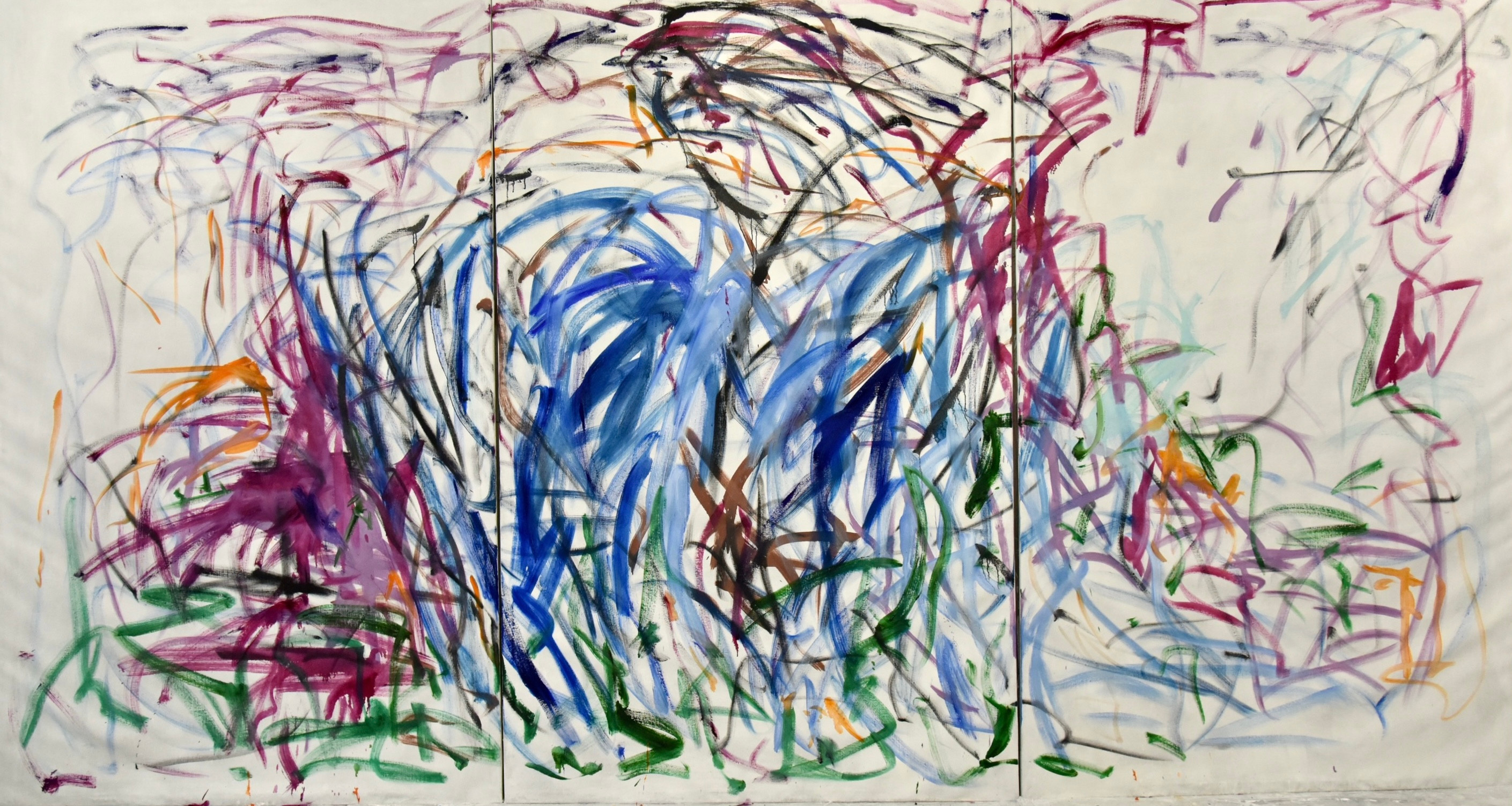
One of the most important stages in understanding the concept of "The Gap Between Image and Reality" is performative painting on large-format canvases. In her "Demon" series, the artist appropriates the image of the Demon from Mikhail Vrubel’s paintings, re-creating it in an abstract expressionist style, inspired by the paintings of Joan Mitchell (for more details, see the previous texts, "The Gap Between Image and Reality," Part I and Part II).
The transition from M. Vrubel’s figurativeness to absolute abstract expressionism allows us to take a fresh look at the internal chaos and tragedy of the classical image, translating Vrubel’s literary and pictorial symbolism into the language of pure gesture, inspired by the American expressionist Joan Mitchell, who reproduced emotional spaces on canvas. Expressive painting becomes a medium where the elemental feminine nature reveals its variability: the color and dynamics of the brushstrokes are transformed, melting into a sensual landscape, preserving Vrubel’s "genetic code." Abstraction here is not just a technique of execution, but an expression of a living, non-static identity that changes directly in the process of applying paint.
Referring to the original work of M. Vrubel, “The Seated Demon, ” 1890 [https://my.tretyakov.ru/app/masterpiece/8393], where the flowering landscape compresses the Demon’s mighty body, creating a physical feeling that the hero is cramped in this world: he is a titan, locked in a narrow space, which visually conveys his inner impasse and the impossibility of self-realization.
Despite the complex palette and abundance of warm hues, the Demon’s skin has a strange earthy bronze sheen, separating him from all lifing things. His eyes look inward, not outward. Working with sharp, cutting movements, Vrubel conveyed the tragedy of the Spirit through the stiffness of the Demon’s posture within a crystallizing landscape that grows from the geogenetic center of the entire canvas—a purple-violet flower in the lower left corner. This flower is both the most vibrant and the most painful point in the painting. Using a blood-red pigment in the center of the bud, Vrubel initiated a point—a "wound."
Turning to the artistic practice of Joan Mitchell, who used metonymy — a separate segment, brushstroke, bloom or withering ("Sunflowers") became not an image of an object, but the very essence of sensation, empathy with the world through pictorial flesh, so the flower-wound separates from the figure of the titan, taking with it all of its internal tension, transforming into an autonomous sensory landscape.
The artist’s subjectivity ceases to be a frozen center- it becomes processual, empathizing with space, unfolding into a voluminous emotional cocoon and generating "seeds of possibility" as a manifestation of a metonymic network, where each seed is a new segment of sensations.
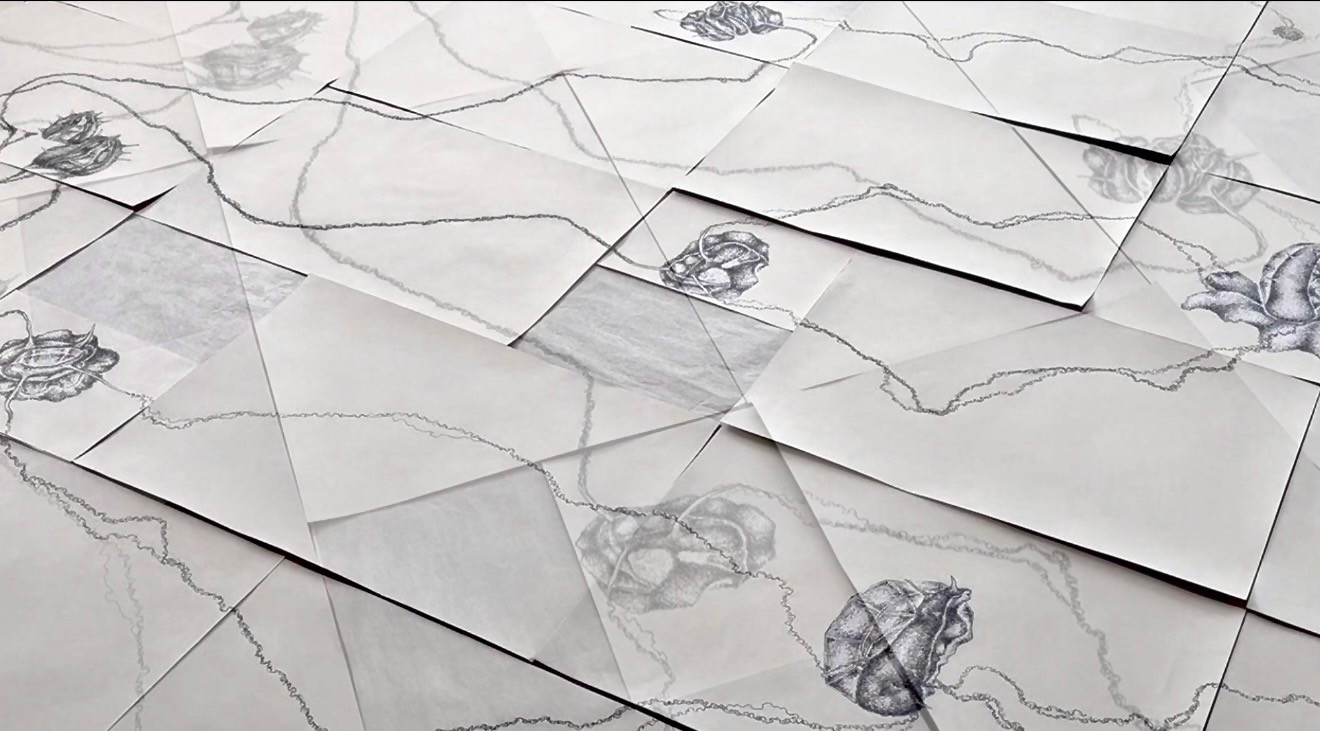
Quanto-flower is a crystalline cocoon pulsating from within. It breathes, expanding in space with a series of gentle pulses, growing into crystalline threads that connect the internal environment with the external space. It is a careful step into the void, a quantum performance. Quanto-flower does not contract after release, it remains open. Space ceases to be empty, it is permeated with connections. Quanto-flower becomes an architect, simultaneously contemplating and self-generating. The connecting threads emphasize that there is no loneliness in this system: all creation remains part of a unified whole.
The transformation of the flower from a painterly brushstroke into a three-dimensional object in space creates a breach of the fourth wall and a materialization of pain. This three-dimensional flower is like a pulsating wound that has transcended the world of art into the world of reality. This flower is a boundary point, an anchor linking the illusory world of the painting with physical reality. The flower’s emergence into volume is also an expressive gesture, disrupting passive contemplation but transforming the painting from an object of study into an active medium that, by invading space, makes the Demon’s tragedy physically tangible.
Quanto-flower is a visualization of a spiritual impulse that has ceased to be constrained by the flatness of the canvas and has acquired volume. It no longer belongs to the Demon, it is autonomous. It is as if the painting’s subconscious has burst forth and begun to live by its own laws of physics, creating the sensation of something existing between worlds: it is a portal through which an idea passes from nonexistence into reality.
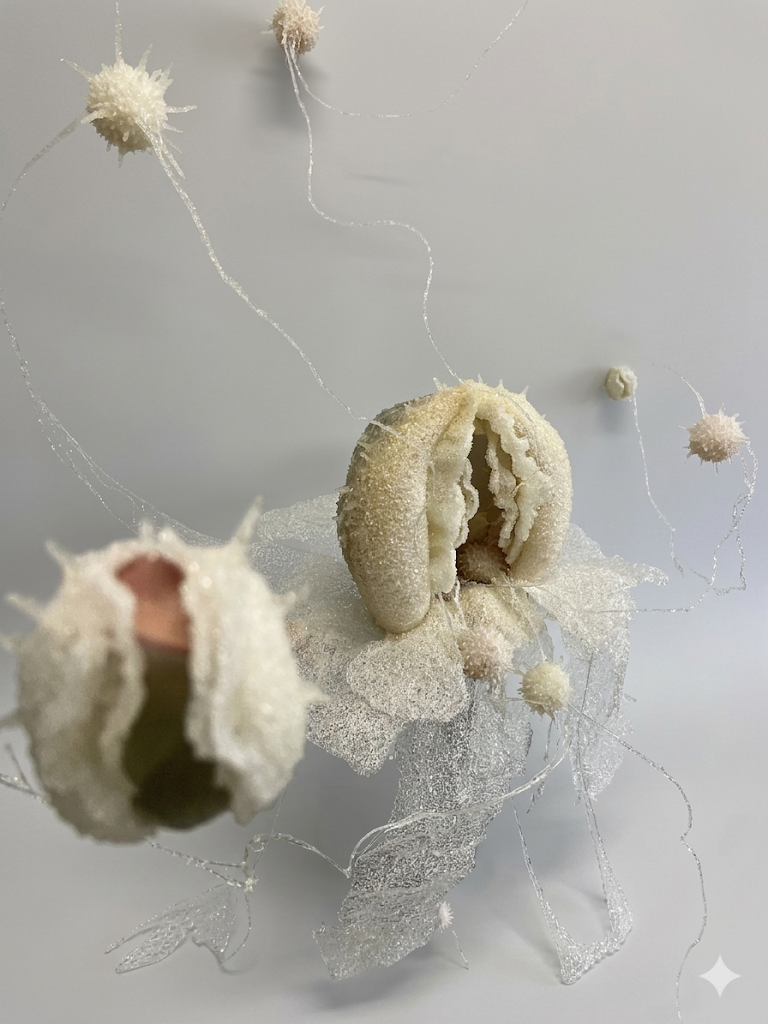
Quanto-flower is a symbol of dynamic creation: it does not hang, it spreads, it does not wait, it generates while simultaneously annihilating everything alien. As an internal landscape, Quanto-flower conveys a complex, fragile, yet rigid inner world: its layers are layers of thought, memory, and emotion. As an external landscape, this object begins to encompass the space around it: it doesn’t depict a landscape, it becomes a landscape.
Quanto-flower is a living, pulsating bio-aesthetics, an expression that no longer fits within brushstrokes, it literally weaves a new reality in three dimensions.
Note: created in collaboration with Gemini