From the Memoirs of Boris Kokenay
Original publication: «Зі спогадів Бориса Кокеная», Yalkut. Karaites of Ukraine. Faith. History. Culture (karaimkharkiv.wordpress.com).
The blog is run by Oleksandr Dziuba, hazzan of the Kharkiv kenesa and a historian by training, a graduate of Kharkiv University. Crimean Karaite families began settling in Kharkiv in the 1840s, and the community opened its first kenesa in 1853. In 1929 the kenesa building was turned into a club of the League of Militant Atheists; today it is a house of prayer again, and in 2021 it was described as the only working kenesa in mainland Ukraine.
- 14 December 1930
- 18 January 1931
- Qırım
- Pre-dawn prayers: Selikhot (forgiveness)
- Kippur oruç
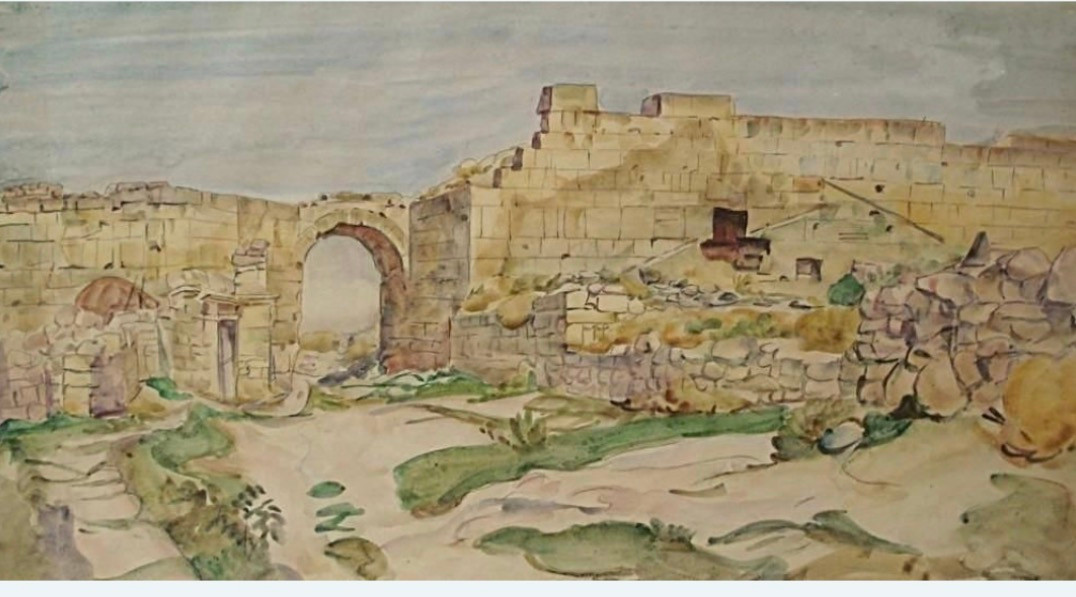
Artist Konstantin Bogaevsky. Çufut Qale.
Boris Yakovlevich Kokenay (1892–1967) was a researcher of the Karaite past, a linguist, and a collector of the folklore, manuscripts and literature of the Crimean Karaites. The memoirs he wrote reveal a remarkable literary gift in their author. They shine with a bright sadness and a nostalgia for Qırım (Crimea) and for youth.
14 December 1930
My father, Yakov ben Mordechai ben Baruch Kokenay, died on 23 August 1897. He was born in 1835 in Qale (Qırq Yer) and was a grandson of the learned hakham Isaac ben Shelomo El-Dur. When he grew up, he taught at the midrash in Bağçasaray, and later in Kefe, where he taught Karaite subjects to Karaite pupils at the midrash and at the Russian gymnasium. He died and was buried in Kefe (I was then 3–4 years old).
In our house, stories of life in Qale were still alive. First, my father came from Qale. Second, my father’s mother lived in our family. She was the daughter of Isaac ben Shelomo El-Dur (author of “Or ha-Levana” and “Pinnat Ikrat”), and she knew well the life of our ancestors in Qırq Yer. Since I remembered both my father and my grandmother poorly, the one to blame for my interest in Qale was my mother, who told me about this city of our ancestors. She herself had often been there too, and in 1878 she lived there with my father, because Panpulov had called him to help with the excavations of Prof. D. Chwolson, author of scholarly works on Qale and on the expeditions of Abr. Firkovich.
My father’s correspondence with Panpulov and with I. I. Kazas is kept in my library. Also kept there is the draft of a long letter from my father to the hakham. The hakham had asked how far the talk of Firkovich’s forgeries, and of the authenticity of the ancient monuments of Qale, corresponded to the truth. My father replies that he takes a negative view of the possibility of such a thing, all the more so because he himself had found stones marked with the year 4000 from the creation of the world. Perhaps I will cite this letter in full below.
My first acquaintance with Qale took place when I was in the second class of the gymnasium. I collected 15 karbovanets and set off from Kefe to Bağçasaray with two friends. The impression was magnificent, and to this day I remain one of the faithful admirers of this ancient nest of the Crimean Karaites. In the following years I tried, at the first opportunity, to use it to visit Qale, and there, in the house of the keeper and hazzan Abram Semyonovich Dubinsky, of blessed memory, I was treated as one of the family. In 1918, after my discharge from military service (I was discharged in May 1917, after the revolution), I began to work in Qale with Dubinsky’s three sons. But that year was very dry, and everything we sowed stayed in the ground. Fate did not bless our labor, and our colony fell apart. Nevertheless, I was in Qale constantly, and after moving to Rostov in the hungry year of 1922, I kept in touch with the inhabitants of Qırq Yer, and I still correspond with them.
18 January 1931
Sunday. Sometimes in dreams I see Qale, but not the usual Qale, rather some other one. Perhaps Qale looked like this in the most ancient times. The paintings of the artist Bogaevsky come very close to my idea of the ancient, or rather the former, Qırım. Sometimes in dreams I see another Qırım, unlike the present one: I see ancient little streets, old small houses of an architecture that has now gone from us, and I feel so extraordinary that in the dream I am afraid to wake, and usually I wake right after that. Once I saw in a dream how Şahin Geray, the last khan of Qırım, walked along the main street of Bağçasaray and bade farewell to the people. Şahin Geray was barefoot, and the people would sometimes come up to say goodbye to him.
So today too I saw an extraordinary Qale and an extraordinary Qırım. First I see myself on the stony road leading to Qale, and I rejoice that only yesterday I dreamed of Qale, and today my wish has come true. I feel exceptionally well. Then this road turns out to be somewhere in the mountains (on a plateau), and a verst ahead the mountains rise steeply, all covered in forest. I can hear the wheels of arbas squelching on the forest tracks, though neither the track nor the horses can be seen. I drink in this bright, sunny, warm day and the sound of the wheels, which in the quiet of noon drifts to my ears like music.
I think that this is a dream and not reality, and I go on thinking: let it be a dream, I am glad even of such a dream. I fall to the ground, weep with happiness and kiss the whole earth of my native Qırım. At that moment I recall a phrase from an eyewitness of the Crimean Tatars’ exodus from Qırım (I myself remember their last exodus to Turkey, in 1900): “They walked, kissed their native land, and walked on again.” And I think that they loved their fatherland just as I do, and I begin to understand how hard it was for them to part with Qırım. I wake with the awareness that it is a dream, that life is never so good, and indeed the picture begins to darken, the awareness that I am sleeping on the bed “net” (the wire mesh of the bed) prevails, and I wake feeling that my pillow is wet with tears.
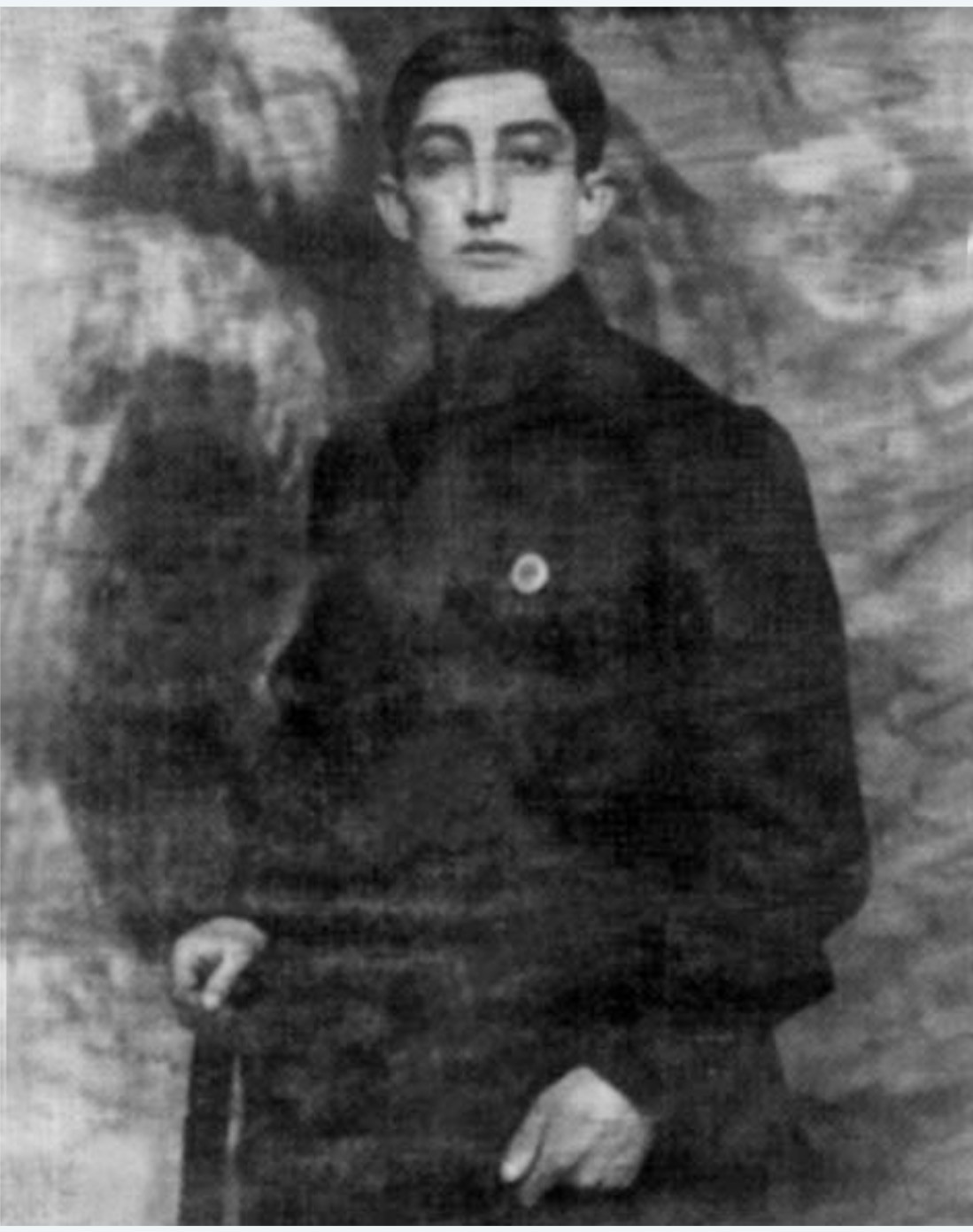
Boris Kokenay in young age
Qırım
“In Qırım, as in all of Russia, when a drought came, people went in a procession of the cross out into the field, beyond the town, to the cemetery, to pray for an end to the drought and for rain to be sent. There was such a drought in the years of my childhood, that is, in the first years of the 20th century. In our town the Russians, Greeks, Crimean Tatars and other nationalities went out of town and held prayer services. For some reason only the Karaites did not go out, although the ritual of Karaite worship contains special prayers for sending rain. People of other nationalities had already begun to say as much to the Karaites.
But then the time came when a day was appointed for a prayer service for rain. The people gathered, and headed by the priest Babacan Babayev they set off for the cemetery with the scrolls of Holy Scripture. The day was sweltering, there was not a cloud in the sky, and the sun beat down at full force. The hazzan Babayev came with a parasol in his hands. The parishioners, nudging one another, pointed at the parasol in the priest’s hands: ‘Look at that, what self-assurance! ’
However that may be, the people set off, reading psalms, along the mountain road to the cemetery. What happened there I do not know, since I did not go to the cemetery, but when my brothers came home, they were all soaked to the last thread from the downpour. The young men had taken off their jackets and covered the scrolls of Scripture with them, while they themselves bathed well under the cloudburst. After this, for a long time in the town, among communities of different nationalities, the talk did not die down about this event, and about how the hazzan Babacan Babayev went to the prayer service with a parasol…”
Pre-dawn prayers: Selikhot (forgiveness)
“As the feast of “Kippur oruç” (the fast) approaches, by ancient custom, ten days before the fast, the pre-dawn prayers called Selikhot begin. Not many communities have preserved these quiet and sorrowful prayers, and not many people attend the kenesa, even in those communities of Qırım where it continues to exist. And as so much of what was ancient and wonderful has died out, and continues to die out, among us Karaites, so too Selikha is living through its last days, and the time is not far off when Selikha will pass into the realm of legend. Probably many Karaites who live far from Qırım do not even know what Selikha is.
At the call of the kenesa attendant, who walks through the Karaite sloboda and sings the word “Selikha” in recitative, the silhouettes of the worshippers slowly emerge from the darkness, and the windows of the temple glow in the dark night with the red lights of lit candles.
Three o’clock in the night. Here and there you can clearly hear the knock of old men’s canes on stone as they walk. Quietly, old and young gather by the walls of the ancient temple in Kefe. The worshippers speak quietly among themselves, as if afraid to break the solemn stillness of the night.
But little by little the people have gathered, and one of the respected elders, or the priest himself, begins the prayer of Selikha. Quietly and solemnly a pleasant old man’s voice rings out in the deep silence of the night, and the echo beneath the vaults of the temple answers it. The voice of the one praying grows stronger, and the wondrous sounds of the Selikha melodies ring out inspired and pour forth, enveloping the soul.
An hour or two passes in prayer. The crowd is electrified by the voice of the mitpalel, full of religious ecstasy, by the solemnity of the surrounding night, and by wondrous melodies that sing of something distant and long forgotten.
And now begins the concluding prayer of Moses, “Vayikhal Moshe”… Many in this prayer forget the whole world, merging in soul with the Beyond, and the mitpalel (that is, the one who leads the prayer), in a weary, pacified voice, sings the last words of the prayer, “Salakhti kidvarekha” (that is, “I have forgiven according to Your word”). Many have tears in their eyes, the tears of a softened soul, cleansed in prayer.
The pre-dawn prayer of Selikha is over. Some remain in the kenesa awaiting the morning prayer, others go out into the yard and look at the sky: the stars are already paling and fading, and only one of them, Çolpan Yıldızı (the Morning Star), still shines brightly. Some time passes, and it too goes out… The morning prayer begins…
All this was some 5–8 years ago, but now it is no longer the same. The wondrous melodies of the pre-dawn prayers have been forgotten, the old have died, there are no people left who love their antiquity, and of the winter Selikha there is not even a memory: it has sunk into eternity. Now 6–7 people come, the pitiful remnants of glorious men of the past, and they weep over their doom, while the wind indifferently carries their lament across the sleeping town.
Written by me, a schoolboy, in the first decade of the 20th century in the town of Kefe. Rostov, September 1964. B. Ya. Kokenay.”
Kippur oruç
Before the fast of “Kippur oruç”, for ten nights running, the kenesa attendant Babay-aka İstanbullı (“the Istanbul one”) would walk the streets of the sloboda, sometimes deep in the night, at about 3–4 o’clock, and sing in recitative: “Selikha! Selikha!”, calling the people to prayer, just as the müezzin called people to the mescit. And it was lovely, and nobody from the non-Karaite families ever complained that he woke them in the deep of night.
As a child I always found it fascinating to go to the night vigil and listen to the sad melodies of deep antiquity from the lips of the elders. Sometimes you walk at night, and in the deep silence and darkness of the southern night you see a single candle placed on the glass veranda of the kenesa, a sign that the temple is already open and waiting for the worshippers. Somewhere in the narrow, crooked streets of the sloboda, the pleasant voice of Babay-aka rings out, his singing waking the parishioners. In the silence someone’s gate creaks and bangs, and an invisible figure, striking a cane against the stones, makes its way toward the candle, to the temple. Since the women’s section of the kenesa was not opened at night, I remember how a few women would sit outside beneath the windows of the kenesa and listen to the ancient melodies. Apart from the older generation, hardly anyone remembers them, and, never written down in notation, after existing for hundreds of years they will vanish without a trace in our godless age of wars and murders.
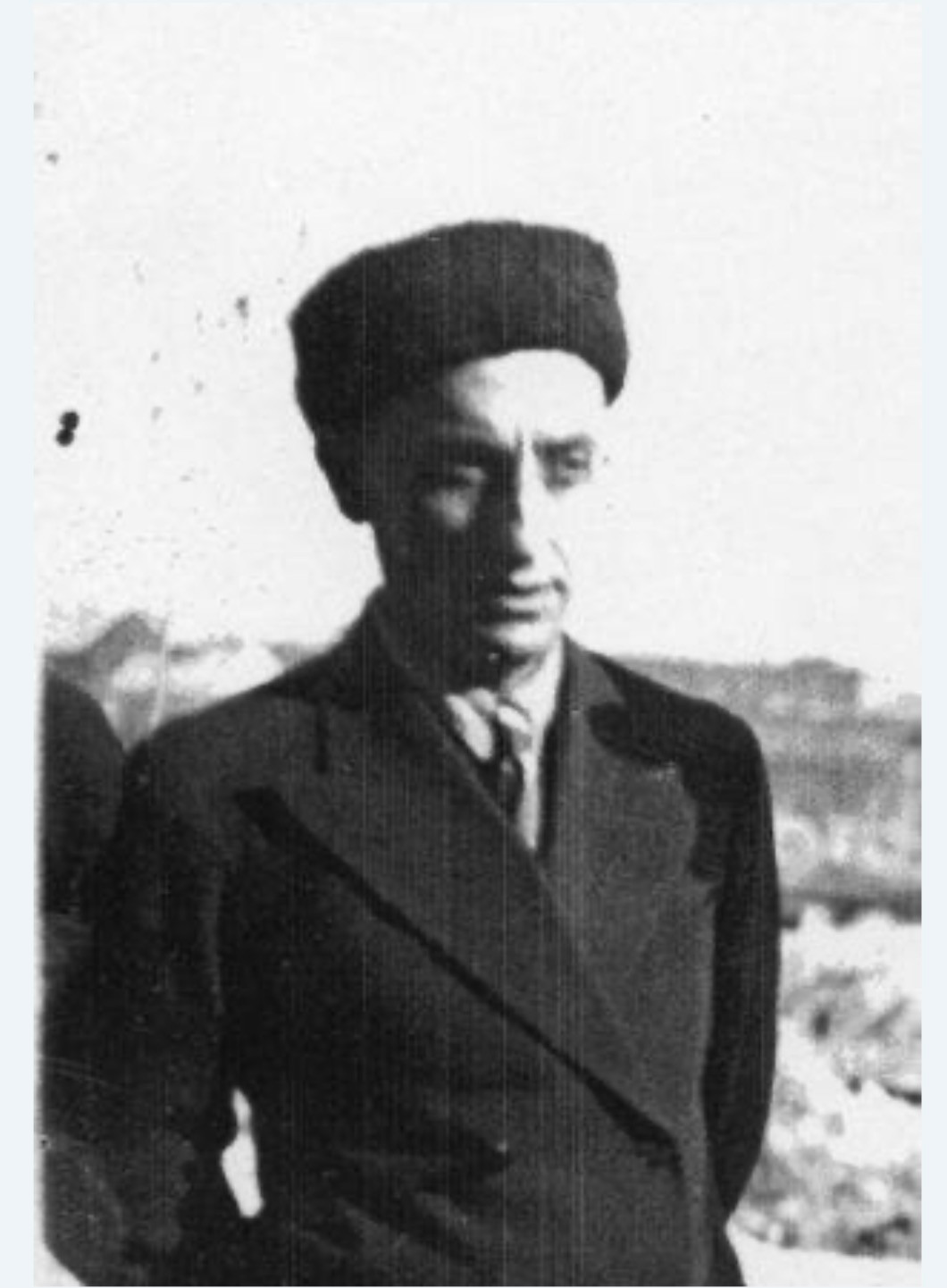
Boris Yakovlevich Kokenay
Before the beginning of the evening service, the parishioners gathered in the courtyard of the temple or in its vestibule, called “Azara”. Here benches ran along the walls. Below, the seats were divided by partitions where those who were praying put their shoes, because entry into the kenesa in shoes was permitted only as far as a certain part of the temple, and beyond that one had to take off one’s shoes, remembering the phrase of the Bible: “Take off your shoes, for this place is holy!” These cubbies for shoes probably date from very ancient times. Thus in Academician Marr we find indications of this in the excavations of the city of Ani (11th century). (See “Ani,” pp. 107/108 and fig. no. 247.) The same cubbies for shoes exist in the kenesas of Kezlev and Qale. In the latter they are of stone.
While waiting for the moment when the evening service could begin, the elderly people told one another the latest events, the news of the day and politics, and we, sitting at a distance, listened to these conversations, not daring to take part, so as not to disgrace ourselves as ill-mannered and uneducated boys. We could only answer questions.
Now, after sunset, the priest would rise, the conversations ceased, and everyone went into the temple. The service was not always conducted by the official minister of the cult, the priest. According to the canons of the Karaite church, it could be conducted by any literate parishioner well acquainted with the rites. If a visitor was present, he was honored by being invited to conduct the service. He would approach the lectern facing the qıble, that is, to the south, just like the Muslims, and not to the east, as Christians and Jews do. On the lectern lay a vestment, white as snow. The one leading the prayer made a prostration, then rose and, reading the prayer for vesting, threw this white covering over himself. Then the evening service began, lasting 25–30 minutes.
Toward the end of the service, before the last prayer, a dead silence fell, because this prayer was ended silently, and each person could add his own words and wishes to the words of the prayer. After this silent prayer the priest would rise to his feet and, stepping back one step from the lectern, turn to the left and say to the congregation: “May your prayer be accepted with favor!” Then he turned to the right and repeated the same phrase, and each time the parishioners answered: “Amen!”
*Translated from Ukrainian by Leo Efet, with AI assistance (Claude); checked against the original
WHAT TO READ
Leo Efet — Месть караимов / The revenge of the karaites
https://syg.ma/@leoth/mest-karaimov
Multilingual fragments on Karaites, Crimean Tatars and the Crimean land today, from salt to occupation.
Галицькі караїми після 1944 року: шляхи до Польщі
https://syg.ma/@leoth/galicki-karayimi-pislya-1944-roku-shlyahi-do-polshchi
Another Karaite community leaving its home: the Halych Karaite community turns 780 this year, and only one of its members is left in the town.
Köçebe — Я помню разноцветную степь
https://syg.ma/@leoth/ya-pomnyu-raznocvetnuyu-step
A Crimean Tatar story about the steppe, childhood and nostalgia for a lost Crimea, a companion to Kokenay’s dream of “another Qırım”.